The Challenges of Authentication in Protecting Creativity at the Source
Innovation, creativity, and the expression of creativity are the fundamental drivers of a country’s scientific, industrial, cultural, and economic success. It is essential to instill confidence in inventors by ensuring we have the capacity to protect creativity at its source. Certifying the authenticity of a new idea—or of the person who conceived it—is indispensable to ensuring fairness in our vibrant age of inventors.
Michel Robert, University of Montpellier and Jean Sallantin, University of Montpellier
The technical challenge is to propose a simplified solution for submitting ideas that has the legal capacity to protect both aspiring and established innovators and can be rapidly deployed on a national scale while respecting the need for confidentiality—only the submitter can view it—and transparency—it is partially disclosed so that good ideas emerge when compared with other ideas. An economic and societal challenge would be ensuring that the management of the proliferation of individual creative acts serves as a source for the emergence of ideas at the local level that are capable of addressing challenges such as those caused by climate change and threats to biodiversity.
Creativity is poorly protected
In the academic world, the recognition of risk-taking and creativity in the evaluation of researchers should be based on practical, recognized metrics that go beyond the current framework—which is too limited and sometimes ill-suited, such as patent filings—for measuring the impact of research.
The protection of research conducted by students and doctoral candidates in laboratories is also a recurring issue, with, unfortunately, instances of abuse in the exploitation of their work—such as excluding them from being listed as authors on scientific publications. However, there are protective measures in place at doctoral schools and laboratories—such as the “lab notebook,” which chronologically records the work performed—but this type of measure is not easily adaptable to all scientific disciplines.
In today’s digital society, with its interconnected devices and new applications (such as video games…), we are increasingly identifying talented students—and even high school students— outside the usual research laboratory channels. Universities and schools play a role by supporting them in various technical, scientific, and educational aspects (see innovation competitions), but they could also play a role in protecting the concepts they develop.
The issue of preserving creative wealth also arises for startups, which by their very nature embody the values of innovation and creativity but have low survival rates; this raises the question of personal protection of inventors’ intellectual property—and the question of how to capitalize on ideas that are, unfortunately, left gathering dust in boxes after one or two years of work on a project!
So, in such a strategic context, how can we support, promote, and ensure the validation of creativity? How can we develop an ecosystem that protects everyone who contributes new ideas?
How can we make the protection of creativity more accessible to everyone?
There are, of course, mechanisms for documenting innovation—such as patent applications or the “Soleau envelope”—but they are too expensive, too complex, and not widely known; above all, they come into play too late and in a non-systematic manner within the value chain. The goal, therefore, is to create an entire ecosystem dedicated to protecting creativity, but above all to collecting, cataloging, and promoting it.
To address these challenges, we propose the creation of a platform that is easy to use, accessible to everyone, visible, and well-recognized—one that is responsible not only for protecting the ideas it hosts but also for promoting them.
- The societal challenge is to create an ecosystem that protects and promotes innovation throughout France.
- The economic challenge is to build trust between the project leaders and the various stakeholders.
- The technical challenge is to develop an efficient, secure, and geographically distributed computer system.
The basic idea here is to disseminate protected ideas online, as they are authenticated by notaries, who are specialists in authenticating all kinds of legal documents. Ideally, this public service would be free of charge to encourage the dissemination of ideas that their creators wish to make public and to ensure the safekeeping of ideas that their creators wish to keep secret for the time being, so they can choose the right moment to disclose them. It would also allow editorialists to keep the platform’s content vibrant by organizing dynamic indexing of the ideas arising from the debates they spark.
Debates are the established means of advancing knowledge for everyone and helping ideas themselves evolve. That is why creators must be given the ability to protect their ideas when they are being debated—that is, even before copyright management or the filing of patents for an invention in which the idea is incorporated. Thus, protection must occur “at the source”; it must be immediate and easily accessible.
To achieve this, it is necessary to be able to provide the technological framework best suited to securing end users, so that every bit of their innovation uploaded to the platform is indisputably linked to their identity while allowing them to showcase their advancements. This is now possible through a blockchain-based approach. The idea is to entrust notaries with the responsibility of authenticating and protecting the ideas of their creators and securing their relationships, while promoting the value of these ideas. Their role as authenticators will drive the process forward and guarantee the certification of transactions. Notaries already have a shared, secure, distributed IT infrastructure for drafting and archiving legal documents. Notaries receive legal documents, some of which are unilateral (authentic wills). By accepting the deposit, the notary helps combat fraud or identity theft and provides the depositor and third parties with assurance regarding the deposit and its date; the blockchain, in turn, secures the file, ensures its longevity, and enables access to it.
Toward a Creativity Authentication Loop
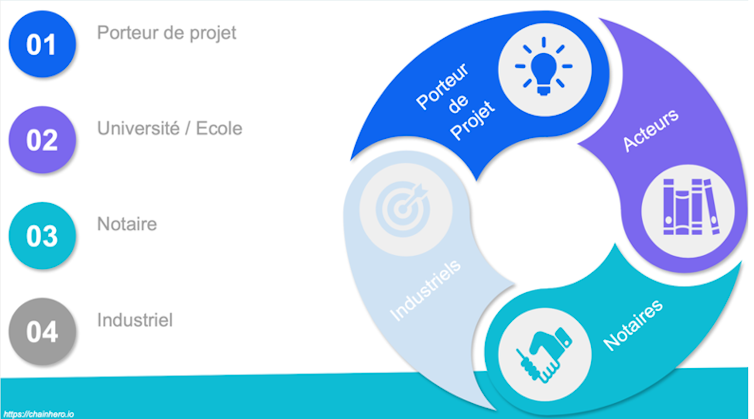
It was in this context that a prototype creativity authentication loop was developed for the Lyon Regional Council of Notaries, using the Hyperledger tool
Provided by the author
The process for validating ideas involves several stakeholders:
- Project leaders who will benefit from the idea protection filing service to promote their work;
- Contributors, who are the individuals and institutions that serve as points of contact for project leaders (such as universities, engineering schools, incubators, etc.) and who will encourage project leaders to submit their ideas and work;
- Validators—who are notaries that will use their authority to record the project leaders' ideas on the blockchain;
- Editorialists whose mission is to disseminate ideas through a communication strategy. These publishers could be private or public agencies seeking to spark new projects, or alternative venues promoting creativity within their region.
- Manufacturers who will have premium access to the ideas catalog in order to request direct connections with project leaders.
A new virtuous and pragmatic ecosystem
By its very nature, blockchain technology—with its cryptographic principles and its approach to distributing data and transactions—is ideally suited to the concepts of timestamping, traceability, and immutability. When it comes to an issue as critical as protecting innovation, it provides a major technological safeguard to protect the interests of project initiators and prevent any conflicts of interest. Nevertheless, it remains merely a facilitator, and for widespread adoption to occur, it is essential that this mission be championed by stakeholders who see both societal and economic value in it. The core idea, therefore, is to offer a blockchain platform that simply meets the immediate needs of the various stakeholders in the innovation ecosystem.
1) For project leaders who lack the technical capacity to protect an innovation, the platform provides a simple and easily accessible digital process for protecting innovations.
2) For those who are unaware of the means of protection available to them or who lack interest in protecting their ideas, they will meet with an editorial team that, together with the notarial network, is responsible for producing a simplified catalog of innovations that will serve to establish a connection between project leaders and potential industrial partners.
3) With a survival rate of less than 20%, all the innovations developed by a young company—which are lost once the company ceases to exist—would be highlighted as protected innovations in a simplified catalog made available to industrial partners.
4) Given the challenges organizations face in innovating and their constant need to attract talent or new ideas, there would be direct access to a simplified, anonymous catalog of innovations, with the option to be put in direct contact with project leaders.
5) Notaries face a general lack of understanding regarding the societal value of their profession. Since they will serve as the moral and legal guarantors of a system aimed at a broad, younger audience, notaries could highlight their role in protecting innovation and creativity—in a simple way and for as many people as possible.
Based on these concepts and the development of a prototype—which could easily be created today using blockchain technology—we can envision a simplified, digital registration system designed to encourage creativity at its source among innovators. Deploying this system within a public framework in collaboration with the notary profession would thus enable the rapid nationwide implementation of new, responsible practices that promote creativity.
This article was co-authored by Denis Pierre Simon, a notary (honorary president of the Lyon Regional Council of Notaries), and Nicolas Herzog (a blockchain development expert).
Michel Robert, Professor of Microelectronics, University of Montpellier and Jean Sallantin, Emeritus Research Director at the CNRS, University of Montpellier
This article is republished from The Conversation under a Creative Commons license. Readthe original article.