Mathilde Guérin's Laurels (ix)
With a story about druids, Romans, and Gauls, Mathilde Guérin, a doctoral student atthe École nationale supérieure de chimie, won not the laurels of Caesar but those of victory in the regional “My Thesis in 180 Seconds” competition. On June 10, she will compete in the national grand finale held in Lutèce, backed by the entire contingent of die-hard supporters from Montpellier.
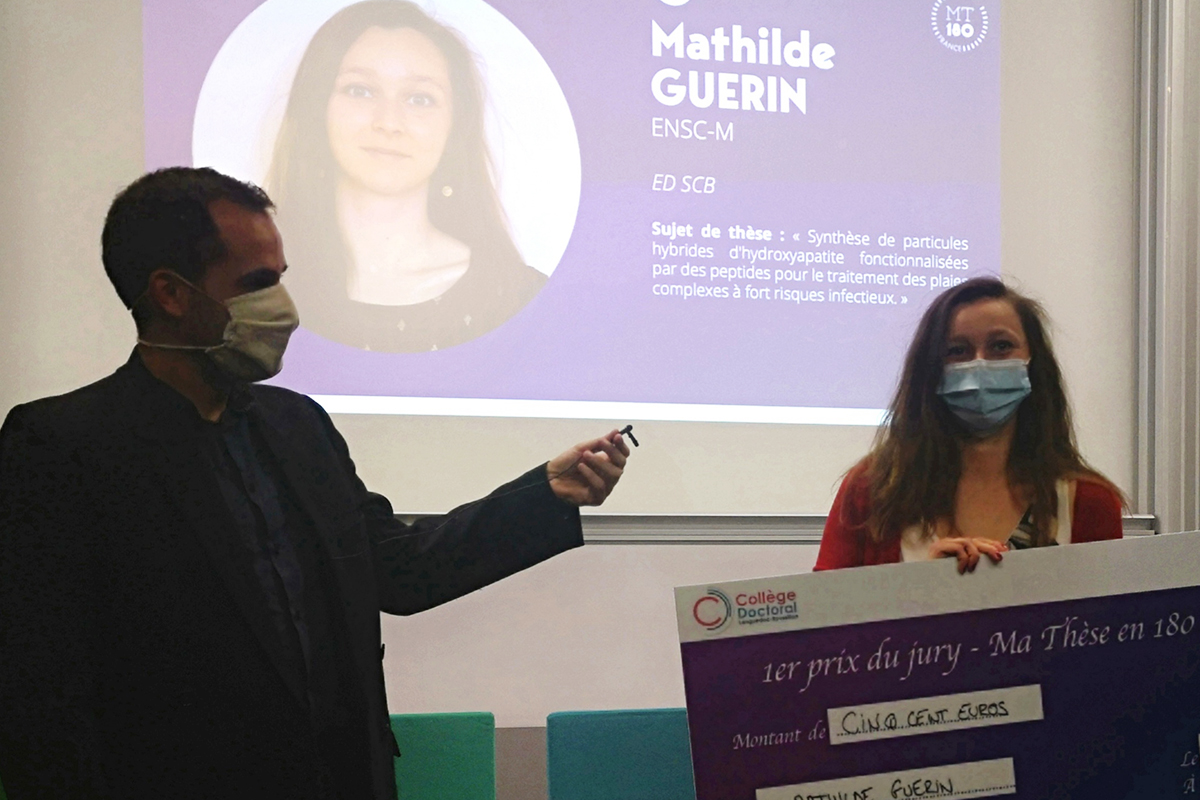
The year is 2021 A.D. All of Gaul is under the grip of the coronavirus. All of it? No! A team of die-hard doctoral students continues to resist the invader and is participating—remotely—in the regional finals of the major science communication competition “My Thesis in 180 Seconds.” As the 19 contestants take the stage one after another in this closed-door “Battle of the Chiefs ,” a young woman dressed in white and red makes her entrance: “Oh, what a nuisance! Maybe Pronostix was right that day when he told me, ‘Listen, young druid, working on extensive, deep, or chronic wounds is going to be complicated! You’re wasting your time—you just want to impress the crowd at the ‘My Remedy in 180 Seconds’ contest!’”
What Pronostix clearly hadn’t predicted was that Mathilde Guérin(-ix), a student at the Balard School of Chemical Sciences, would charm the jury with her presentation straight out of an Asterix comic book, “except that my Romans are bacteria trying to invade the village of Open-Wound-That-Hurtsix.” The tone is set! Enrolled in a Ph.D. program atthe École nationale supérieure de chimie de Montpellier, the apprentice druidess has been pursuing her “Idefix” for nearly two years: fighting bacterial resistance by designing a smart bandage made of hybrid particles capable of aiding wound healing and preventing secondary infections. A real alternative to antibiotics —“because antibiotics aren’t a given—talk to your druid,” Mathilde jokes during her presentation.
Mathilde's Tour of Gaul
It was in 2019 that the young woman from Normandy—a distant cousin of Olaf Grossebaf—settled in Montpellier after earning her engineering degree in Strasbourg. Her “Realm of the Gods”? Chemistry “since I was a teenager” and biology “because the human body and everything that goes on inside it fascinates me.” ” Mathilde Guérin knew very quickly what she was looking for: “A thesis topic that would allow me to combine my two passions and that could be applied to healthcare. ”The Max Mousseron Institute of Biomolecules in Montpellier and Cirimat in Toulouse offered her this opportunity as part of a thesis funded bythe Carnot Institute for Chemistry Balard Cirimat.
Mathilde had planned her participation in “My Thesis in 180 Seconds” a long time ago, back when she was a student in a physics-chemistry preparatory class in Le Havre and was already thinking about her thesis. “It’s true that I’ve been thinking about this competition for a long time. I like to set myself challenges; I like to explain complex ideas in simple terms—I do it all the time with my family and friends because I want to share what I’m working on. It’s also an opportunity to show the general public and young students the world of research… and why not spark some curiosity—and who knows, maybe even inspire a career path.” Before this first experience, Mathilde had also successfully participated in the “My Thesis in 400 Words” competition organized by the University of Perpignan, where she also won the jury prize.
The Secret of the Magic Potion
As she awaits the national grand finale on June 10, for which Mathilde Guerin has qualified, she’s fine-tuning her script, working on her diction, and putting into practice the advice she received during the three-day training session led by the doctoral college last March: “We learned how to better master public speaking, the importance of pauses, slides, and the coherence of the text—I changed my script at least fifteen times… We meet doctoral students from other disciplines and realize that explaining complex concepts to a general audience is different depending on whether you’re in quantum physics or the humanities. And beyond the competition, it’s a great experience for our future careers.”
A career that the young chemist naturally envisions in research—whether in the private or public sector, it doesn’t matter —“as long as the approach is multidisciplinary and applies to the medical field.” And as we were about to part ways, we asked her the secret behind such enthusiasm and energy, and she replied with a smile: “You mean my magic potion? Classical dance and the violin, which I’ve been studying at the conservatory since I was four.” That’s enough to outshine the bard Assurancetourix at the upcoming victory banquet scheduled for June 10!
My Thesis in 180 Seconds (MT180)
Organized annually by the CNRS in partnership with university presidents, “My Thesis in 180 Seconds”invites doctoral students to present their research topic—in French and in simple terms—to a diverse audience of non-specialists. Each doctoral student must deliver, in three minutes, a clear, concise, and compelling presentation on their research project. All this with the help of just one slide! This competition is inspired by the Three Minute Thesis (3MT®), developed at the University of Queensland in Australia. The concept was adopted in Quebec in 2012 by the Association francophone pour le savoir (Acfas), which sought to expand it to 20 French-speaking countries.