UM , and ENSCM Join Forces to Pursue a Shared Strategy and Common Goals
The change in status of the University of Montpellier—which became an experimental public institution—made it possible to integrate the Montpellier National School of Chemistry (ENSCM) as a constituent institution of the University. The first major step was the signing of a multi-year contract setting out objectives and commitments.
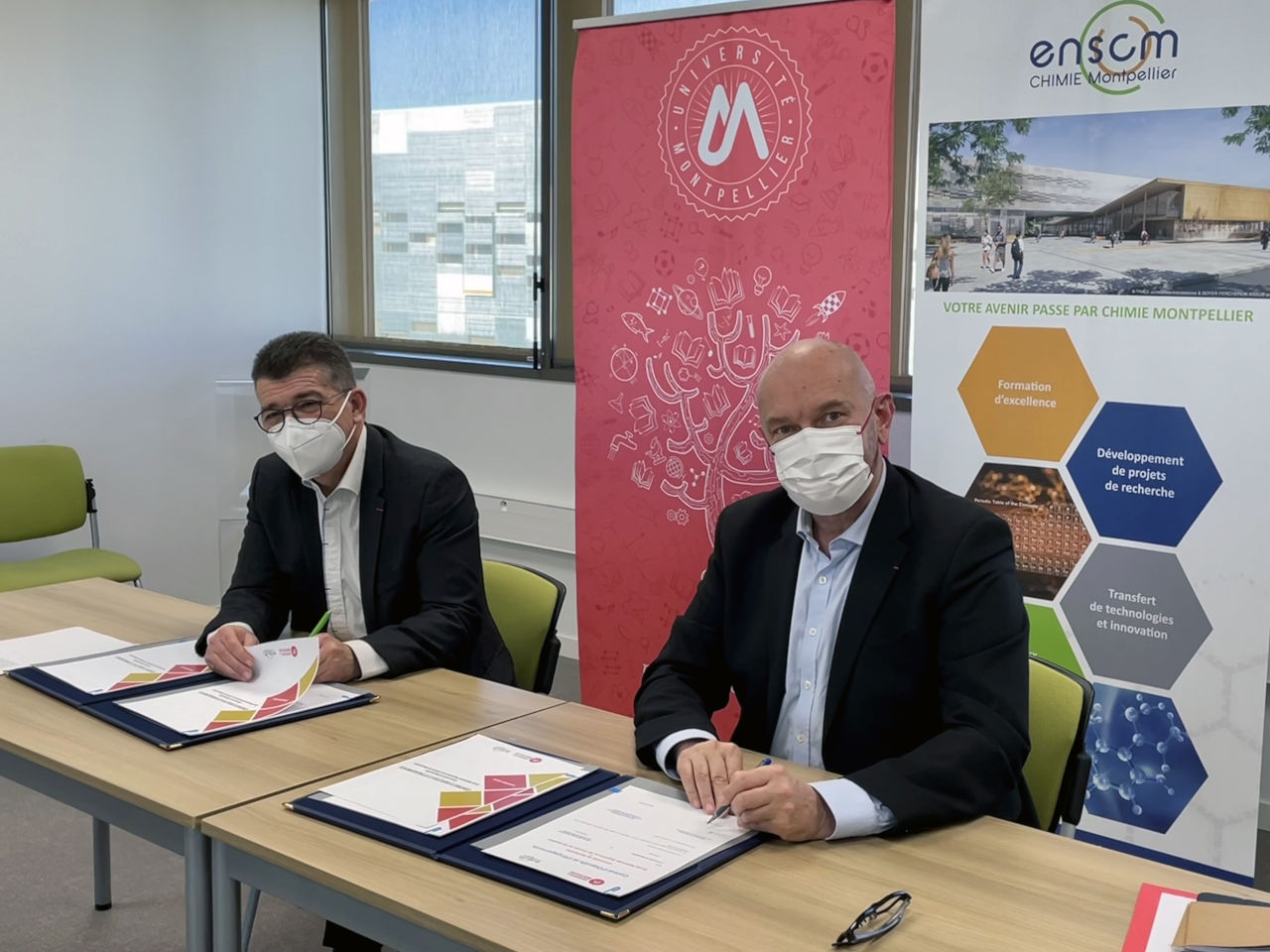
Following its approval by the University of Montpellier’s board of directors, Philippe Augé, president of theUM , and Pascal Dumy, director of the ENSCM, signed their first multi-year contract setting out objectives and commitments, which formalizes their mutual goals of convergence and resource sharing to support the implementation of the University of Montpellier’s ambitious strategy.
“The stakes—behind what might seem to some like a mere institutional formality—are high and are not limited to a commitment made as part of our I-Site MUSE initiative,” says Philippe Augé, president of the University of Montpellier.
The institutional mechanism in question is none other than the integration of the ENSCM, which is now enshrined in the bylaws as a constituent institution of theUM. It thus has a special status, as it retains its legal personality, its governing bodies, and its operational resources (staff, budgets, etc.). One of the key commitments, for example, is the joint signing of diplomas.
Mutual and lasting trust
This integration, which reflects the mutual and enduring trust that has developed in recent years between the school and the University, offers new opportunities—in education, research, and for both staff and students—while contributing to the development and outreach strategy of theUM.“The goal is to firmly anchor theUM and the ENSCM within a shared strategy at the campus level and under a common banner, in particular to secure the resources needed to support our ambitions: to ensure that theUM ranks among the best national universities and to strengthen its appeal and proven reputation in international rankings,” adds the president.
The multi-year contract setting out objectives and commitments between the University and its constituent institution, as provided for in the EPE’s bylaws, is part of a shared ambition to address a twofold challenge: regional roots and excellence. These are two criteria required for international visibility but which also ensure a prominent position for the chemistry sector under the “University of Montpellier” brand in the areas of education, research, and innovation, as emphasized by Pascal Dumy, director of the ENSCM:
“This agreement is the score that sets our responsibilities and rights to music, and enables the conductor to carry out our shared strategy in order to achieve our common goals and ambitions.”
Strong and Ambitious Strategic Objectives
This agreement is structured around three main areas: “research and commercialization”; “education, student life, and social responsibility”; and “institutional life and administrative modernization.” Its strategic objectives are to enhance the scientific potential of both partners, promote the shared “University of Montpellier” brand internationally, and foster greater national and international visibility in the field of chemistry and its interdisciplinary areas. In terms of education, this agreement offers an attractive, coherent, and enriched program, including interdisciplinary courses with other fields. It also contributes to the development and promotion of engineering programs at the University of Montpellier. Finally, it promotes social responsibility for all students and staff.