[LUM#23] Africa's Tribute
Rising temperatures, prolonged drought, delayed monsoons… Africa is bearing the brunt of global warming, and farmers are on the front lines, putting food security at risk. How can we limit the damage on a continent that is already vulnerable? Benjamin Sultan, a climate change specialist at the Espace-Dev laboratory, offers some insights.
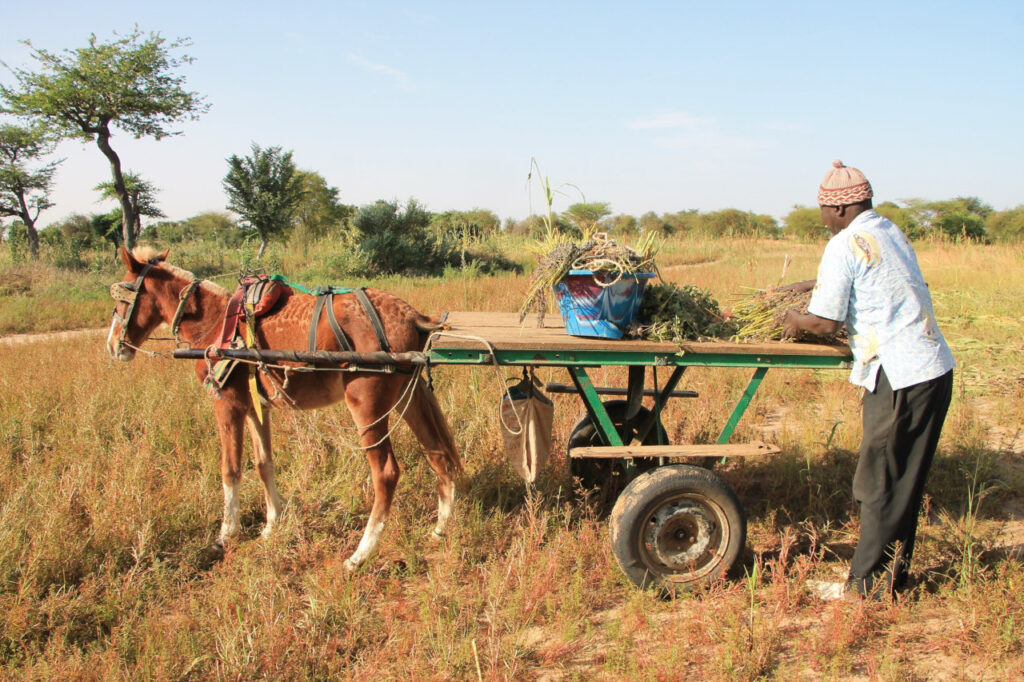
If there is one phenomenon that pays no heed to fairness, it is global warming. With 7% of cumulative emissions since the industrial era, Africa is the continent that has emitted the fewest greenhouse gases. And yet it is warming as fast as, if not faster than, the rest of the globe. This threat adds to the many challenges Africa faces, such as food security, poverty, and political instability. Furthermore, the continent is “highly vulnerable because it relies heavily on agricultural production and lacks the resources to adapt, ” explains Benjamin Sultan, a researcher at the Espace-dev laboratory.
"50% would be unheard of"
In Africa, as elsewhere, temperatures are rising and extreme weather events are becoming increasingly frequent. Drought, which African farmers have always had to cope with, is intensifying. “It can be linked to a lack of rainfall, as is the case in southern Africa, or to heat, which increases evapotranspiration, causing water stress in plants,” explains the climate change specialist, whose research focuses on the African continent. And less water means lower yields. “In particular, we expect net losses of 10% for sorghum and millet if temperatures rise by more than 1.5 degrees; yields could even be cut in half under scenarios where temperatures rise by 3 degrees.”
This has a major impact on food security, as these grains are very important food crops in Africa. “A 10- to 20-percent decline over several years would already trigger a food crisis; a 50-percent decline would be unprecedented, ” warns Benjamin Sultan. Not to mention that rising temperatures are affecting farmers’ working conditions. “It is estimated that a 3-degree increase would reduce work capacity by 30 to 50 percent in Africa, ” explains Benjamin Sultan.
Food Crisis
And global warming doesn’t just affect the quantity of food produced; it also impacts its nutritional quality. The cause: rising atmospheric CO2 levels. “Even if production levels remain the same, the nutritional value of plants is lower, ” explains the expert. (Read “What If Plants Could No Longer Feed Us?”)
While the plant-based portion of the diet is directly affected, animal protein sources are also under scrutiny. “The lack of water impacts the quality of forage, and the extreme heat threatens livestock health. This leads to high mortality rates among livestock and a sharp rise in meat prices,” emphasizes Benjamin Sultan, who notes that a temperature increase of more than 2 degrees would result in a 30 to 40 percent drop in pasture productivity (France Info, February 10, 2026). Add to this the impact on fisheries, which affects fish stocks, and all the ingredients are in place for a looming food crisis.
Diversify to Adapt Better
“There’s no turning back, but many of the consequences of climate change could be avoided through better climate risk management,” Benjamin Sultan notes. The goal is to adapt—for example, by setting up an early warning system. “It could be triggered at the very first signs of a drought or heat wave to speed up food aid.”
Adaptation strategies that could also be implemented earlier on, particularly by diversifying crops to make farmers less vulnerable, “but also by encouraging them to diversify their activities so they have another source of income in the event of a bad year,” adds Benjamin Sultan, who notes that risk aversion is very high in Africa. “And for good reason: here, a poor harvest can mean death, so farmers are already very good at planning ahead—but will that level of preparedness be enough in the face of a risk that is on the verge of becoming permanent?” the researcher asks.
3.8% of global funding
A rather bleak picture that can also be viewed in a different light, as the impact of global warming on agriculture in Africa could be offset by a transformation of the agricultural system. “This is one of the places in the world where yields could be tripled. There are levers that have not yet been activated in the fields of agronomy, economics, and environmental protection, ” explains Benjamin Sultan. Which ones? Technical advances, mechanization, the purchase of inputs or higher-yielding varieties, market integration, and the establishment of an insurance system. “The potential is enormous, and if we put these measures in place, it could help offset the impact of global warming, ” the researcher adds.
And the crux of the matter, as is often the case, is funding. “Starting with research funding! Today, only 3.8% of global climate research funding is allocated to Africa; there aren’t enough African researchers to help farmers, nor is there enough data, enough observations, or enough publications, ” the researcher laments. And it’s a fact: there are fewer studies on sorghum and millet than on wheat, corn, or soybeans. “It’s high time to increase the resources allocated to research in Africa, ” asserts Benjamin Sultan. And to give more wheat for millet.
Check out theUM podcasts, now available on your favorite platform (Spotify, Deezer, Apple Podcasts, Amazon Music, etc.).