The University of Montpellier is accelerating its energy transition with solar power installations
The University of Montpellier is continuing and strengthening its energy transition policy with the upcoming commissioning of solar power plants on the campuses of the IUT in Nîmes and the Richter and Saint-Priest campuses in Montpellier. This project aims to sustainably reduce the University’s environmental footprint while lowering its energy costs through a collective self-consumption program for university-owned facilities.
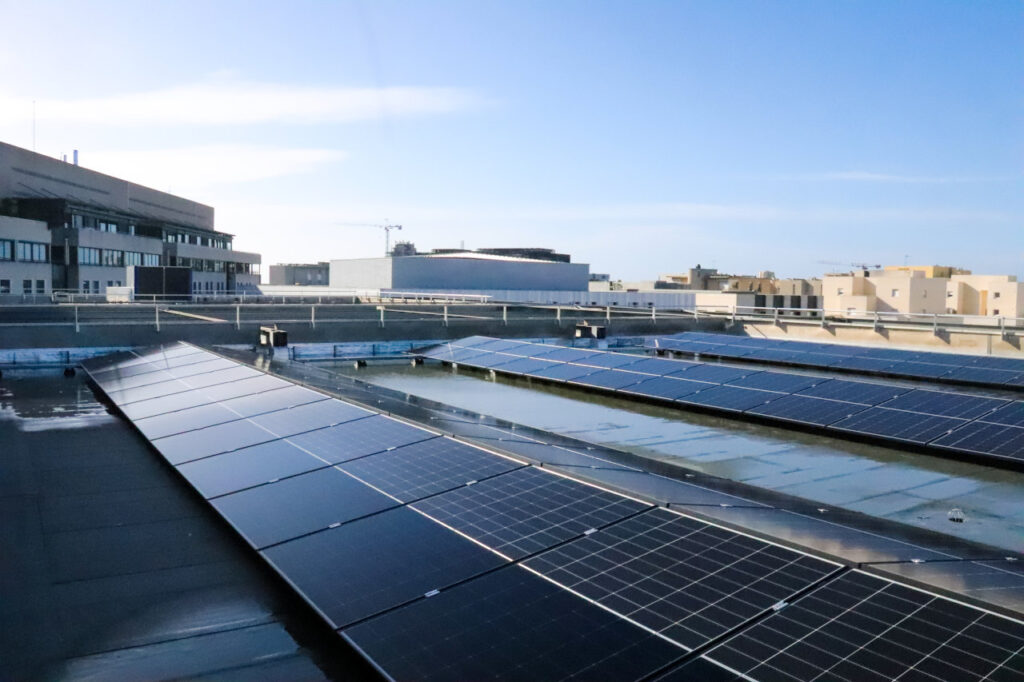
Solar Power Plants Supporting Local, Shared Energy
As part of its overall strategy for the energy-efficient renovation of its buildings, the University of Montpellier is installing three solar power plants, each with a capacity of 100 kW, located in Nîmes and Montpellier. These facilities are part of the new national program for collective self-consumption by institutional properties, which allows electricity generation to be shared among several nearby buildings.
Specifically, the electricity generated by the solar power plant installed on the Richter campus will be used by all the buildings on the site. In Nîmes, surplus electricity from the IUT’s power plant will be redistributed to the School of Medicine, located about one kilometer away. This model optimizes the local use of the energy generated and strengthens the University’s energy self-sufficiency.
Funding for the project—which totals 300,000 euros for the power plants—was made possible by the Objectives, Resources, and Performance Agreement that the University signed with the Ministry of Higher Education, Science, and Space ( Research , and Space), with the University covering the costs of the remaining work. The investment is expected to pay for itself in six years. The photovoltaic systems will also serve as an educational and scientific tool: students and researchers will be able to monitor production in real time and conduct performance analyses.
A comprehensive energy transition as part of a long-term strategy
Beyond solar energy, the University of Montpellier is taking action across all its decarbonization initiatives. It is gradually reducing its CO₂ emissions and its reliance on natural gas by connecting its buildings to district heating networks as soon as possible. To date, nearly half of the university’s floor space (approximately 250,000 m²) is already connected to these networks. In the short term, this proportion will reach two-thirds with the upcoming connection of the School of Pharmacy and the Montpellier-Sète University Institute of Technology (IUT) to the Réseau de Chaleur Nord Alco, currently under construction by Montpellier Méditerranée Métropole.
All of these initiatives are part of the University of Montpellier’s Master Plan for Ecological Transition (SDTE), a strategic document aimed at expanding existing measures and coordinating the implementation of an ambitious environmental policy that is commensurate with the University’s commitments and responsibilities.
Practical Information:
The three solar power plants installed at the Nîmes University Institute of Technology (IUT), the Richter Campus, and the Saint-Priest site in Montpellier comprise a total of 1,260 m² of rooftop solar panels, with a combined capacity of 300 kWp and an estimated annual output of approximately 400 MWh. The project also allows for the waterproofing of certain roofs to be redone and their insulation to be reinforced, thereby improving the energy performance of the buildings in question.