Ob.i LAB: Creativity at the Heart of the Montpellier-Sète University Institute of Technology
Inspired by Anglo-Saxon Fab Labs: Ob.i LAB[1],was inaugurated atthe Montpellier-Sète University Institute of Technology (IUT) in September 2017. The IUT invites you to explore this one-of-a-kind facility at the university—and, more broadly, in Montpellier. Take a guided tour.
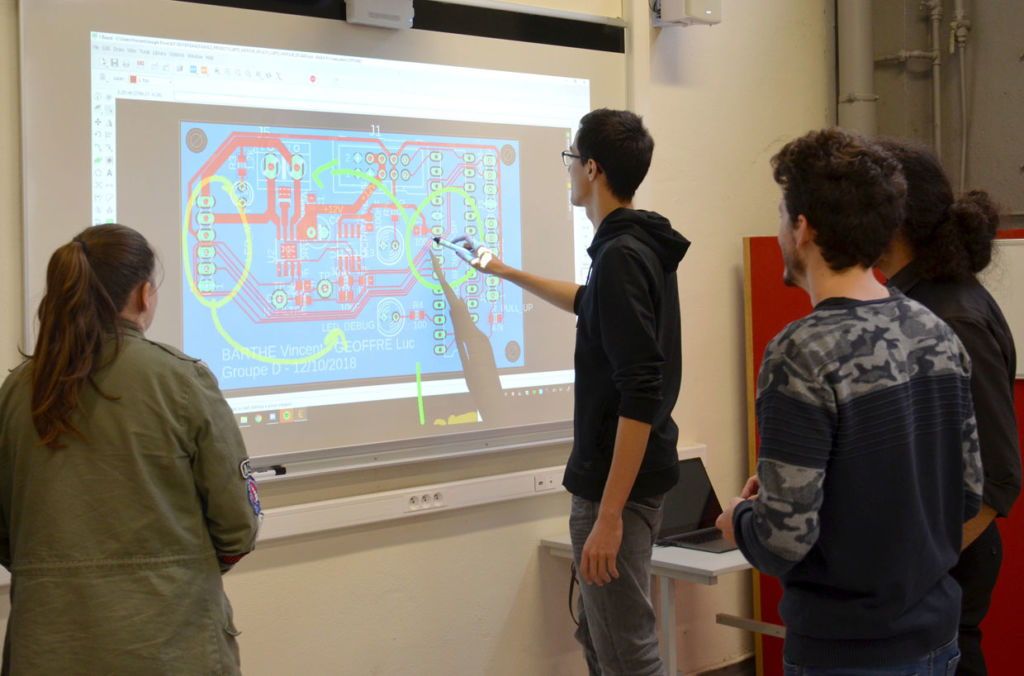
It is amid the pine trees on Avenue d’Occitanie, on the Montpellier campus ofthe IUT Montpellier-Sète, that the Ob.i LAB[1] space recently opened its doors. In Building D of the institute, no less than 300 m2 now house the University of Montpellier’s first space dedicated to both creativity and digital technology. “Since 2010, Fab Labs have been popping up all over the world. In France, every major city now has a digital creation workshop open to the general public, where visitors have access to machines that were originally reserved for industrial use,” explains Alexandre Lalanne , who is busy in Ob.i LAB’s “fabrication” area, printing a bright red nut on a 3D printer.
Coworking and a Friendly Atmosphere
A year ago, the 25-year-old mechanical engineering graduate was hired to serve as the coordinator of the IUT’s new high-tech creative hub. This was a project that Philippe Combette, a project manager at the institute, had been working on for several years. Open to IUT students and staff as well as outside professionals, Ob.i LAB aims to be a space particularly conducive to bringing ideas to life. In its friendly and relaxed coworking space, inspiring decorative objects made on-site sit alongside comfortable sofas, among other things. “Since academic programs are particularly siloed within IUTs, we felt it was necessary to create a welcoming space on campus for collaboration and work that brings together students from all our programs. At Ob.i LAB, they can now come together around a common goal: creating projects, ” explains Matteo Valenza, director of the Montpellier-Sète IUT, who sees Ob.i LAB as the new gateway for businesses into the heart of the IUT.
Design and Prototyping of Objects
During peak hours—between noon and 2 p.m.—many IUT students gather in the “fabrication” space at Ob.i LAB to work on their supervised projects. Specifically, they are creating an object commissioned by a specific company, which will be evaluated as part of their second year of the DUT program. “I encourage each student to share their creative vision with me as freely as possible and explain the technical possibilities offered by Ob.i LAB to bring it to life, ” explains Alexandre. Responsible for visitor safety, the technician provides training on how to use all the equipment in the workshop (oscilloscope, multimeters, generator, laser cutter, mini-milling machine, etc.), which will very soon be equipped with a new space dedicated to video production. While giving visitors free rein to their creativity, the facilitator supervises the various stages of creating objects (such as a mini-rocket, an animal trophy, and a remote-controlled electronic lock), some of which now proudly adorn the walls of this one-of-a-kind space at the university. Co-funded by the Occitanie region and the IUT, the creation of the Ob.i LAB hall is a first for the region. It is an innovative concept for a high-tech, open-access digital hall that could be replicated in the future within other departments of theUM , where inspiring students—whether budding or established creators—is a top priority.
[1] UOb stands for "object" – i stands for "intelligent" – LAB stands for "laboratory"
More info:
Obi. LAB is open free of charge to students, IUT staff, and professionals from 9 a.m. to 12 p.m. and from 1 p.m. to 5 p.m., Monday through Friday. It is located in Building D at the Montpellier-Sète IUT.
The IUT Through a Student's Eyes
Hugo Pietri, 19, a sophomore in the DUT program in Physical Measurements
 “I’m currently in my second year of a DUT in Physical Measurements, and once I graduate, I hope to attend an engineering school and then work in the aviation industry—or, why not, in aerospace. I often visit Ob.i LAB in my free time, and I’m about to start working with three classmates on the creation of an ‘artificial horizon.’ This instrument measures the orientation and pitch of aircraft (cargo planes, airliners, helicopters, or others) and transmits this essential data to pilots. Working a few hours a week, we hope to have our prototype ready by the end of the academic year.”
The IUT in Numbers
- 2,300 students
- 7 university degrees in technology
- 20 professional bachelor's degrees
- 90% of the training programs offered are work-study programs
ISO 9001 Standard: 4 certified professional licenses
Since June, the ABF, GASP, GEEB, and MMIC professional degree programs atthe Montpellier-Sète University Institute of Technology (IUT) have been ISO 9001:2015 certified. This certification by AFNOR recognizes the quality, design, implementation, and evaluation of these programs, as well as the work carried out by the institute’s support services (reception, information, communication, and student support). “This certification recognizes the exemplary dedication shown by the institute’s administrative staff and teaching teams, who worked tirelessly to bring this quality initiative—launched nearly six years ago— to fruition, ”notes the institute’s director, Matteo Valenza, who hopes to obtain certification for at least three additional professional bachelor’s degree programs at the IUT in 2019.