Philippe Augé Re-elected President of the University of Montpellier
The Board of Trustees of the University of Montpellier met on Wednesday, December 17, 2025. At that meeting, Philippe Augé, a professor of public law, was reelected president of the University of Montpellier (UM) for a four-year term.
Philippe Augé was reelected in the first round of voting, receiving 29 votes out of the 36 members of the Board of Directors. Last November, during the elections for the institution’s central councils, the slates supporting him won 11 of the 14 seats in the “ Professors,” “teachers,” and “researchers” colleges of the Board of Directors.
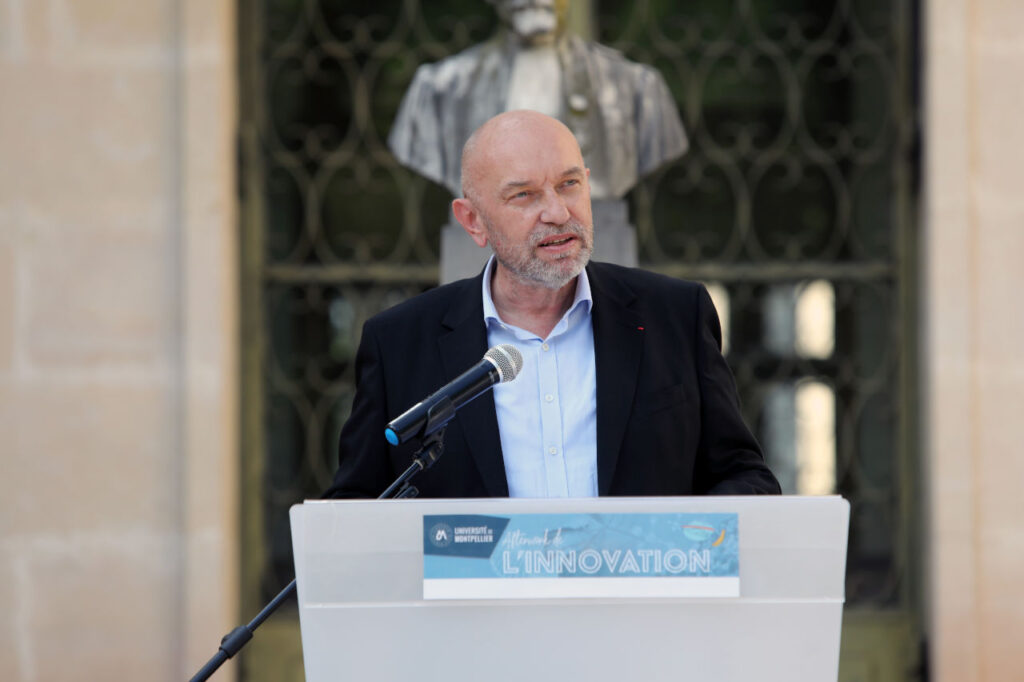
After leading the merger of two Montpellier universities in 2015 to create the University of Montpellier, Philippe Augé worked to secure I-SITE accreditation through the “Montpellier University of Excellence” project, which involved 15 local partners. This momentum was reinforced by numerous successes in national programs such as the “Structuring of Education through Research s in Initiatives of Excellence (SFRI),” “Integration and Development of IdEx and I-SITE (IDéES),” and “ExcellenceS.”
Awarded the “University Innovation Hub” designation in 2021 and the “Science with and for Society (SAPS)” designation in 2024, the University of Montpellier has also been selected for projects under the “Skills and Careers of the Future (CMA)” program. Philippe Augé also led the university’s transformation into an experimental public institution effective January1, 2022.
“I am honored by the renewed trust placed in me. Together with my team and the entire university community, we will work collectively to build on the momentum we’ve established in order to strengthen scientific excellence, innovation, quality, and career readiness in our programs, as well as our university’s international reputation, while celebrating its history, unique characteristics, and values,” said Philippe Augé, President of the University of Montpellier.
During that same meeting, Nicolas Marty, an associate professor, director of the IPAG in Montpellier, and vice president of the National Conference of IPAG/CPAG Directors, was elected vice president of the Board of Directors with 30 out of 36 votes.
Elections for the other statutory and delegated vice presidents will take place during the first half of January 2026.
Update as of January 8, 2026:
The University of Montpellier’s “ Research ” Committee met on Monday, January 5, 2026. Upon the President’s nomination, Agnès Mignot was elected Vice President in charge of “ Research ” by an absolute majority of the current members in the first round, with 24 votes out of 34 voters (9 blank ballots, 1 invalid vote).
The Committee on Education and Campus Life met on Tuesday, January 6, 2026. Upon the President’s proposal, Agnès Fichard-Carroll was reelected Vice President for Education and Campus Life by an absolute majority of the current members in the first round, receiving 31 votes out of 38 voters (6 blank ballots, 1 invalid vote).
About the University of Montpellier
With its 17 faculties, schools, and institutes, its affiliated institution (the École Nationale Supérieure de Chimie de Montpellier), and its 73 research centers, the University of Montpellier brings together a vast community of knowledge spanning the sciences, technology, physical education and sports, medicine, pharmacy, dentistry, law, political science, economics, and business administration. With more than 52,000 students and 5,000 staff members, the University of Montpellier is now one of the largest universities in France.
TheUM is internationally recognized for the excellence of its education, research, and capacity for innovation across a wide range of scientific fields related to major societal challenges, foremost among which are environmental protection and human health. It holds a leading position in international rankings, as evidenced in particular by its place among the world’s top 200 in the Shanghai General Ranking.
TheUM is particularly committed to issues of gender equality and the fight against all forms of discrimination. Its strategy also addresses challenges related to the ecological transition, scientific integrity, and the relationship between science and society.