Philippe Combette: “Innovation cannot exist without trust”
Philippe Combette, director of the Montpellier Institute of Electronics and Systems (IES), was appointed vice president for partnerships and innovation at the University of Montpellier during the board of trustees meeting held on September 26. He succeeds François Pierrot, who has been called upon to take on national duties at the CNRS. An interview with the new champion of innovation.
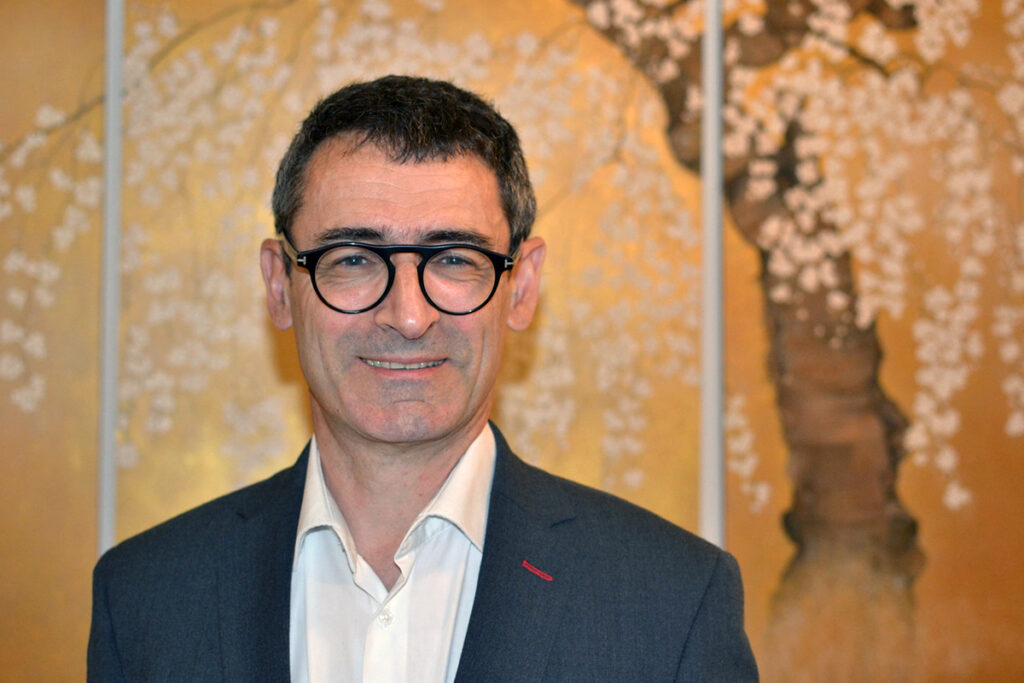
Philippe Combette, you’ve just been appointed vice president in charge of partnerships and innovation. How do you envision this role?
Before I get started,I’ll need to take stock of the landscape before me. I need to understand the forces at play and those that need to be engaged to ensure that innovation remains a success at the University of Montpellier. We are regularly ranked at the top of the list of innovation-focused universities in high-potential sectors. However, at the national level, university laboratories that collaborate with industrial partners rely on no more than 15 to 20 percent of their staff for these efforts. In this regard, we still have room for improvement. Moreover, our capacity for innovation has been recognized at the highest levels of government with the award of the “University Innovation Hub”designation—a mark of trust that we must live up to.
How would you define innovation?
It’s true that we need to be precise; for some, innovation is associated with a market, while for others, it’s associated with research and development. For me, the definition provided by the DGFIP is clear.
Had you ever thought about becoming vice president before?
No, not at all, but I am a person of integrity and, above all, deeply committed to the public good. I am passionate about development and innovation, and I have a good understanding of the key players at the regional and national levels. I suppose that made me a good candidate.
In an interview, François Pierrot, your predecessor, described innovation as a public service mission for the university. Do you see yourself continuing in that vein?
Yes, absolutely. The nation must be able to implement a strategy for commercialization and innovation, and without universities, that would be difficult. We need to bring innovation to life, right here and now. Personally, I find it very rewarding for a researcher or a team to see an idea come to fruition and be commercialized. It’s not the commercial aspect that takes precedence, but rather a form of contribution to society.
How do you view the relationship between academia and innovation?
I know that some labs are reluctant to share their resources with the socio-economic sector. They believe that, above all, their mission is to contribute to the advancement of knowledge. Certainly, there is sometimes a bias on the part of academia toward the industrial sector, but the reverse is just as true.
For my part, I believe we shouldn’t pit these two worlds against each other; they are two sides of the same coin: knowledge. And personally, I find it hard to believe that the future of French research will be solely academic. We’ll need to strike a balance between basic research and applied research.
Where do these preconceptions come from?
Because these two worlds don’t have the same rules or the same goals, and as long as we don’t share those rules or goals, we won’t succeed. There need to be moments of friction between labs and companies—regardless of the company’s size, whether it’s a startup, a very small business, an SME, or a large corporation.
How can we overcome them?
I start from the premise that innovation cannot be mandated; it must be given the means to emerge naturally, and to that end, I believe more in the small, everyday things than in grand gestures. We see this when startups are welcomed into research labs. This close collaboration builds trust. The company must trust the lab and its ability to deliver on time, and the lab must understand that the company isn’t there to steal its ideas. Innovation cannot exist without trust.
Do we work the same way with a large corporation as we do with a startup?
No. Large corporations, after all, often operate on time scales that are almost in sync with ours; they’re part of larger strategic plans. The dynamic is different with SMEs or startups, which are fragile, sometimes still in their early stages, and for which time is a critical factor. This is what François Pierrot set in motion by making it possible to welcome these types of companies into the labs, since they represent the bulk of the French industrial network. This is where the university has a role to play as a mentor, and often, it’s these types of companies that come to us and need our help.
What image do these companies have of the university?
They feel like they’re walking into a giant ivory tower, so it’s up to us to help them understand that the academic world has changed.
The University of Montpellier has become an EPE, and the PUI is on the horizon… What will be the major challenges of your term?
The world is evolving. Startups are evolving; units that aren’t generating value but could be are evolving. And above all, young people are evolving. There are more and more student entrepreneurs. We must continue to develop this kind of initiative and do so in partnership with local governments—the metropolitan area, the region, and the department… There is a whole range of stakeholders who will participate in this PUI.
Is that what you set out to do when you created Ob.i Lab at the Montpellier IUT?
Yes, it’s a space where laboratories, companies, and students come together. We need to bring these worlds together and rely on our young people to help shift mindsets. We need to offer students new opportunities for the future—that is, ways for them to envision themselves in the workforce. That, too, is the goal of innovation.
You mentioned the Region, as well as the Satt, which is celebrating its tenth anniversary. How do you envision relationships with innovation partners?
We need everyone, and each person must have a clearly defined role. Who does what? At what level? Based on what connections? In fact, we need to know and recognize one another.
Until now, you were the director of the Institute of Electronics and Systems. What did you take away from that experience? Did you work on commercialization there?
Yes, in 2021 we created a commercialization unit divided into two entities: IES Engineering and IES&Companies. The first is more focused on research and development, with the goal of addressing purely industrial challenges.
What about IES Companies?
It provides space for startups on the lab’s premises; there are hosting contracts and agreements in place. Currently, about ten companies are housed there and pay rent to the lab while benefiting from a top-tier scientific environment. As I mentioned earlier, we know each other well and can collaborate on regional, national, and international calls for proposals.
And did it pay off?
In 18 months, revenue went from a few tens of thousands of euros to nearly 2 million euros. So yes, it works.
You’re fromthe IES; François Pierrot was from the Lirmm—is there a stronger culture of innovation in the so-called technological sciences than in other fields?
There’s the IES, the Lirmm, and there’s chemistry, too. In fact, our close ties with industry mean it’s in our DNA, but just because we work with industry doesn’t mean we don’t need basic research—quite the opposite. It’s a bit like the metaphor of a drawn bow: the force comes from basic research, know-how, and expertise… The arrow that hits the target is innovation stemming from the sciences—including the social sciences, which aren’t discussed enough but which nonetheless have a vital role to play in this sector.
What does this appointment mean for you? Will you continue to teach?
I’ll be teaching less, but I want to maintain at least some contact with the students because that’s really where you encounter real life. I love Asian culture; I’ve been practicing martial arts for 35 years, and there’s this wisdom in viewing the present as a gift. Well, students make me feel—sometimes in a positive way, sometimes in a negative way—but they make me feel what the present is all about. I’d like to apply that in my new role as VP—to draw strength from the present so we can better move forward into the future.