What is a data center? Why do these facilities spark so much debate?
The growth of digital applications relies on data centers, which form the primary physical foundation of the digital world and AI. They enable, for example, the secure storage of bank transactions and customer data; the streaming of movies and TV shows; online gaming, which involves latency and response time issues; the management of real-time social media interactions; the archiving of photos and videos; government digital services and issues of sovereignty; and more.
Michel Robert, University of Montpellier
THE ESSENTIALS
- Computer and data centers are critical infrastructure in our digital world. Their size and computing power are growing exponentially, in tandem with the rise of generative artificial intelligence.
- Numerous construction projects are currently underway, both in France and abroad.
- But at a time when their profitability is being called into question—and when some are struggling to secure a sufficient supply of electricity—some simple yet crucial questions arise: What exactly are these data and computing centers? What do they depend on?
The term “data center” is translated into French as “centre de données,” “centre de traitement des données,” or, historically, “centre informatique.” However, with the rise of AI (artificial intelligence) and the growing need for high-performance computing, modern data centers are no longer limited to data storage; they can also incorporate massive processing and high-performance computing capabilities.
Strictly speaking, these critical infrastructures should therefore be called “data and computing centers” (CDC), or, in English, “Compute and Data Center.” They are firmly rooted in the real world, which contrasts with a somewhat “ethereal” perception of the digital realm—a perception shaped in part by its ubiquity and also by the terminology used (cloud computing, fog computing).
Guided Tour of a Data and Computing Center
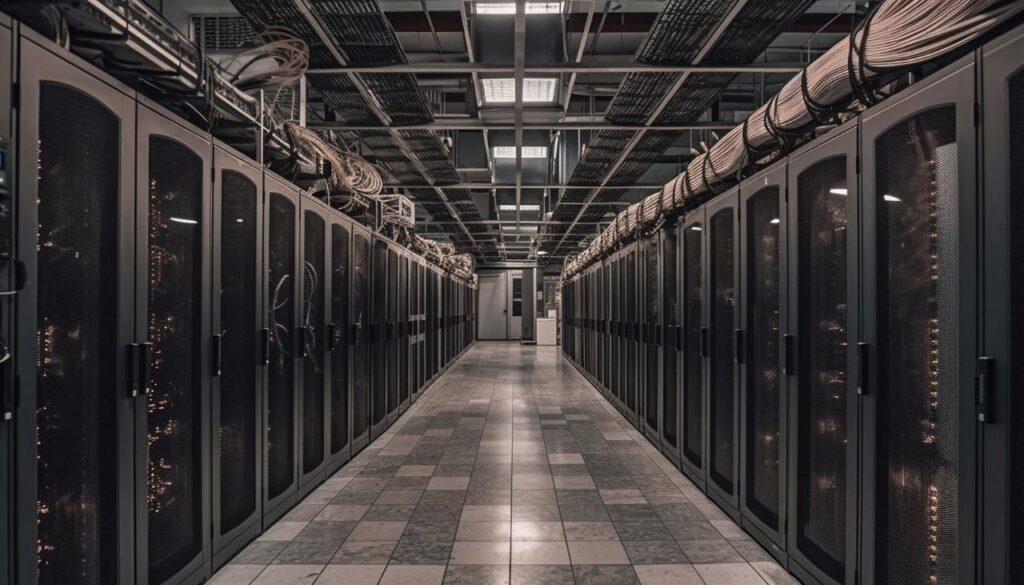
A CDC is an industrial facility designed for data storage and processing operations that can be divided into several zones:
- server rooms housing servers—that is, physical or virtual machines that run applications and store data—data storage arrays (memory cards, disks), and communications network equipment (routers, switches, cables, and equipment used to interconnect servers and provide external connectivity);
- cooling zones: air conditioning, ventilation, or liquid cooling systems to maintain an optimal temperature;
- Electrical infrastructure: To prevent outages and ensure uninterrupted service 24 hours a day, 7 days a week, so-called “redundant” systems provide power (UPS units, generators, batteries). Electricity consumption stems from energy-intensive computer servers, cooling systems, and round-the-clock operation with redundant power lines to ensure a quality of service that can be adjusted based on usage;
- information systems, IT security (cyberattacks, data breaches, system failures), software (operating systems, virtualization, data management, monitoring tools, backups, and archiving, etc.);
- logistics areas: physical security, access control, cameras, fire detectors, etc. (software, operating systems, virtualization, data management, monitoring tools…);
- living and working spaces.
Before a CDC can be installed anywhere, all of these subsystems must be precisely characterized based on the specific characteristics of the areas where they will be located, since the nature of the equipment, the calculation methods, and the cooling techniques will have an impact on the resources required (electricity and water) and the populations affected.
Explosive growth in size
Let’s summarize the journey so far. Our starting point is 1946: the first electronic computer, the ENIAC, made up of relays and vacuum tubes, with a power consumption of 150 kilowatts—roughly the equivalent of 150 vacuum cleaners running at full power—weighing 30 metric tons, and capable of performing 5,000 additions per second.
In the 1970s, IBM computers exceeded one million operations per second thanks to technological advances (transistors, followed by integrated circuits containing a few dozen and then a few thousand transistors on a silicon substrate).
Today, spectacular advances in microelectronics make it possible to manufacture processors containing more than 100 billion transistors on silicon chips measuring just a few square centimeters, and to mass-produce supercomputers whose complexity now exceeds one billion billion (10¹⁸) operations per second while consuming less than 20 megawatts of electrical power (equivalent to 20,000 vacuum cleaners!).
In other words, over the course of eight decades, the performance of a supercomputer has increased by a factor of approximately 200,000 billion! This has enabled the miniaturization of computing functions (the emergence of the first personal computers, laptops with built-in batteries, tablets, smartphones, etc.) and the birth of an interconnected digital world.
Computer Architectures
It should be noted that the architectural principles of the Central Processing Unit (CPU), formulated in the last century by John von Neumann and inspired by the workof Alan Turing, still apply today.
They consist of an arithmetic and logic unit, a control unit, a memory area for storing data and instructions, and, finally, input/output ports to facilitate communication with the outside world. Of course, today’s technologies and capabilities are more advanced and have led to five overlapping levels: integrated circuits comprising independent processing units (the “cores”); MCMs ( Multi-Chip Modules, or 3D integration of CPU, GPU, and memory silicon chips); computers and servers; and, finally, CDCs.
Bottlenecks and physical limitations are the same across these different levels of integration: memory management, communications—particularly computation and memory—parallelism, speed performance, and power consumption…
There are several CDC models, tailored to different needs in terms of security, sovereignty, and energy efficiency:
- in-house CDCs managed for its own needs;
- outsourced data centers, by renting space in a third-party data center to install its own equipment;
- carrier-provided cloud data centers, where resources are virtualized and accessible on demand;
- so-called "hyperscale" CDCs to handle massive volumes of data and, more recently, GPU computing arrays tailored for generative artificial intelligence.
The rapid growth of generative AI is disrupting these organizations
GPU accelerators distribute matrix computations across thousands of units (cores), unlike CPUs, which are limited to a few more complex cores and sequential processing. Equipped with very fast but limited-capacity on-board memory, they thus offer a performance boost for training and inference in generative AI, at the cost of increasingly high power consumption—running in the range of several hundred watts.
The size of the matrices (or parameters) in language models plays a key role in their performance and resource requirements. For aLarge Language Model(LLM) designed to handle complex language comprehension and generation tasks, size is typically measured in billions of parameters, requiring tens of thousands of GPUs. To give an order of magnitude, multiplying two 4096×4096 matrices requires approximately 68 billion arithmetic operations (without optimization).
This rapid increase in the number of GPUs used for machine learning and inference—driven by increases in the density and power consumption of integrated circuits —has led to a proliferation of data center projects that now exceed one billion watts of power consumption.
The Environmental and Societal Impacts of Data Centers and Computing Facilities
CDCs thus join power plants, transportation and communications networks, and production lines—and they depend on them.
Their operation has environmental and societal impacts: resources required for equipment and operations (electricity, water), land development, emissions (noise, heat islands), and discharges (diesel generators, refrigerants), and, finally, the management of equipment obsolescence…
There are therefore many challenges (energy efficiency, safety, monitoring of impacts), and they will require efforts in the areas of adaptation, creativity, regulation, and transparency.
This rapid expansion is thus running up against economic and physical limits. As recent news reports highlight, AI infrastructure is advancing at a pace that the market is struggling to keep up with. According to IBM’s CEO, equipping more than 100 gigawatts (GW) of data center capacity could cost between $6 trillion and $8 trillion. To make such an investment profitable, revenue would need to be generated on an unprecedented scale.
In Loughton, less than 30 kilometers from London, another challenge has arisen: finding enough electricity to power Nscale’s 90-megawatt (MW) AI mega data center. The project, which has already been delayed, is running into a simple but critical obstacle: insufficient capacity in the local power grid!
Michel Robert, University Professor, University of Montpellier
This article is republished from The Conversation under a Creative Commons license. Readthe original article.