Stock Buybacks: In the Face of Market Excesses, Regulation Remains Too Timid
Current events in today’s world are full of major issues on which the public expects economic and political leaders to make concrete decisions that can help improve the situation. Among these many current issues, we would like to focus on a company’s buyback of its own shares—transactions that are seemingly technical and little known to the public. Yet these transactions deserve closer examination for the behaviors they reveal and their economic implications.
Elisabeth Walliser, Université Côte d’Azur and Roland Pérez, University of Montpellier

Over the past many years, these transactions—which were once rare or even prohibited—have become very common. These share buybacks significantly alter the functioning of financial markets, as they can amount to stock price manipulation.
Back in 2019, we had already drawn attention to this troubling trend in the U.S. stock markets. Since then, this trend has persisted, driven by “accommodative” monetary policies ” monetary policies (quantitative easing, or QE, in Europe, and zero interest rate policy, or ZIRP, in the United States), which have made it easier to access credit. In the United States, this trend has been further amplified by tax measures enacted under President Donald Trump to encourage U.S. multinational corporations to repatriate liquid assets held abroad.
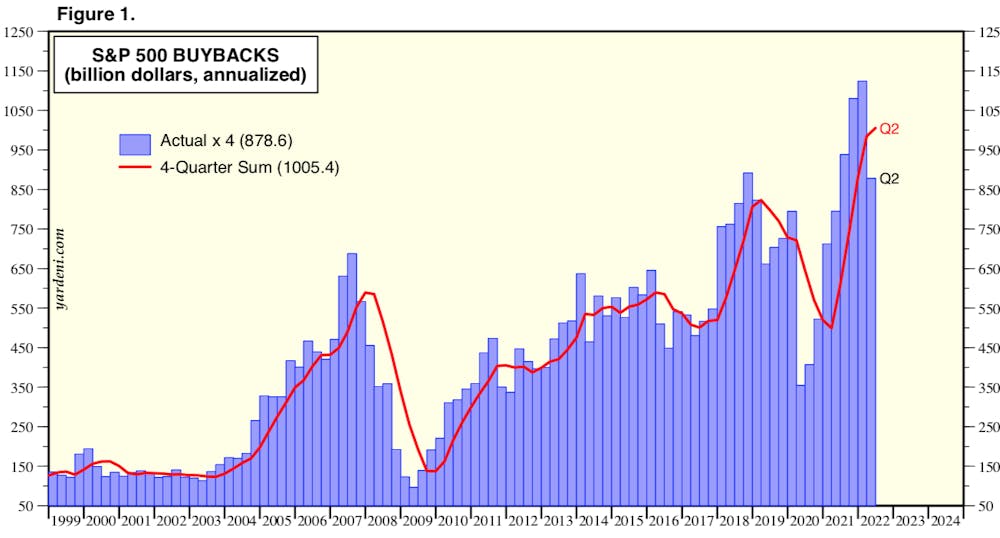
Yardeni.com
By the end of 2021, the total value of these share buybacks had even surpassed the $1,000 billion mark in annual flows for the S&P 500 alone—the stock index based on 500 large publicly traded companies. These annual flows have become larger than those of dividends paid. For example, in 2021, Apple conducted $85.5 billion in share buybacks compared to $14.5 billion in dividends. Over the past ten years, the total amount of share buybacks by the Cupertino-based company has reached $567 billion. In some years, the combined total of dividend payments and share buybacks even exceeded the proceeds from new share issuances, thereby reversing the financing role of financial markets.
A trend that is taking Europe by storm
In other parts of the world, these transactions are less massive but are beginning to take on significant proportions. On September1, the newspaper *Les Échos* reported: “Major European companies have turned to share buybacks on a massive scale since the pandemic. They have tripled in one year, reaching 70 billion euros in the first half of the year in Europe, including 15 billion in France.”
Accordingly, the TotalEnergies Group has launched a new share buyback program “in line with its announced policy of allocating up to 40 percent of the excess cash generated above $60 per barrel to share buybacks,” as the same newspaper noted a month earlier; these buybacks are expected to total $7 billion in 2022.
[Nearly 80,000 readers rely on The Conversation’s newsletter to better understand the world’s major issues. Subscribe today]
Given the scale of this near-tsunami, it is surprising how muted the reactions have been, both from the relevant authorities and the research community. As for the authorities responsible for these issues, the measures taken or being considered are modest. In the United States, after much hesitation, the Securities and Exchange Commission (SEC), the U.S. securities regulator, issued new regulations governing these transactions in late 2021, aimed primarily at improving disclosure requirements. Additionally, in August 2022, the U.S. Senate passed a bill imposing a small tax (1%, effective as of January 2023).
In other parts of the world, however—particularly in Europe—we have not, to date, heard of any proposed decisions on this matter, unlike other related but distinct issues, such as “superprofits” and their potential taxation…
"Mainstream" finance
The silence—or at least the scarcity—of research devoted to this issue of share buybacks seems even more surprising. Admittedly, there are a number of studies that have focused on these issues, sometimes with great insight; but the researchers involved are often marginalized in the academic world of finance. The latter remains largely dominated by a theoretical framework developed over several decades, forming a paradigm—known as “mainstream finance”—from which researchers, it must be acknowledged, find it difficult to break free.
Thus, a share buyback can be easily explained using the concept of free cash flow, which refers to the cash flow available once investments have been recouped. Executives are encouraged to return this excess cash to shareholders rather than use it in a suboptimal manner. Share buybacks thus serve as a means of holding executives accountable and reflectshareholder-oriented corporate governance, as recommended by this school of thought.
Such a theoretical justification may have raised a smile among many finance professionals. Admittedly, share buybacks can be the appropriate solution for resolving specific situations (for example, the death of a co-founder of a company whose remaining partners wish to retain exclusive control) or, more broadly, for publicly traded companies, to modify the ownership structure by reducing the “free float” in favor of stable shareholders.
Nevertheless, beyond these capital-allocation transactions, the primary purpose of these share buyback announcements is to please shareholders in the short term by propping up the stock prices of the companies involved. Executives who propose such maneuvers also stand to benefit, as strong stock prices have become a key measure of their ability to “create value,” and incentive schemes have been created for this purpose (such as stock options).
Necessary Regulation
We can refer to these as “maneuvers” or “signals” because many of these transactions remain merely declarative and are not actually carried out; others are carried out but are then followed by a capital increase—thus having the opposite effect. This outcome therefore appears consistent with the hypothesis of price manipulation.
Conversely, when these transactions result in the cancellation of the repurchased shares and a corresponding reduction in both the cash reserves and the equity of the company in question, the company could find itself in difficulty in the event of subsequent developments (or opportunities) requiring rapid and significant financing to address them; a situation which, incidentally, is consistent with a disciplined, shareholder-oriented approach to corporate governance, as the financial market is called upon to assess the situation.
As can be seen from these few examples and initial reflections, it seems desirable that financial professionals, the general public, research institutions, and government authorities all recognize the challenges posed by this excessive reliance on share buybacks so that much-needed regulation can be implemented.
Elisabeth Walliser, Director of the IAE in Nice, Management Research s Group (GRM), Université Côte d’Azur and Roland Pérez, University Professor (ret.), Montpellier Research in Management, University of Montpellier
This article is republished from The Conversation under a Creative Commons license. Readthe original article.