Restoration of the Astronomy Pavilion: Stars for the Garden
While strolling through the Jardin des Plantes, you’ll come across a small dome nestled in the English garden near the lotus pond. This building, whose rounded shape echoes that of the water lilies, is the astronomical observatory, which the University of Montpellier has chosen to restore in order to reestablish the connection between the observation of living things and our understanding of the universe, thereby returning the stars to the Jardin.
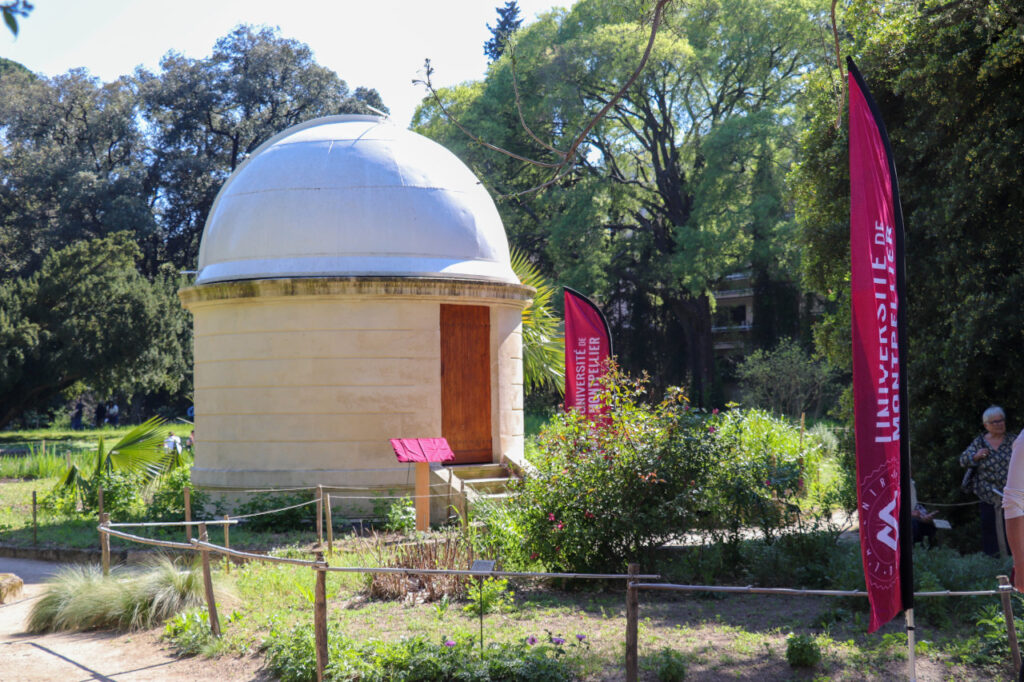
People come here to stroll in the shade of the bamboo grove or wander along the paths of the “école systématique,” visit the Martins Greenhouse and its “succulent” plants, or admire the lotus pond, or “nelumbos pond”… But there was a time when people didn’t come here just to look down at the flowers—they also came to look up at the stars. For the Jardin des Plantes boasts a heritage that is sometimes overlooked: its astronomy pavilion, whose creation was a small big bang.
Foucault's Telescope
At the end of the 18th century, Montpellier—then a major center for astronomy—was searching for a new site for astronomical observation following the closure of the Babote Observatory in 1793. The building was intended, in particular, to house the Foucault telescope, a state-of-the-art instrument acquired in 1877 thanks to a bequest from Professor Jean-Nicolas Legrand. “And at that time, the Jardin des Plantes was the place in Montpellier with the least amount of light, ”explains its current director, John de Vos. This made it an ideal spot for stargazing. But it was also damp…
This was an argument put forward by Charles Martins, then director of the Garden and professor at the Faculty of Medicine, in opposition to the construction, as he believed that humidity could damage the equipment. A controversy ensued with faculty members from the Faculty of Sciences, requiring arbitration by the Minister of Public Instruction, who ultimately approved the project. The pavilion was thus built in the English garden near the lotus pond and was inaugurated on July 28, 1879, during the observation of the occultation of the star Antares by the Moon.
A Continuing Scientific Tradition
In the early 20th century, the dome began to deteriorate and use of the pavilion gradually declined, until the telescope was removed in 1964 and transferred to the Languedoc University of Science and Technology. The pavilion was then temporarily converted into a planetarium in 1988 before being closed to the public. To breathe new life into this iconic piece of the university’s heritage, while enhancing the experience of visitors to the Jardin des Plantes, the University of Montpellier decided to restore the astronomical pavilion.
Inaugurated on April 9 in the presence of Philippe Augé, president of the University of Montpellier; Isabelle Laffont, dean of the Montpellier-Nîmes Faculty of Medicine; and John De Vos, its restoration was fully funded by the University of Montpellier at a cost of 122,000 euros. The cost of restoring this site to its heritage, educational, and symbolic significance, in keeping with Montpellier’s scientific tradition. “It could potentially be used for temporary exhibitions, ”explains John De Vos. “It’s like an artifact from the past that we can bring back to life.”