Signing of a partnership agreement between the Montpellier University Innovation Cluster (PUI) and seven competitiveness clusters
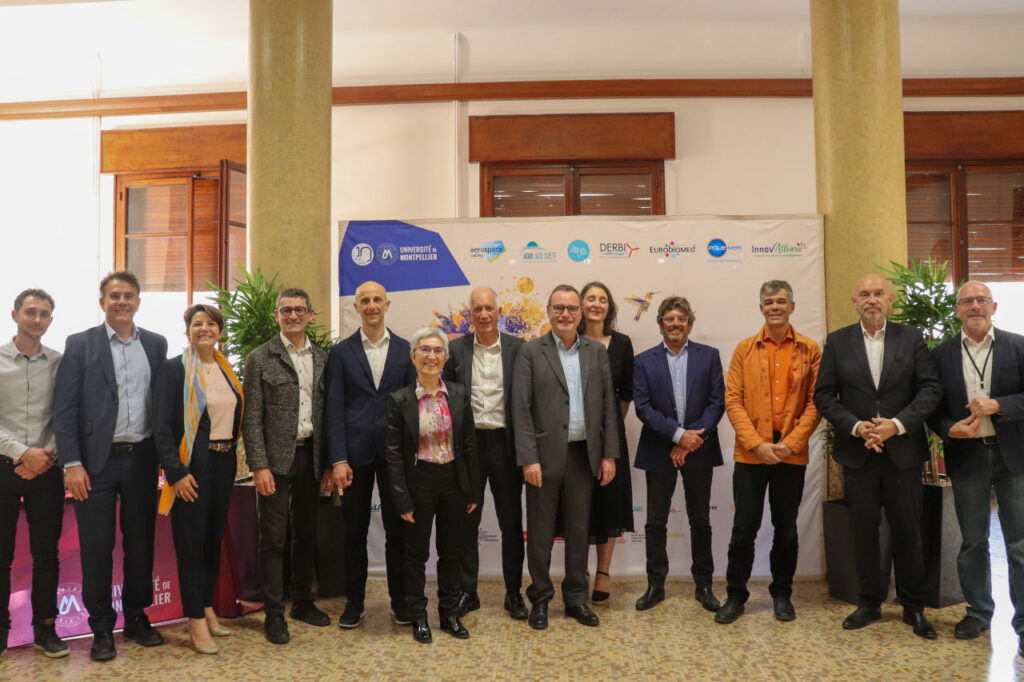
On Monday, April 7, at 6:00 p.m., at the Institute of Botany at the University of Montpellier, the first partnerships were signed between the Montpellier University Innovation Cluster and seven competitiveness clusters in our region (Aerospace Valley, Agri Sud-Ouest Innovation, Aqua-Valley, DERBI, Eurobiomed, Pôle Mer Méditerranée, and Innov’Alliance). By strengthening synergies among all key players in the local ecosystem, this first foundational collaboration aims to accelerate innovation and foster the development of high-impact solutions.
The University of Montpellier: A Hub for Innovation
Drawing on its scientific expertise and strong regional roots, the University of Montpellier—the lead institution of the University Innovation Cluster (PUI)—is embarking on a new initiative by collaborating with competitiveness clusters. This alliance aims to catalyze synergies between research and industry to drive innovation in Occitanie.
The PUl in Montpellier embodies the ambition to drive innovation that benefits society and the region. Structured around the “Feed, Care, Protect” triad of the I-SITE program, it brings together higher education and research institutions. Thanks to a dynamic ecosystem that includes one-third of Occitanie’s researchers and 70,000 students, Montpellier has established itself as a major hub for innovation. The PUl also relies on key players such as the SATT AxLR, the Montpellier metropolitan area’s BIC incubator, and the regional economic development agency AD’OCC to stimulate the creation of startups, support innovation among SMEs, and attract strategic investments.
Competitiveness Clusters: Catalysts for Growth
Competitiveness clusters play a vital role in the innovation ecosystem. By bringing together companies, research laboratories, and institutions, they foster the development of high-potential collaborative projects. Their mission is to accelerate the commercialization of new technologies, products, and services resulting from research by supporting companies as they scale up their operations.
A Partnership to Turn Innovation into Economic Impact
This agreement establishes a framework to intensify the commercialization of scientific innovations within the Montpellier Metropolitan Area and the Occitanie region. It aims to strengthen connections between research, the broader socio-economic sector (companies, associations, consulting firms), and key players in local innovation. Through the support mechanisms of the Montpellier PUI and dedicated strategic events, this agreement aims to: transform scientific advances into high-value-added industrial innovations, structure ambitious collaborative projects, and strengthen cooperation between researchers and industry, supported by sector-specific analysis from competitiveness clusters.
This collective commitment will therefore help enhance the appeal of the Montpellier region, showcase local expertise on the national and international stage, and raise awareness of innovation. It is also based on concrete commitments: a framework agreement formalizes the actions and commitments of the stakeholders, the PUl steering committee ensures rigorous monitoring, and strategic meetings facilitate the coordination of initiatives. An evaluation system will measure the impact of the actions undertaken to enable continuous adjustment of strategies.
This agreement marks a key milestone in the development of innovation that is more fluid, efficient, and aligned with economic and societal challenges. It also paves the way for the creation and support of deep-tech startups emerging from research laboratories by providing them with privileged access to the PUl’s resources and expertise. Montpellier is thus positioning itself as a driving force for technological and entrepreneurial innovation in Occitanie, strengthening its appeal and international influence.
Practical Information
- Date of signing: Monday, April 7, 2025
- Location: Institute of Botany, University of Montpellier