UFR STAPS: An Exemplary Renovation Project
October 19 was a day of celebration on the Veyrassi campus. Building A, renovated after a year and a half of construction work, was officially inaugurated. Here’s a look back at a €5 million project that proved exemplary in many ways, starting with the commitment shown by the university administration and the entire “Staps” community.
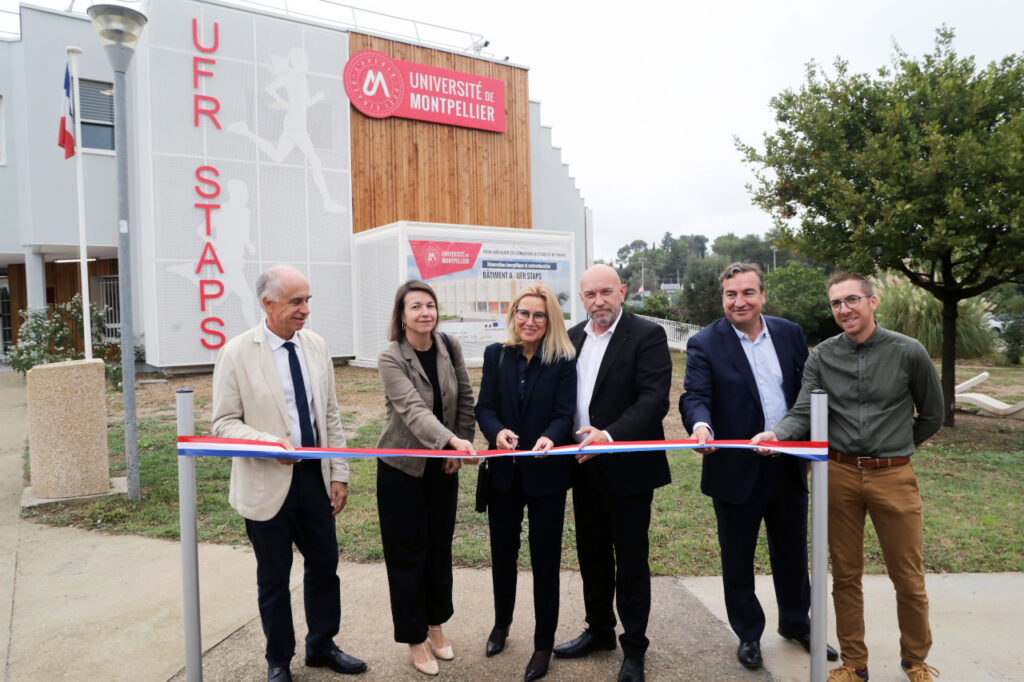
“Now when students refer to Building A, they call it ‘thenewbuilding’—that says it all,” says Angèle Chopard, dean of the UFR Staps, with delight. “We’ve received nothing but extremely positive feedback.” It must be said that the particularly successful renovation of this building brings a breath of fresh air that is more than welcome to this campus, which is home to 2,200 students, more than 70 faculty members and Professors about thirty administrative staff.“ Whether it’s the restructuring of the department’s activities made possible by this new building, its energy efficiency, or the strong commitment from the university administration and the UFR Staps leadership, this project serves as a model for us in many ways ,” summarizes Bernard Maurin, vice president in charge of real estate.
Guided tour
Opened in 1980, Building A—which welcomes visitors as soon as they arrive on campus—now features modern facades adorned with the silhouettes of male and female athletes.“On the first side, we see a pair of runners who symbolize gender equality for us; on the right and left sides, a tennis player and a rugby player; and on the last side, a wheelchair basketball player to highlight our commitment to inclusion,” explains Angèle Chopard, who came up with this “little personal touch.”
With a floor area of over 3,000 square meters, this building was constructed over three floors, all of which have been renovated and restructured. The ground floor houses an e-library—the first at the University of Montpellier—administrative services (registration, logistics, reception), a room reserved for people with disabilities, and a beautiful lounge area opening onto a small terrace. The 150-seat lecture hall has also been completely renovated.“This lecture hall was notorious for its dilapidated condition and unpleasant odor due to ventilation issues, ”recalls the dean. “Today, it is a magnificent and very pleasant space.”
Quality of life at work
The garden level, located one floor below the ground floor, is largely dedicated to students. It features: the student office, a study room with three individual cubicles and a relaxation and social area that also opens onto an outdoor terrace, a brand-new learning lab, and a state-of-the-art fitness room equipped withrowing machines, treadmills, and SkiErgs… “Everything is connected to enable real-time analysis, thereby training students in the analysis and evaluation of physical activity, technological tools, exercise physiology, and more, ” explains Angèle Chopard. Finally, the first floor, reserved for the teaching staff, houses the administration, the academic affairs office, the boardroom, faculty offices, and the Santesih research laboratory.
“These new facilities bring a fresh energy and greater comfort. We run into each other much more often, which fosters more interaction and a friendlier atmosphere. You could really call it a better quality of life at work,” notes the dean.To ensure smooth movement across these three levels, an elevator and an access ramp have been installed. And color is everywhere: “ orange for the Sports Training Department (ES), pink for the Adapted Physical Activities and Health Department (APAS), turquoise blue for the Education and Motor Skills Department (EM), and midnight blue for the Sports Management Department (MS).” “And in the staff offices, everyone was also able to choose their own color,” explains Angèle Chopard, who spearheaded this initiative. These colors were highlighted during a dance performance by the students on the day of the inauguration, directed by Frédérique Tison, head of the dance program.
Energy-efficient renovation
And this renovation goes beyond mere cosmetic improvements. The building’s energy efficiency has been completely overhauled in accordance with the government’s stimulus plan, which funded a large portion of the work, totaling 5 million euros. Exterior insulation of the entire building envelope, installation of new windows, replacement of the air handling unit with a dual-flow system, replacement of the old lighting with LEDs, and finally, accessibility upgrades (installation of an interior elevator and an exterior ramp) as well as safety improvements.
The resilience plan unveiled by the government in March 2022 also made it possible to replace gas boilers with a heat pump, thereby reducing greenhouse gas emissions and, at the same time, limiting dependence on fossil fuels.“This is a project that had long been identified by the DPI—whose proactive approach deserves recognition—but which could not be carried out previously due to a lack of necessary funding,” emphasizes Bernard Maurin . “We benefited from a windfall effect thanks to these two plans, but above all, we gave ourselves the means to secure this funding.”
An extraordinary mobilization
For this windfall effect comes at a price. While these government plans represent a genuine opportunity for public institutions, they are accompanied by significant constraints, particularly in terms of deadlines, with relatively tight timeframes.“We had to move very quickly to put together the applications and then issue all the construction contracts. There was an exemplary mobilization on the part of the relevant UM departments, including the Real Estate Assets Department (DPI), of course, but also the Procurement and Contracts Department.” The completion of the work was also subject to tight deadlines; yet these stimulus plans, due to their scale, are creating a sharp increase in demand nationwide.
“All companies are being called upon at the same time by government contractors, which has three consequences: shortages of materials and components, rising prices exacerbated by inflation, and overburdened contractors, not all of whom have been able to meet their commitments,” explains the vice president. What does this mean for the Staps renovation project? A delivery delay of several months and a bill inflated by 600,000 euros.“And here again, I want to highlight the commitment of the University, which was able to finance this cost increase with its own funds, and the exemplary conduct of the Staps staff and students, who were able to operate under difficult conditions for over a year.”
“It was definitely worth thewait,” exclaims Angèle Chopard! And the campus renovation isn’t stopping there: in 2024, a climbing wall will be installed at the Veyrassi University Sports Center, a key facility whose surrounding area will also be made safer. The dean also hopes that the Montpellier metropolitan area will carry out the project to replace the current rugby and baseball fields with synthetic turf fields in order to optimize soccer, rugby, and baseball practices through triple-marking.“Then we’ll be able to say that our campus is optimal. It will greatly contribute to the quality and reputation of our teaching and research, and will enable shared sports activities,” continues Angèle Chopard, before letting Bernard Maurin conclude:“We had a perfect alignment of the stars, but we couldn’t have seized this opportunity without this exceptional mobilization!”