“One year after Cyclone Chido, the situation in Mayotte remains critical”
Cyclone Chido devastated the French department of Mayotte on December 14, 2024. While the government launched a massive response to address the emergency, promises of structural reconstruction appear far from having been fulfilled. An interview with Mayotte-based geographer Fahad Idaroussi Tsimanda.
Fahad Idaroussi Tsimanda, University of Montpellier
The Conversation: One Year After Chido: How Is the Reconstruction Progressing?
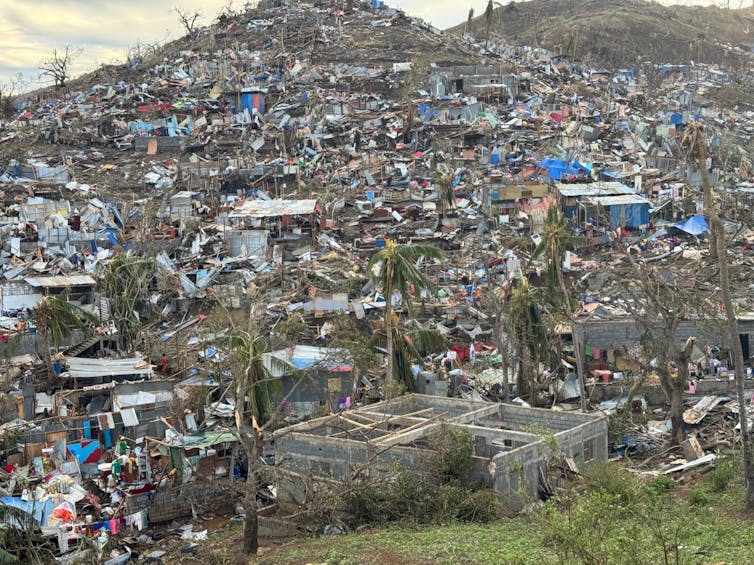
Fahad Idaroussi Tsimanda: On December 14, 2024, Cyclone Chido struck Mayotte and damaged 80% of the island’s territory (nearly 60% of housing was reportedly damaged or completely destroyed, along with much of the infrastructure, agricultural land, and natural areas). This was a major humanitarian disaster, despite an official death toll limited to 40 dead and 41 missing. The government quickly mobilized significant emergency resources after declaring a state of exceptional natural disaster. On the ground, more than 4,000 personnel from civil defense, the police, the gendarmerie, and the armed forces were deployed. Humanitarian aid was distributed on a massive scale—including water packs, potatoes, bananas, flour, oil, and more. Roads and the main drinking water and electricity networks were restored within about a month.
There was also significant political mobilization throughout 2025. To formalize and guide the island’s reconstruction, the government passed an emergency law in February 2025, followed by a law for the rebuilding of Mayotte, establishing a multi-year investment plan totaling 4 billion euros. These laws were supplemented by executive orders aimed at accelerating reconstruction, notably by temporarily adapting building codes to facilitate the rebuilding of destroyed homes.
However, our assessment is that, beyond the immediate emergency, structural reconstruction has still not taken place, and the situation on the ground remains critical. We are still a long way from what the people of Mayotte expected. According to figures from Representative Estelle Youssouffa, very little money has been spent: only 25 million euros since the beginning of the year, or about 0.6% of the total promised budget of 4 billion euros.
I noticed that in the capital, Mamoudzou, several public buildings (those of the Department of Mayotte, City Hall, the police station, the intermunicipal authority, etc.) are still covered with tarps. At the Mayotte Hospital, roofing work is underway, but the bulk of the work has already been completed.
As for individuals, a zero-interest reconstruction loan was promised to the people of Mayotte—specifically, to households affected by the disaster—with a budget of 50,000 euros. But I don’t know anyone around me who has benefited from it. Some residents have already rebuilt their homes, while others are just beginning their construction projects.
I am a teacher, and I have noticed that the situation in schools remains dire, with many classrooms unavailable, which leads to overcrowded classes. It is estimated that 40% of schools were destroyed or damaged during the hurricane. The closed classrooms force students to attend a limited number of class hours on a rotating schedule.
The slums were devastated by Chido. What has happened in those neighborhoods over the past year? François Bayrou, who was prime minister at the time, had pledged to block their reconstruction. Has that been the case?
F. I. T.: The very day after Chido struck, migrant families living in the shantytowns began rebuilding their homes. The prefect of Mayotte banned individuals from purchasing sheet metal unless they could provide proof of residence, in order to prevent the reconstruction of shantytowns. However, it was very easy to get around this by using a neighbor’s proof of residence. Those who could afford it bought corrugated iron sheets and rafters. Others reused the warped sheets and cut up fallen coconut trees for the structures.
The idea of rebuilding with permanent structures in these neighborhoods is a pipe dream. People living in the slums are often undocumented; they are not eligible for public housing, which is in short supply anyway. What other option is there? According to official statistics, before Chido, there were about nine public housing units per 1, 000 residents—an extremely low figure. Yet 40% of homes in Mayotte are made of corrugated iron, and 77% of residents live below the national poverty line. The shantytowns, rebuilt exactly as they were, remain just as fragile and vulnerable to inclement weather.
After the Chido incident, migrants were singled out by some members of the French political establishment. The Bayrou administration passed legislation to tighten the requirements for obtaining French citizenship and promised a tougher stance on immigration. How is the situation evolving on the ground?
F. I. T.: Nearly half of the people living in Mayotte are foreigners, including many undocumented immigrants living in shantytowns. Large-scale police operations, such as “Wambushu” or “Place Nette,” aimed at razing shantytowns and carrying out mass deportations, were not repeated in 2025. However, border police continue to intervene at sea and on the island to deport undocumented immigrants. But they keep coming back: the island is easily accessible by boat from neighboring islands, and the borders are difficult to control.
Despite the government’s efforts, illegal arrivals continue. Migrants still live in precarious housing conditions, with limited access to basic rights and persistent inequalities.
Relations between France and the Comoros play a central role in this migration issue. What is the current state of these relations? https://www.youtube.com/embed/aOhrlxqqv3I?wmode=transparent&start=0
F. I. T.: In 2018, an agreement was reached between the Union of the Comoros and France. Under the agreement, France would assist the Comoros in the areas of agriculture, education, and health—on the condition that the Comorian government halt the departure of migrants from the island of Anjouan. But since then, nothing has changed. The president of the Union of the Comoros, Azali Assoumani, constantly repeats that France must give up Mayotte and that the island must become part of the Union of the Comoros. He claims that Mayotte belongs to the Comoros—no doubt to appease his electorate—even as the people of the Comoros live in extreme poverty.
What is the general mood among the islanders you interact with?
F. I. T.: The people of Mayotte are resilient. After the hurricane, they helped one another; they stood together. Here, life goes on as usual. Some criticize the government, but, in general, the people of Mayotte are confident about the future. What is a source of tension are incidents of violence that sometimes involve migrants. This isn’t something that started with Chido. The migration issue has gained prominence since the island became a French department in 2011.
Fahad Idaroussi Tsimanda, Geographer, Research Associate at LAGAM, University of Montpellier
This article is republished from The Conversation under a Creative Commons license. Readthe original article.