A New Perspective on the Jardin des Plantes
Since last December, the people of Montpellier have been able to rediscover one of their favorite spots from a new perspective. After being closed for more than twenty years, the Portail d’Honneur has reopened, leading to the upper section of the Jardin des Plantes. We took a tour with John De Vos, the garden’s director, who shared the main priorities of his tenure with us. Listen to the full audio interview.
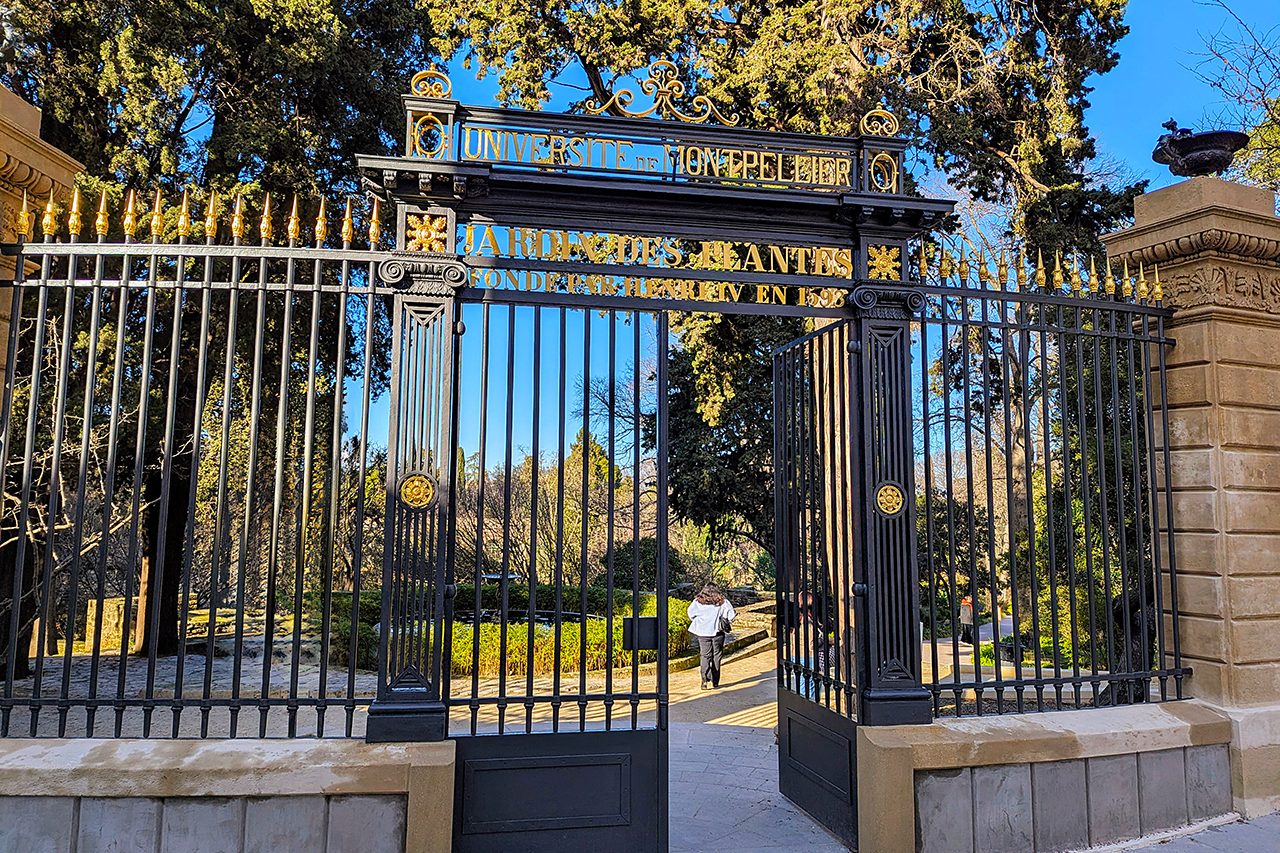
UM : So here we are in front of the new gate to the Garden, which reopened last December.
JDV: This gate was built in the mid-19th century, in 1841. You can see the distinctive 19th-century style—it’s both massive yet features very delicate ironwork. It opens wide onto the Garden when you approach from Peyrou. We were very disappointed to have to close it about twenty years ago due to issues with deterioration and safety. It has been completely renovated and can now be opened as soon as the garden is open to the public.
UM : Who was involved in this renovation?
JDV: The funding came primarily from the University, the metropolitan area, and the government. It offers a new perspective on the Jardin des Plantes that the people of Montpellier will be able to enjoy.
UM : Speaking of which, can you describe what we see from here?
JDV: The original intention was that, once visitors passed through the gate, they would have a view of the Orangery, one of the garden’s signature buildings. That’s indeed what you can see in winter, but over the years, trees have grown, and as soon as spring arrives, they block the view of the Orangery. So it’s a view that changes throughout the year!
UM : Let’s go inside… You took over from Thierry Lavabre-Bertrand in September 2024 as director of the Garden. What are your plans?
JDV: First, to continue the work Thierry Lavabre-Bertrand began, particularly in the area of heritage preservation. He inaugurated the Martins Greenhouse and oversaw the renovation of the Orangery. These were major projects that have been greatly appreciated, as we regularly host exhibitions and events in the Orangerie while maintaining its core function: sheltering plants during the winter to protect them from frost. We’ve continued with the Portal d’Honneur, and our focus going forward will be on renovating the Intendance.
UM : Is there also a project regarding signage?
JDV: Yes , in addition to this architectural heritage aspect, there’s the Garden. We need to continue developing it, making it more accessible, and stabilizing the team of gardeners—a very dedicated team. To better showcase the plants, we’re launching a signage initiative that will start by labeling all the plants—there are more than 6,000 of them, representing over 3,000 different species—so this is a major labeling project that will begin this year. We’re also planning signage to indicate the exit and the various sections, and, most importantly, educational panels to explain certain topics, such as the challenges facing biodiversity or specific plant families.
UM : As you said, it’s a big job—who’s handling it? Researchers? Students?
JDV: The plants have already been identified; Didier Morisot, the Garden’s chief botanist, knows them all. For the educational aspect, we’ll be drawing on expertise from within the Garden—since there’s plenty of it—as well as students and faculty from other departments at the university, such as the Faculty of Sciences or the Faculty of Education.
UM : Through the “école systématique,” we rediscovered another dimension of the Garden. How would you define its role?
JDV: The Jardin des Plantes is like a set of Russian nesting dolls. It has many interlocking aspects, which is precisely what gives it its charm. For many residents of Montpellier, it’s a very peaceful, lively park where you can hear birds and animals and see plants. But it’s also—and this is the primary function of a botanical garden—a place that hosts a vast diversity of plants, particularly wild plants. If there are rose bushes, they are mainly wild roses, not cultivars. Its role, therefore, is to raise awareness of this diversity of plants.
And then there’s the historical side, with its very romantic elements: the faux ancient arches, the old wells, and the busts that remind us that the Garden’s history spans more than 400 years. Finally, last but not least, there’s the literary and poetic aspect. A number of authors have strolled through the garden and written either poems or sections of books there.
UM : I think there’s a bench dedicated to Paul Valéry, isn’t there?
JDV: Paul Valéry, André Gide, and many others walked and sat in this garden!
UM : What is your favorite spot in the garden?
JDV: It’s a tree we call the “wishing tree” or “tree of wishes.” It was planted by Pierre Richer de Belleval—or by someone from his time—so it’s over 400 years old. It’s a broad-leaved filaire, and just gazing at it with all its nooks and crannies, you can sense its age and wisdom. It looks like a character—an old wizard, but a benevolent one—who’s watching over us.
UM : Do you know what happens to all those little pieces of paper?
JDV: Sometimes I joke that the team at the Garden goes to great lengths to create them, but in reality, to keep the tree from turning into papier-mâché, the gardeners remove them regularly.
UM : We’ve arrived in front of the Intendance. What’s the status of this renovation project?
JDV: Funding has been secured. The building permit is being finalized, and construction will begin either this year or next year. This building will house a museum space, educational areas for school groups where workshops can be held, offices for the administration, and finally the seed library—that is, the “index seminum,” which collects all the seeds harvested each year and makes them available not only to the garden’s own gardeners but also to gardeners at other botanical gardens across Europe and even around the world.
UM : Are there any new plants being added to the garden today? We imagine it as a sort of plant museum…
JDV: The garden is by no means static. Of course, the trees don’t move, but plants regularly die and others are planted to replace them. There are annuals that need to be replanted every year and perennials. New shrubs—and even new trees—are planted regularly.
UM : The astronomy pavilion has also been renovated. When will the grand opening take place?
JDV: Yes, the astronomy pavilion—or observatory—was completed last spring. It will be inaugurated this spring, on April 9. It was built in the mid-19th century against the advice of the director of the Jardin des Plantes at the time, Charles Martins […] It was equipped with a telescope that, at the time, was state-of-the-art for observing the stars. It was used for this purpose until World War II. From now on, this space—which is currently empty—will be used for temporary exhibitions and workshops.
UM : It gives this part of the garden a very romantic feel…
JDV: This section, known as the English Garden, is indeed very romantic, with its nelumbos [lotus] pond, its slightly wilder layout, and its lawns. […]
It's absolutely stunning. You have to come see the pond in late June when the lotuses are in bloom.
UM : We’ve come to a noria; there are several in the Garden, but I believe this one is going to be renovated?
JDV: There are two main ones: the South Noria and the North Noria, which is right in front of us […]. That’s where we pump the water—from an aquifer located 7 meters deep and 6 meters thick. Not all the plants need to be watered, but the ones that do are watered with water from this aquifer, not city tap water.
UM : So will it receive funding?
JDV: Yes , we’re going to reinforce it, but we’ll also make sure that nothing obstructs the water intake. If droughts—which will worsen in the future due to global warming—cause the water table to drop, we need to be able to continue accessing the water.
UM : Where does this passion for botany come from? It’s not the focus of your research, though.
JDV: No , I’m a doctor—a hematologist by training—and the department head at the hospital, where I manage the cell therapy unit and the department that also houses the tissue bank. My research focuses on stem cells, and I’m working with a pulmonologist, Professor Arnaud Bourdin, to regenerate the bronchi of patients with very serious genetic diseases. Botany is a passion that I developed a very long time ago, back in my teenage years. I was initially self-taught, then became involved in clubs—first orchid clubs and later botanical societies such as the SHHNH.
UM : What do you like about botany?
JDV: When you learn about plants, you see nature in a completely different light. You immediately see its diversity and richness. You recognize the ones you might be able to smell or eat. When you go for a walk, you notice changes in the environment, because suddenly there are species from wet or dry habitats. It’s a bit like music—it’s something you appreciate more once you learn about it.