UniverlaCité Brings the University to Neighborhoods
For the past 10 years, the “UM ” has been visiting schools in priority neighborhoods. The goal? To introduce young people to scientific and academic disciplines and, perhaps, to spark an interest in attending college.
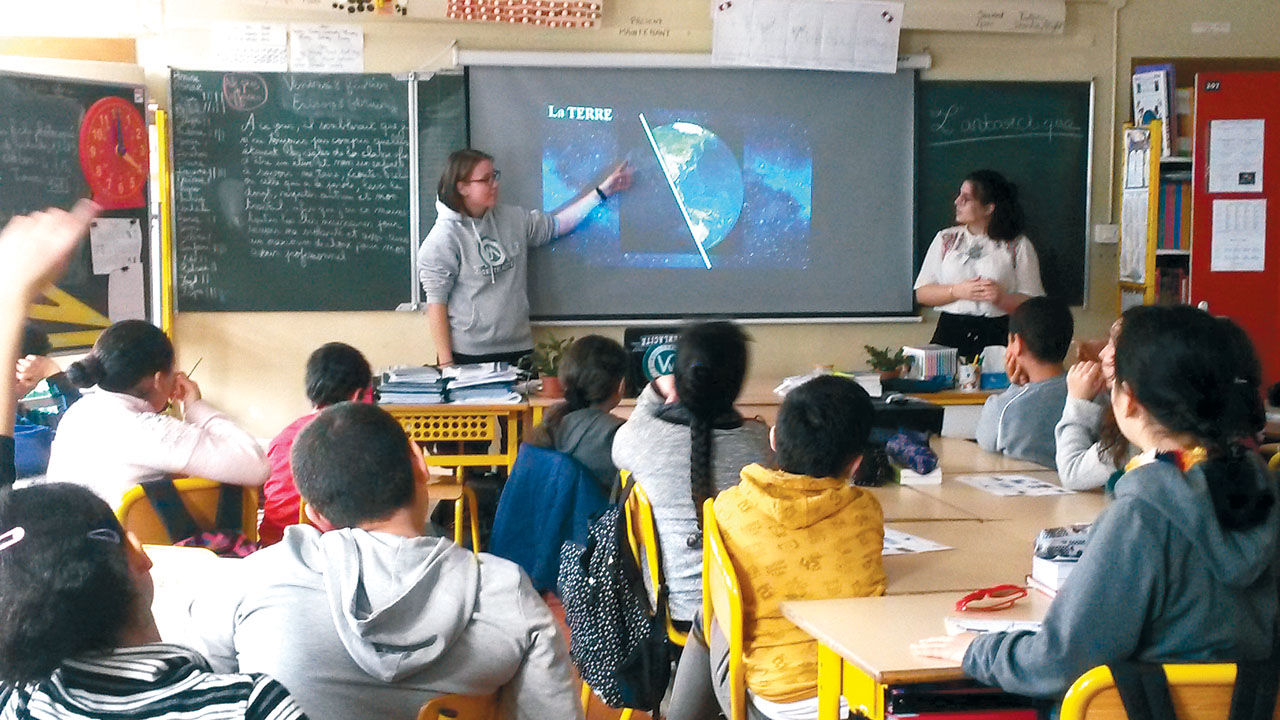
Friday, February 7, 2019, 2:00 p.m. On the second floor of Simone Bolivar Elementary School in the Mosson neighborhood, Olivier Abdank-Kossousky’s fifth-grade class is buzzing with excitement. Is it just the excitement of the weekend approaching? Far from it! Just as they have done twice already since the start of the school year, students from the College of Sciences have come to pay the students a quick visit…
Arctic and Antarctic
“What’s the coldest place on Earth?” “What’s the difference between a walrus, a sea lion, and a seal?” The questions Lara and Lucille asked the children upon their arrival in the classroom were enough to restore silence. For their second visit as part of the UniverlaCité program at Bolivar School, the two third-year undergraduate students majoring in biology, environment, and earth sciences at the Faculty of Sciences chose to introduce the students to the northern and southern polar regions, better known by their generic names: the Arctic and Antarctica. For nearly an hour, an engaging, well-paced, and illustrated educational presentation on the exploration of the poles—and more specifically the South Pole, its climate, and its endemic flora and fauna—unfolded seamlessly under the teacher’s watchful and attentive eye. The young students, captivated by the two speakers’ remarks, remain attentive and actively participate in the session, while at the back of the room, two students majoring in microbiology and pharmacy —who, in a few weeks, will take their turn speaking to students—take notes on Lara and Lucille’s well-honed techniques for “managing the class.”
A New Perspective
“We’re in a challenging neighborhood where, despite everything, there’s enthusiasm for school. However, almost none of my students speak French at home. What’s more, the vast majority of them come from modest backgrounds—and some even face extreme hardship. So every opportunity to spark their curiosity and broaden their general knowledge is one worth seizing!” explains Olivier Abdank-Kossousky, who is delighted to occasionally hand over the reins to young people passionate about science.“UniverlaCité gives students a concrete idea of what they can learn and become by studying at the university. This exposure to science opens up a perspective these vulnerable, underprivileged children had never considered before: pursuing higher education!” adds Catherine Dicky, the principal of the elementary school that has been hosting student volunteers participating in the program for nearly 10 years.
Regions and Priority Education Areas
A testament to the societal dimension of theUM, UniverlaCité was founded in 2009 with the goal of promoting the university in priority areas, particularly in schools within Montpellier’s priority education network. All volunteers with a deeply humanistic spirit, the students of theUM who are involved withUniverlaCité work primarily in schools in the Mosson and Petit Bard neighborhoods. Each session is supervised by Thierry Noëll, the program’s founder and coordinator. “The students propose a scientific topic to me, and together we define the necessary framework to adapt it—in terms of format and vocabulary—to the target audience, ” the animal biology technician recently explained to us on the way to an elementary school where, that day, a young girl passionate about ornithology was preparing to teach a fourth-grade class how to identify urban birds.
As an ambassador forUM ’s outreach programs and a committed academic activist, Thierry Noëll is now considering expandingUniverlaCité to the towns surrounding Montpellier. The goal is to continue offering every child, regardless of their social background, the right to dream of becoming an astronaut, a zoologist, or—why not?—an explorer.