Science Villages: Step into a New Era!
In January 2020, the University of Montpellier gave its largest campus, the Triolet Campus, a new look. Carried out as part of the “Opération Campus” initiative, this project—dubbed “Village des Sciences”—adds two new buildings to the campus.
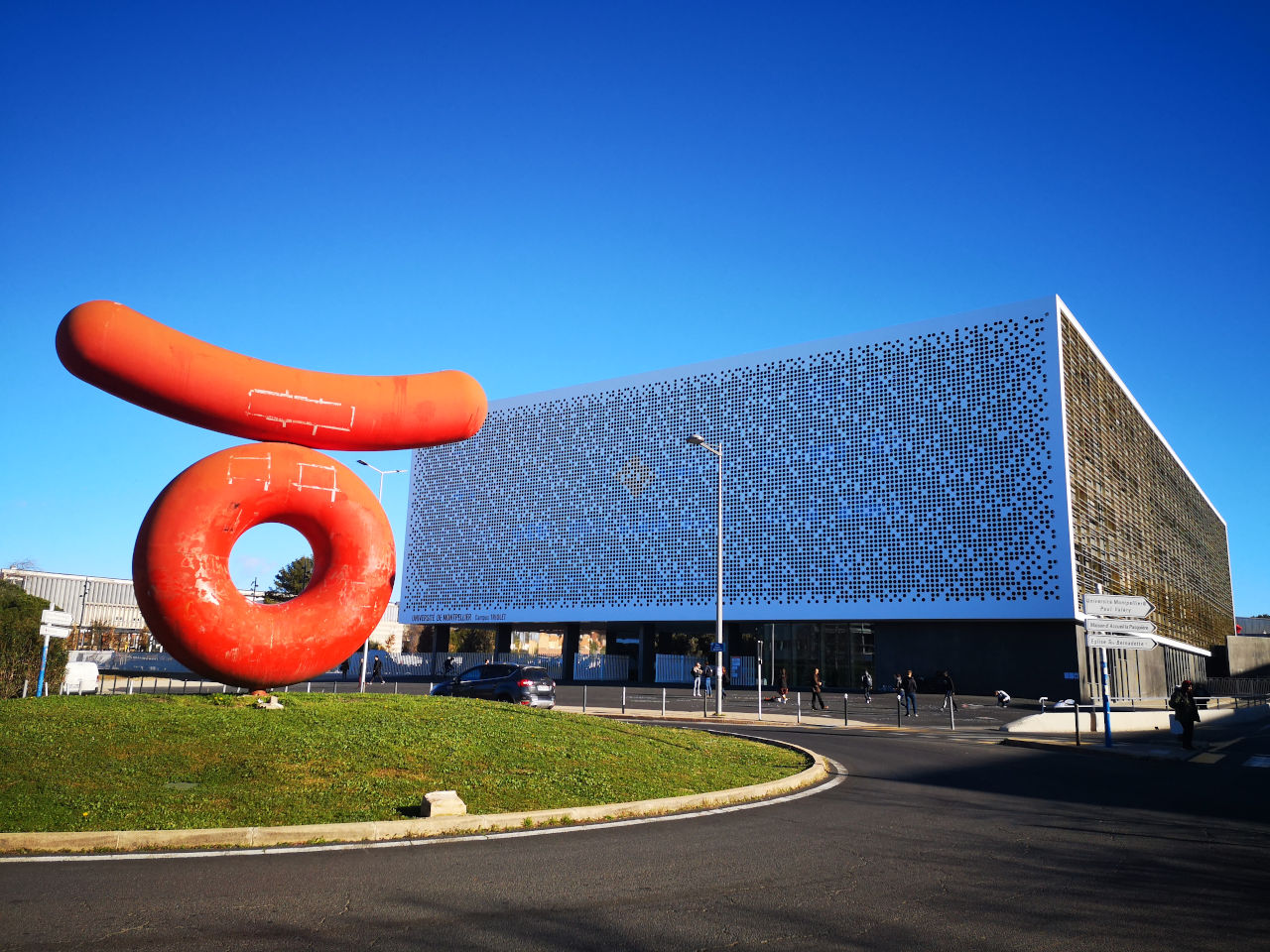
A new entrance to the campus
Numbered 36, this first building serves as the new entrance to the Faculty of Sciences. Opening onto the city and running through it, it forms a covered passageway providing access to the Triolet campus from Place Eugène Bataillon. The perforated lacework adorning its facade is a translation into binary code of the great names in the history of science since antiquity. Designed with five stories and covering an area of 8,660 m², it is entirely dedicated to teaching. “It includes 9 lecture halls, 40 tutorial rooms, and 9 computer labs, all fully adapted to our educational needs,” explains Alain Hoffman, director of the Faculty. It also features several communal spaces, a terrace, a loggia, and bleachers…
A building dedicated to biology and ecology
With a reputation for excellence in biology and ecology, the University has dedicated Building 35 to these disciplines. “It brings together under one roof the academic programs and administrative services that were previously spread across three sites,” the director continues. Spanning three floors, the building features 25 lab rooms and preparation areas. “It allows for practical sessions to be held in groups of twenty and meets the storage requirements for products and equipment in accordance with safety and hygiene regulations.” This building, which includes a greenhouse, also provides access to educational green spaces and existing experimental plots on campus.
Science and Art
Visual artist Vincent Mauger was chosen to create the ceiling for Building 36 of the Village des Sciences. His work will thus join the collection of artworks acquired over nearly 60 years by the Faculty of Sciences as part of the “1% for the Arts”program: Pol Bury’s *Colonnes* (1974), the murals and exterior cladding of the university library created by Yvaral (1972), the tapestry by François Desnoyer (1972), and Albert Dupin’s *Seven Signs of Life* ( 1970). Also worth mentioning is the “Homage to Confucius,” a work commissioned in 2000 by the city’s mayor, Georges Frêche, from sculptor Alain Jacquet, a representative of French pop art. Humorously nicknamed “the sausage-donut” by generations of students, this work, located at the entrance to the campus, is today one of the symbols of the playful spirit that also characterizes the university.
Phase B
The second phase of the project, known as Villages des sciences B, will continue with the demolition of the current Building 6 and its replacement with a new structure offering approximately 5,000 m² of usable floor space, divided into two sections. The first section, dedicated to teaching, will house the departments of physics, computer science, mechanical engineering, and EEA (electronics, electrical engineering, and automation). Its design will incorporate the specific requirements of these disciplines (floor loads, anti-vibration measures, etc.). The second section will be dedicated to students and preventive medicine.
The construction of the Science Village is accompanied by a major landscape renewal project that includes the redevelopment of the outdoor spaces at the Montpellier North, Triolet, Balard, and Route de Mende campuses. The goal is to promote sustainable transportation, improve accessibility for people with disabilities, and—once again—make our faculty a place that is up to the challenges of today.