Zhi Li: Credit for the Environment
In a few days, environmental economist Zhi Li will return to Xiamen University in China. After six months in Montpellier as part of the Visiting fellows program at the MAK'IT Institute's, he intends to continue the various collaborations he has begun with laboratories in the Hérault region.
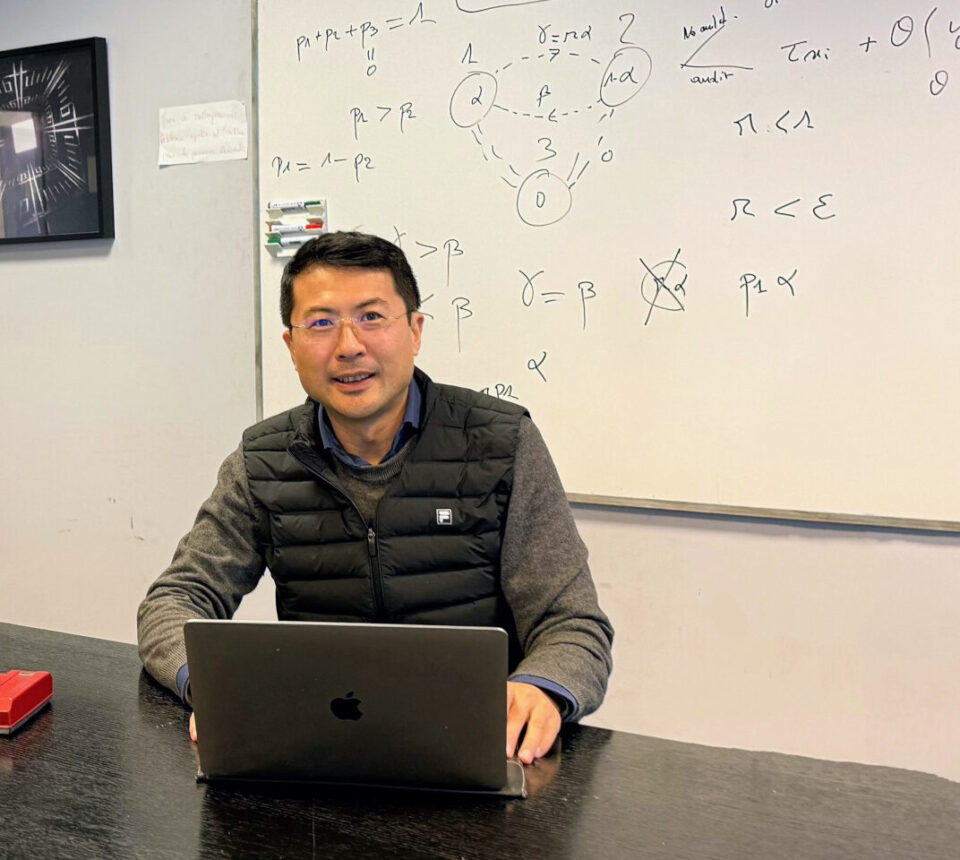
It's not easy to arrange a meeting with him. Everything is happening at once for economist Zhi Li, who is finishing his six-month stay at UM as part of the Visiting fellows program at the MAK’IT Institute and is preparing to return to China. The researcher is, in any case, a very busy man. Whether some people like it or not, the environment remains on the agenda of economists. At least for Zhi Li and his colleagues, who are determined to promote environmental goods and services so that they carry weight in political calculations.
“I have a background in science—specifically atmospheric sciences,” Zhi Li states right off the bat, emphasizing his environmental focus. “But I’ve always been interested in human behavior. ” So off he went into the social sciences, which took him to the United States for seven years, from which he returned with a master’s degree in environmental and natural resource economics and a thesis in economics. His focus is therefore no longer on modeling climate phenomena but on the behavior of economic actors, with the aim of developing tools for natural resource management and environmental protection.”
Save the Meadow Bunting
He combines this theoretical research—which draws in particular on game theory—with experimental field research.“Together with my colleagues, we have worked with the American NGO The National Audubon Society to save the meadow harrier on the U.S. Northeast coast by designing a to encourage citizens to invest in protecting the habitat of this songbird,” says Zhi Li.
The economist then went on to cite two initiatives on an entirely different scale: China’s carbon and water markets.“I am involved in providing technical support for the design of China’s national carbon market system, which requires decisions on the initial allocation of carbon credits and their price…,” explains the researcher. As for water, there has indeed been a national market for this resource in China since 2016:“How should water rights be reallocated for optimal allocation? What share should be left to the market, and what shareshould remainunder government control?” the economist explains.
Voluntary Carbon Credit Mechanisms
With no shortage of topics to explore, Zhi Li is also working on designing multi-factor environmental credit markets—in other words, situations where a single action contributes to multiple benefits and thus to an equal number of credits:“For example, a farmer who produces both carbon credits and high-quality water.” This is known as “credit stacking” in the industry.
This work overlaps with that of laboratories in Montpellier. In 2024, Zhi Li and his Chinese colleagues are invited by Cee-m to a seminar at the University of Montpellier. Then in 2025, it is the turn of the Montpellier researchers to visit Xiamen University. When the MAK'IT Institute opened residencies on the theme of ecological transition and water, in an interdisciplinary setting, Zhi Li ticked all the boxes in the call for projects. And he was selected for the Visiting fellows program. Since then, he has strengthened his local collaborations: "With Cee-m, we are working on voluntary carbon credit mechanisms. And with G-eau, we are working on the impact of water policies on farmers, with field surveys planned in Europe and China." These partnerships will continue in the years to come.
Happy to be returning to China? Against all expectations, life in Montpellier reminds him of his hometown—a coastal life where he also walks along the river to reach the sea. As we finish a slightly lukewarm cup of oolong tea, Zhi Li talks about his love for French culture, which was nurtured in his youth by the adventures of Jules Verne—“Around the World in 80 Days changed the way I look at life”—and later by the novels of Hugo and Balzac. He even decided to start learning French before his arrival so he could read them in the original. These early basics were certainly not in vain, as he tells us in one final anecdote: while waiting for the tram in front of the Agora de la Danse, he understood a lady’s unlikely invitation to accompany her to a concert. And he accepted.
News

Montpellier Global Days 26: A Dialogue Among Cultures
Published on: July 2 , 2026
On June 23 and 24, the University of Montpellier and its partners in the program of excellence…