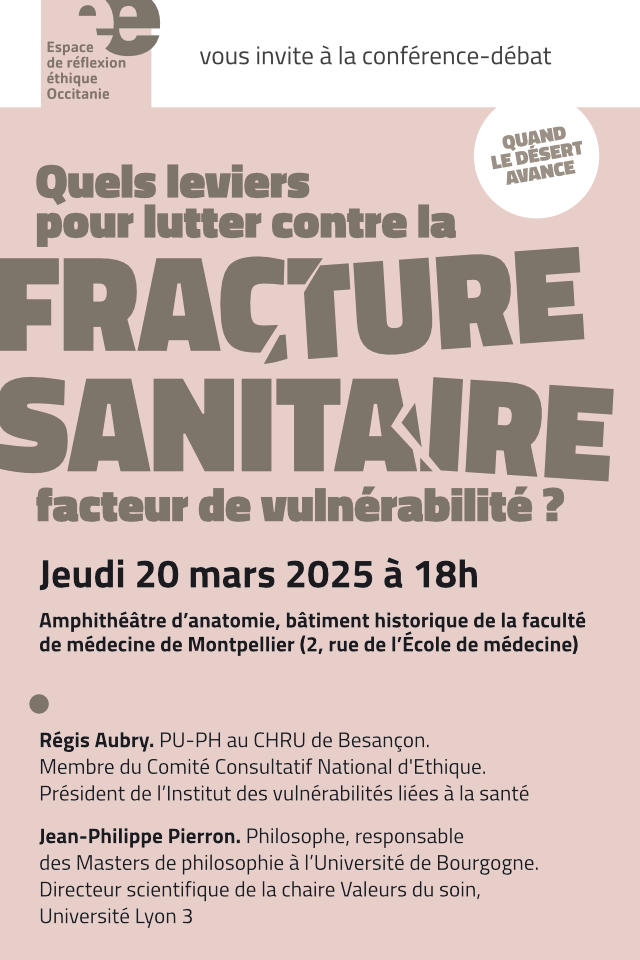
As the desert advances… What measures can be taken to combat the health divide, a factor contributing to vulnerability?
This event has already taken place!
Vulnerability isn't always where you'd expect it to be.
While it is certainly common to all individuals, it is not evenly distributed. In recent decades, the term has become widely used and is closely associated with exclusion and precariousness. It is used to describe the risks we face in a context of growing uncertainty and our inability to control them.
Some situations of vulnerability are obvious (disabilities, chronic illnesses, childhood, and old age, etc.). Others, which have emerged more recently, are less widely recognized. This is the case for people living in areas with a shortage of medical care.
A growing healthcare divide… 30% of French people live in a medical desert.
There is broad agreement that regional disparities in access to health care have worsened. For the past thirty years or so, public policies have failed to reverse this trend.
… and reveals a new form of vulnerability. The loss of opportunities resulting from this growing inequality in access to care is an intolerable violation of the republican pact and the social contract. Systemic change is essential in the face of such public health challenges. How can doctors’ civic responsibility better contribute to reducing regional inequalities in access to healthcare? What urgent measures must be taken to restore balance to the forces at play and level the playing field?
Admission is free with prior registration
Receive a weekly summary of theUM 's schedule
* By entering your email address, you agree to receive a weekly summary of the “UM ” calendar via email and acknowledge that you have read ourprivacy policy. You can unsubscribe at any time by using the unsubscribe linkor by contacting us via email.
News
"UM : Science" [S06-ep01]: Green Education, the Education of Tomorrow
Published on: September 14 , 2026
For this first episode of the new season, *A l’UM * explores the future of science with Sylvain Wagnon, a researcher…