Stories with and for Science
Between February and March, young visitors to Montpellier’s media libraries had the opportunity to discover three science-themed stories, the result of the “Science Tells Stories” residency. A collaboration between laboratories and artists organized as part of the project UM Via des sciences , certified under the “Science with and for Society” program.
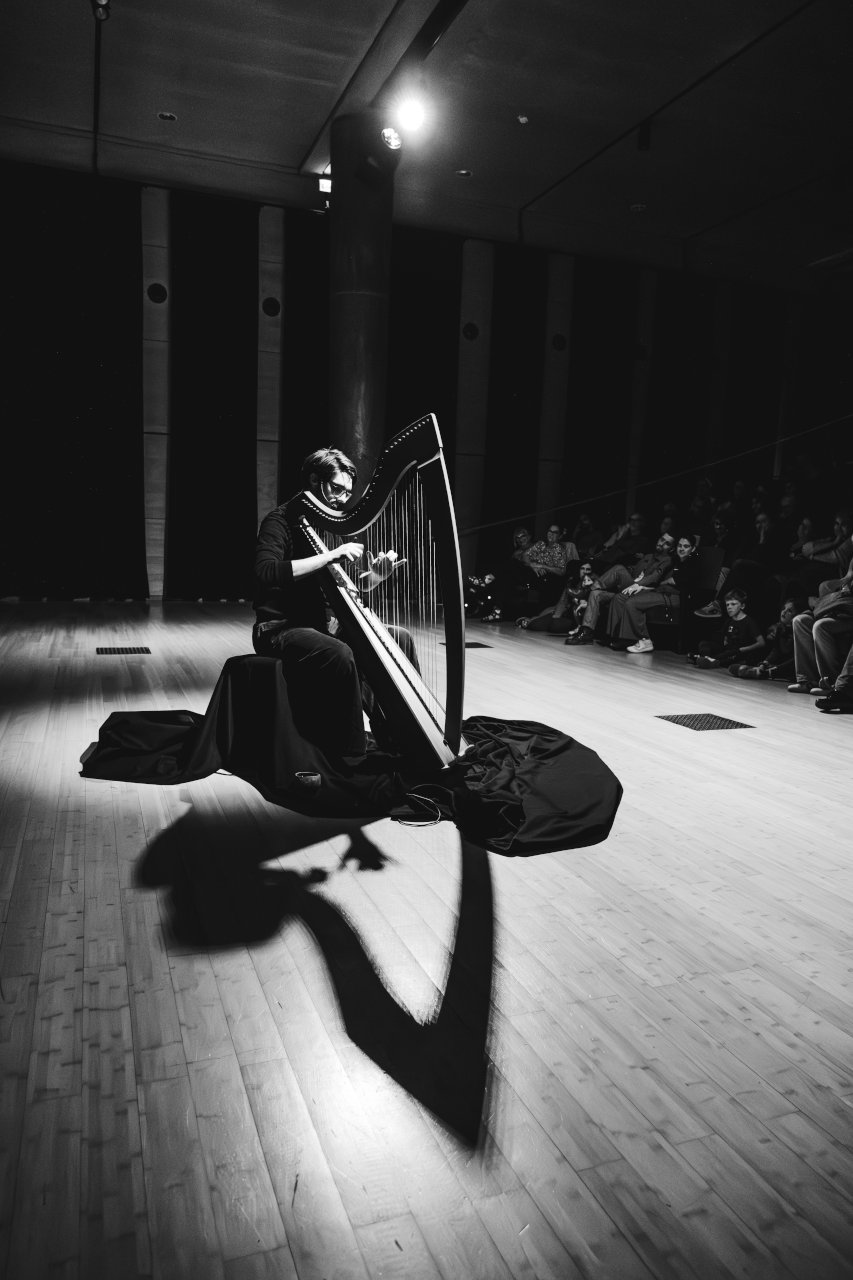
Three shows—all sold out! Nearly 500 people—children and parents alike—were able to hear and see *Lokili*, *Les mondes de l’eau*, *Cosmos des Minus*, and *Peut-on conter sur le moustique?* Three original stories aimed at children ages 6–11, performed at the Emile Zola Media Library and created as part of the“Science Tells Stories” residency, which began in 2025 in the laboratories of theUM and its partners, with support from the Montpellier metropolitan area’s network of media libraries and scientific culture initiatives. “To our knowledge, we are the first scientific university in France to organize a storytelling residency,” says Lou Deny , project manager for “Science with and for Society” at theUM.
Like all good ideas, this one is simple: form pairs or groups of three consisting of a storyteller and one or two researchers, and have them collaborate within the same laboratory. “ The storytellers were selected through an open call for applications, while we had already identified the researchers for theirs capacitys to popularize and share, the project manager explains. We then had them work together in a sort of “speed dating” setting to see who would get along with whom. "
Bringing the Magic Back to Science
Francine Vidal, from the theater company La Belle Aventure, caught the science bug alongside Mathieu Sicard, a researcher atISEM (Montpellier Institute of Evolutionary Sciences), and Claire Loiseau, a researcher at Mivegec (Infectious Diseases and Vectors: Ecology, Genetics, Evolution, and Control). Rémi Garcia Kerviel delved into the world of water with Caroline Lejars (CIRAD) and Géraldine Abrami (INRAE), a researcher and an engineer, respectively, at G-eau. Finally, Gwladys Batta took a back seat alongside microscopy specialist Marie-Pierre Blanchard, technical manager at MRI (Montpellier Imaging Resources).
Once the pairs were formed, each lab was able to establish the rules for the residency . “Some preferred to host the artist for a full week, while others split it into several one- or two-day sessions.” In the end, each storyteller was able to spend 22 days in residence at the lab between October and December 2025. (Read: Lokili: When Science and Storytelling Give Rise to a Tale of Water, INRAE) “The exchange centered largely on practical methods. The scientists told us that this experience had somewhat re-enchanted the way they view their work,” reports Lou Deny, who also discussed this collaboration on the Divergence radio show.
Stories to Pass On
Twenty-two days of incubation to bring these three stories to life before watching them take flight and live their own lives. “This residency is an experiment; the current result isn’t polished.” We hope that the storytellers will continue to carry their stories with them for a long time and that they’ll develop them further as they tell them and interact with the audience. Perhaps they’ll even pass them on to other storytellers,” the facilitator says.
A process intrinsic to this oral form that the storytellers were able to develop while working with undergraduate students in the “Science and Society” track from September through December 2025: “They taught the students to recount, in the form of stories, the scientific experiments offered to classes participating in the Univerlacitéprogram.”
Six elementary school classes thus benefited from these activities, which combined storytelling, hands-on experiments, and scientific discovery, right within the partner schools. And in February 2026, six other classes also participated directly at public libraries (Émile Zola in Montpellier, La Gare in Pignan, Françoise Giroud in Castries, Albert Camus in Clapiers, and Garcia Lorca). To share these workshops with us, Lou Deny herself took on the role of storyteller…
Gwladys in the Land of the Infinitely Small
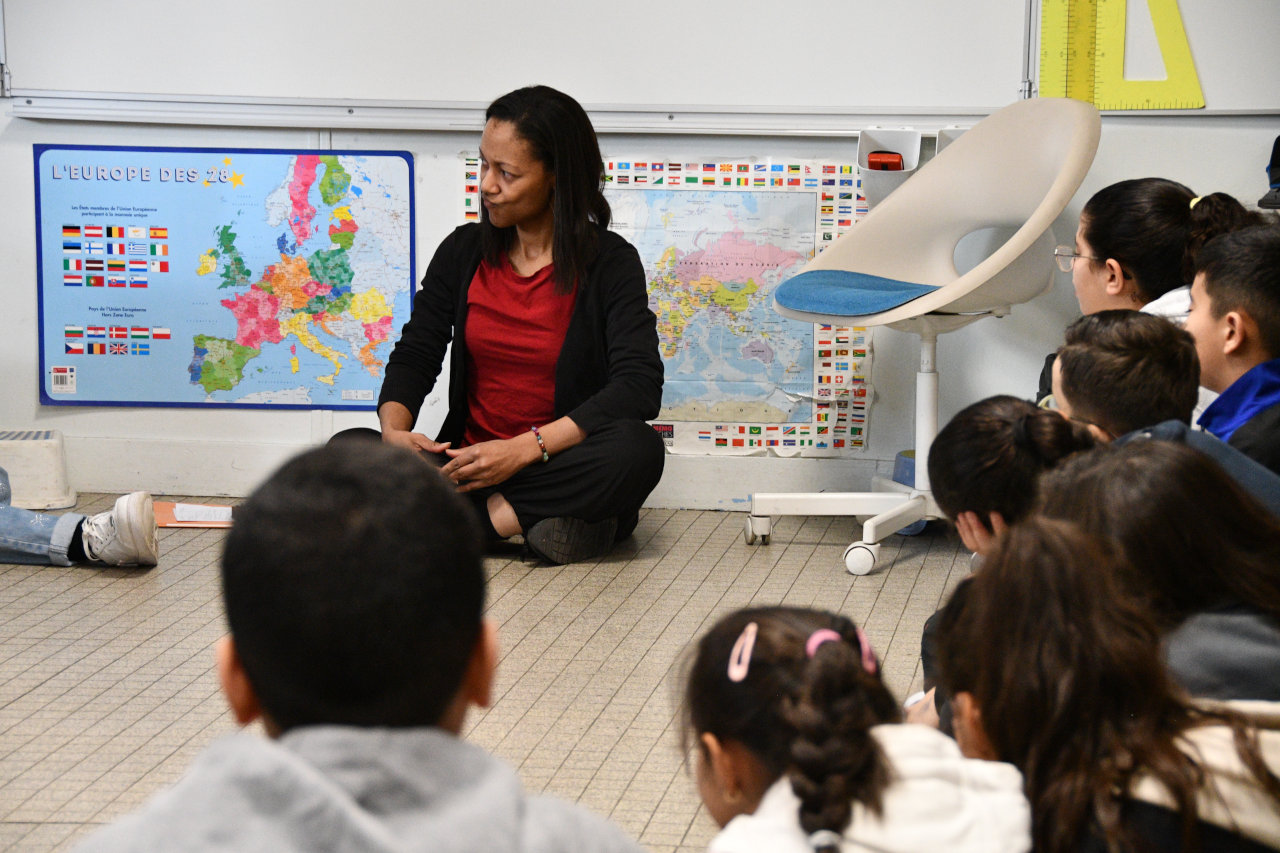
“I imagine a storyteller wearing a big fairy dress.” As soon as you walk through the door of Garcia Lorca Elementary School, little sparkling eyes are waiting to ask Gwladys Batta their questions. Is being a storyteller a job? “ We all tell stories, ” Gwladys replies.“ Today, it’s your turn to listen and make up your own.” She pulls out a small kalimba, and a gentle melody rises from her thumbs. Then… Not a sound. “This is my instrument for taking off to the land of stories…”
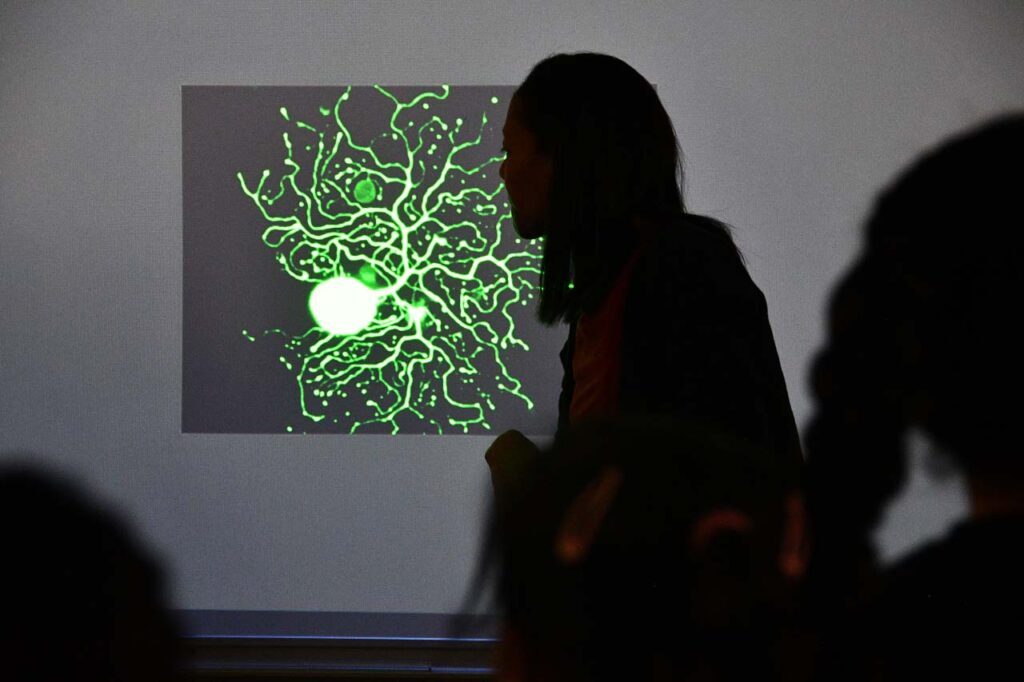
After a five-month residency at the Institute of Human Genetics, working alongside microscopy specialist Marie-Pierre Blanchard, Gwladys shares her experience through a game. She asks,“What do you think of as ‘very big’? An elephant, a giraffe, the universe, the sun? And what about ‘very small’? An earthworm, a microbe, a virus?” The children stand up, take on the role of the universe or the microbe, and line up from smallest to largest.
Then the instrument sets the pace of the story once more, and the storyteller continues:“Coralie has a pet fly.” We have to observe it, come up with theories, and wonder if it has feelings, if it could learn to read. With wide eyes and hands on their cheeks, the students react immediately: “I had a pet insect, too! ” Snails in boxes that eventually escape. Without even realizing it, they observe, research, and form hypotheses. The children tell stories, and without even realizing it, they’re already telling stories about science.
Rémi and the Island of Tales
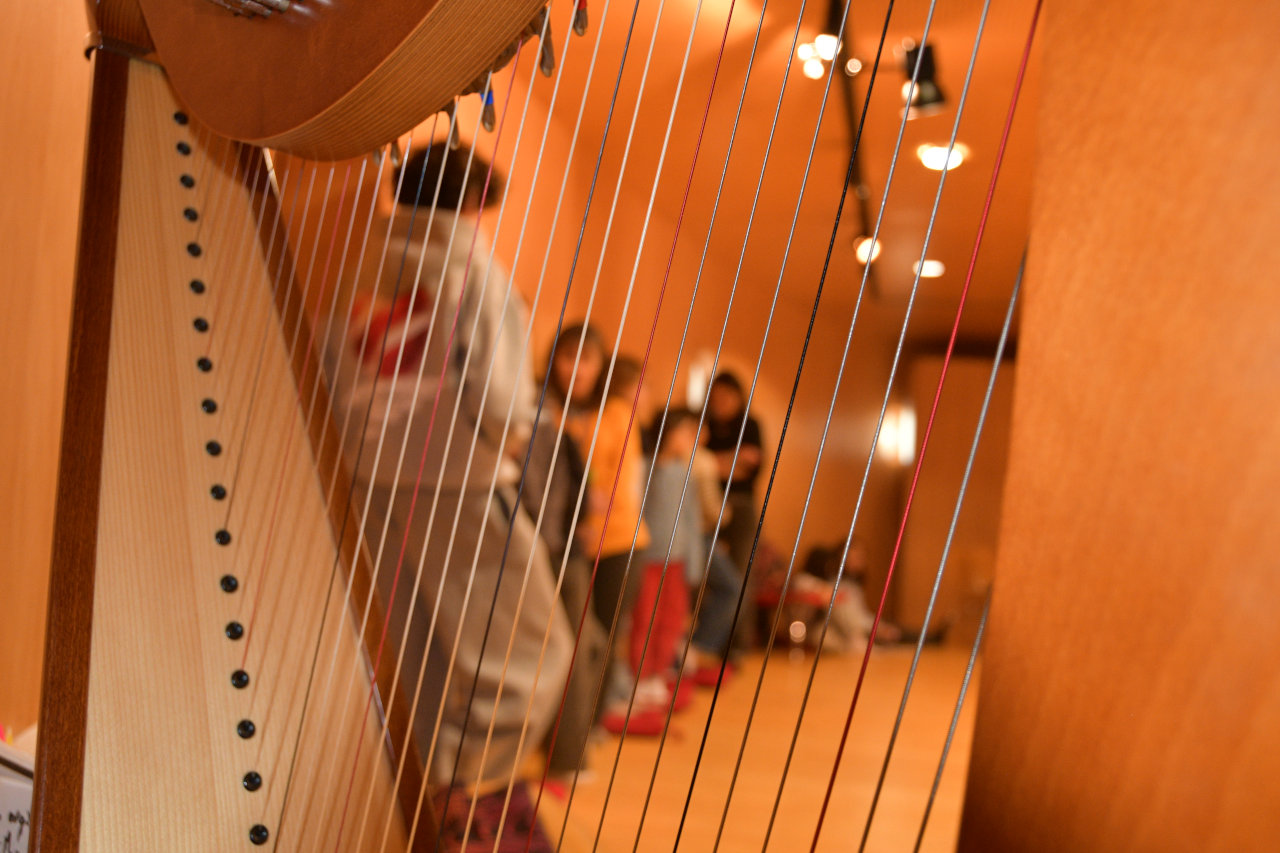
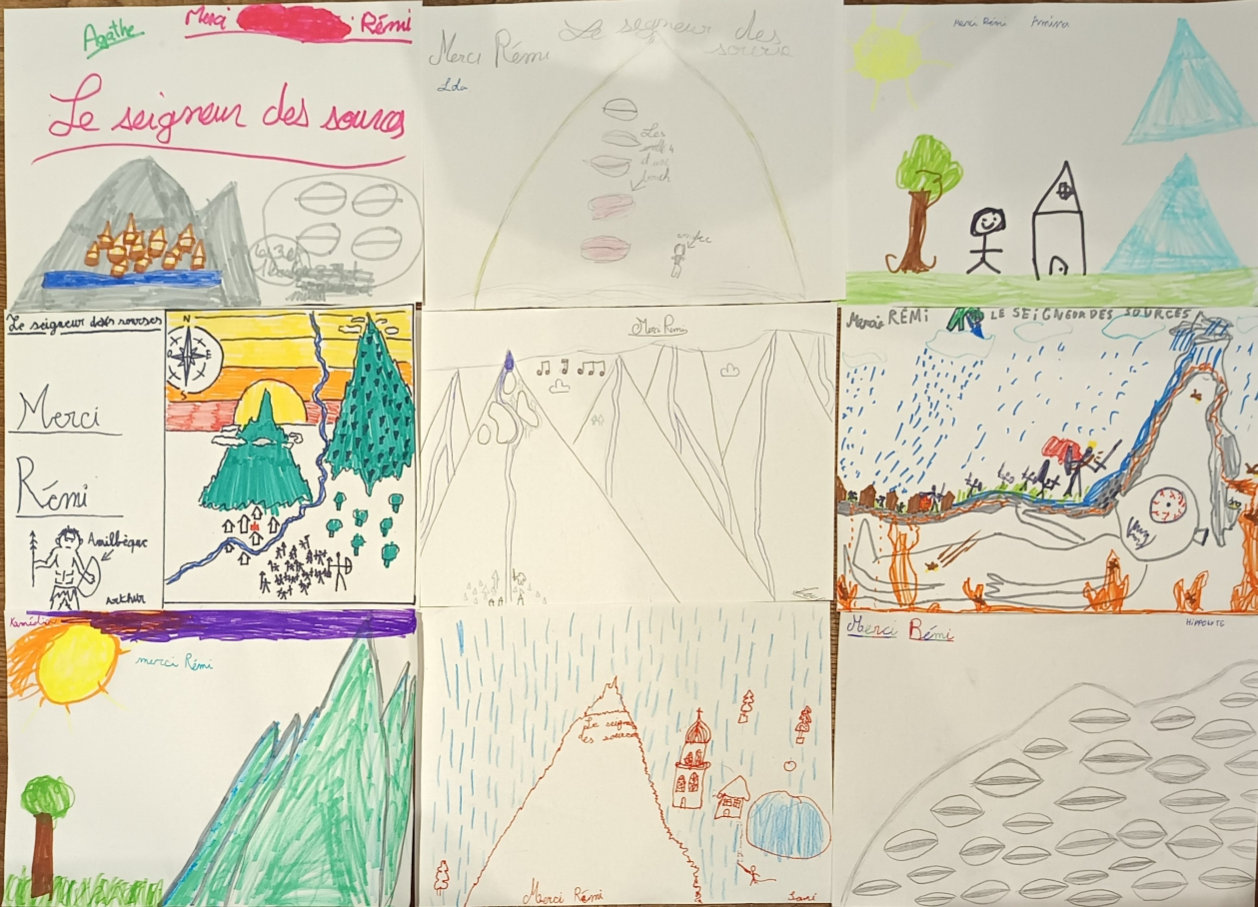
The shoes are lined up in front of the entrance to the small storytelling area at the Emile Zola Media Library. We take them off as if crossing a threshold, as if entering another world. Chuchoti, chuchota. A whisper: “My name is Rémi, and I heard my first story when I was your age, in the Forest of Brocéliande, in front of a tree. ” A personal revelation that says everything about this man and his relationship with stories. Not a room, not a stage: a tree. The forest as his first theater. The children want to know:
– What is the shortest story? And the longest?
– The longest story comes from the peoples who came before us—an attempt to describe the world as it is, to find the true name of each thing. The shortest story is the one yet to be born, the one that has not yet been told.
– Is there always a moral to the story?
Rémi doesn't like the idea that there's only one truth:
– Moral lessons vary by geographic region, culture, and individual. A fairy tale is not a sermon.
– Why is it important to know fairy tales?
– You spend the whole day telling stories, even on your phone. And when all hope is lost, it’s the stories that bring it back…
Francine and the Mosquitoes
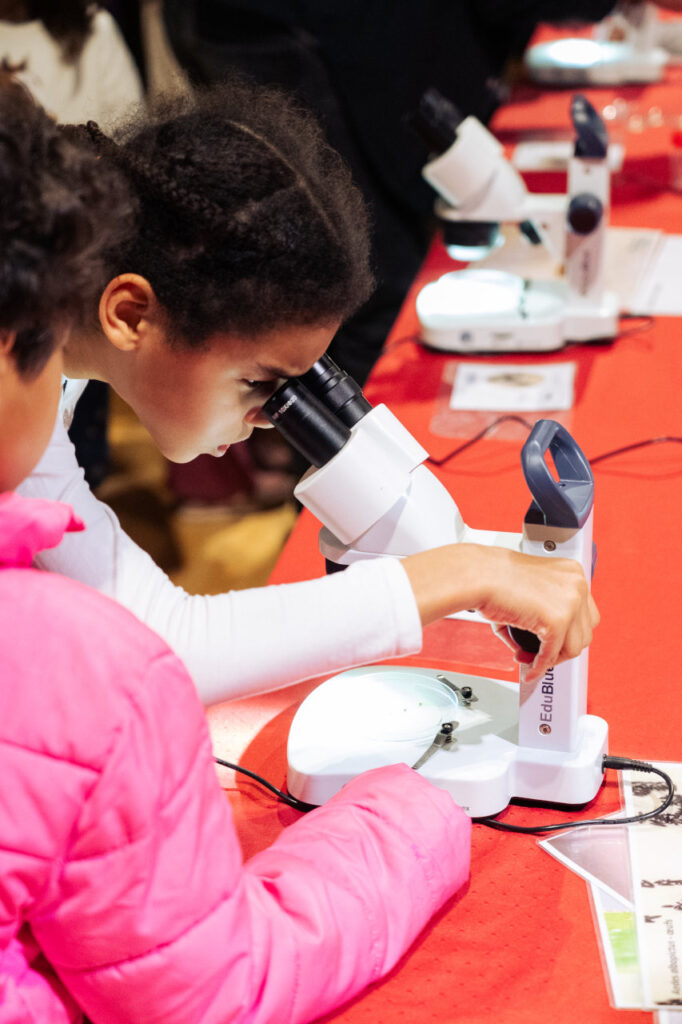
Francine Vidal and Chimène Mangoua Njonté, a sociologist at ISEM, invited three classes to the media libraries in Castries and Clapiers so they could“discuss things together.” As the conversation began with the form of the story itself, the children were quickly encouraged to share their thoughts on science: microscopes, Albert Einstein, test tubes, rats, microbes, and… mosquitoes! This gave the sociologist the opportunity to share a traditional Cameroonian song and follow up with some facts about it.“There are 3,500 species of mosquitoes, only 100 of which bite humans!”
The session covers the diseases transmitted by this insect vector, as well as its role in the ecosystem as a food source for swallows, frogs, and spiders, and as a pollinator. “But how do mosquitoes make love?” Aquestion that only children seem to know the answer to—and one that the hour-long session wasn’t long enough to answer.
From Fairy Tales to Podcasts
To continue the adventure at home with the family, podcasts based on the stories from these educational sessions will delight listeners of all ages. The storytellers, joined by the scientists who participated in the residencies, perform a series of original tales centered on the themes of mosquitoes, water, and the infinitely small. Through stories that blend imagination and scientific knowledge, they invite young listeners to journey between science and storytelling. For 15 minutes, children ages 6 to 11 can listen intently and immerse themselves in imaginary and scientific worlds.
Coming soon to Spotify, Deezer, YouTube Podcasts, SoundCloud, and Apple Podcasts.