[LUM#16] Drip-Feed Savings
Irrigating crops with wastewater? Installing smart water meters for farmers? These are some of the approaches researchers are exploring to conserve water resources, of which the agricultural sector is a major consumer.
Turn off the faucet while brushing your teeth. Limit the time you spend in the shower. These are all everyday actions we can take to reduce our water consumption. That’s good, but clearly not enough on a global scale—especially when you consider that 50% of the water consumed in France is used by the agricultural sector. That figure rises to 70% worldwide.
“This is a major challenge because irrigation needs are increasing with global warming, particularly as we move northward, where we now have to irrigate certain crops that previously didn’t require it,” explains Nassim Ait-Mouheb*. Everywhere, the need for irrigation is arising earlier in the year and affecting more and more crops. “This is particularly true for grapevines, for which irrigation is now permitted in France, ” notes the researcher, a specialist in fluid mechanics and process engineering as applied to irrigation techniques.
And it is precisely an ingenious process that he is implementing to help reduce the pressure on our “blue gold” resource: the reuse of treated wastewater, more commonly referred to by the Anglicism “reuse.” The idea is simple: use non-potable wastewater from treatment plants to irrigate crops, thereby reserving high-quality water for consumption. “A solution to avoid conflicts over water use in certain cases, in a context where resources may be limited.”
Full-scale laboratory
While this alternative is promising, its implementation poses a real challenge that the researcher at the G-EAU laboratory has set out to tackle. Technological challenges, agronomic considerations, health concerns, social acceptance… the reuse of wastewater for agriculture raises many questions.
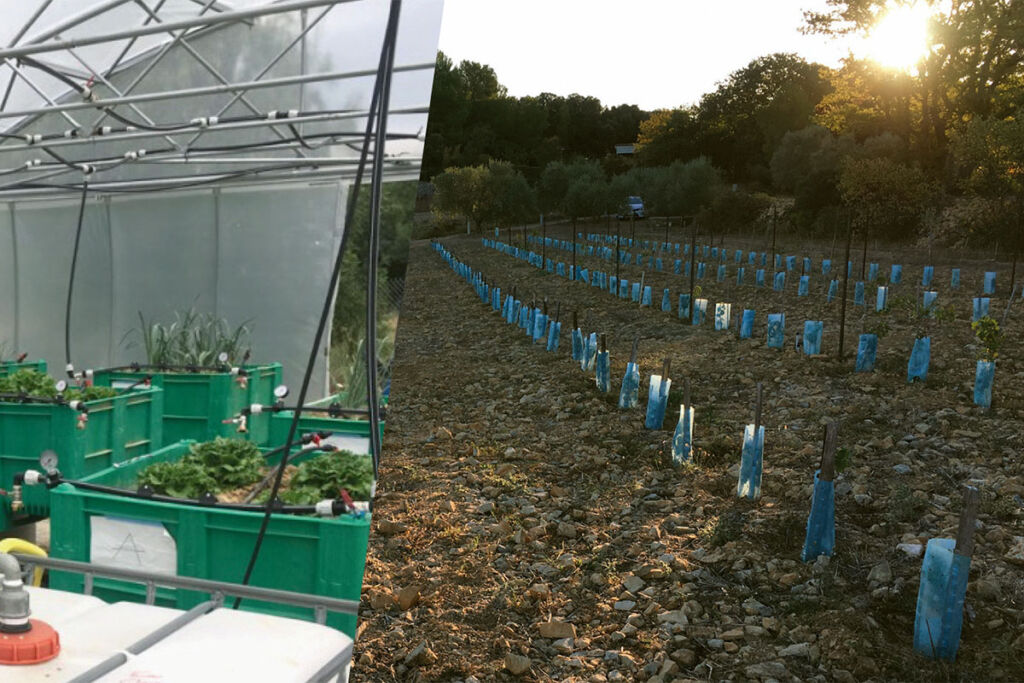
To address this, Nassim Ait-Mouheb has a full-scale laboratory at his disposal: a small plot of vineyards, olive trees, and fruit trees nestled in Murviel-Lès-Montpellier, which houses an experimental platform for reusing treated wastewater in drip irrigation. “A system of pipes running along the ground with drippers is a technique that’s increasingly being used and can lead to water savings, provided it’s implemented properly and its effectiveness and durability are ensured—particularly by avoiding the risk of clogging caused by biofilms.” In other words, the risk that all these systems will become clogged by accumulations of bacteria or other microorganisms found in wastewater…
Thanks to this platform—the only one of its kind in France, established in 2017—researchers can test the effects of this type of irrigation under real-world conditions: “We have a farm plot and an experimental site with above-ground tanks where we can irrigate crops either with wastewater that hasn’t gone through a treatment plant or with clean water,” explains Nassim Ait-Mouheb. The goal is to observe the effects of water quality on crops, from both an agronomic and a health perspective.
Drawbacks
From an agronomic standpoint, the results are quite positive: “We’re achieving good yields thanks to nutrients like nitrogen, phosphorus, and potassium, which occur naturally in wastewater, ” explains the specialist. From a health perspective, researchers are testing lettuce and leeks for residues of antibiotics, Escherichia coli, and enterococci. “Pathogen indicators are a key focus of our studies,” explains Nassim Ait-Mouheb. Another factor to consider is the impact of irrigation with wastewater on the soil, “which can be problematic due to its salinity, which may eventually degrade soil quality.” “Wastewater reuse offers a promising way to reduce water consumption in the agricultural sector, but numerous caveats must be considered before moving from theory to practice.” In Murviel-les-Montpellier, these challenges are being tackled head-on to make reuse a solution for the future. Currently in France, less than 5% of treated wastewater is reused, and even then only for very limited purposes.
Irrigation 2.0
To reduce their water consumption, some farmers have adopted smart meters. What makes them special? They allow farmers to track their water usage in real time, enabling them to better manage their irrigation and thus facilitate water sharing across a common network. Another benefit: these meters provide managers with frequent and accurate consumption readings. This data is invaluable for regulating water infrastructure and optimizing water releases from reservoirs. “For this system to be effective, a sufficient number of farmers need to adopt it,” explains Raphaële Préget. “But today, only a minority of farmers are equipped with these meters.”
How can we encourage them to adopt a smart meter? That is the question a researcher at CEE-M**(Montpellier Center for Environmental Economics) asked herself as part of the C4EAU project. “We surveyed 1,272 farmers to test various incentive mechanisms.” Among the instruments tested and approved was a conditional subsidy “that would be paid to farmers if, and only if, a certain number of them adopt the smart meter. It’s a way to spark a collective momentum for change by leveraging social norms, ” explains Raphaële Préget.
As part of these behavioral economics approaches, researchers also tested various “nudges”—small prompts, or “non-monetary incentives designed to guide choices without forcing them, ” the researcher explains. An example of a nudge? “We shared a testimonial from a farmer who had installed the technology and praised the benefits of smart meters. ” These are effective incentives for fostering greater cooperation, which is essential for managing a shared resource.
See also:
* G-EAU (CIRAD – AgroParisTech – IRD – INRAE – Institut Agro)
** CEE-M (UM – CNRS – INRAE – Institut Agro)
Check out theUM podcasts, now available on your favorite platform (Spotify, Deezer, Apple Podcasts, Amazon Music, etc.).