Leather Industry: A New Endowed Chair to Promote a Revolutionary and Sustainable Tanning Process
The University of Montpellier has launched the SICLE.e industrial chair, centered on an innovative silicon-based leather tanning process. It is one of the first projects in Occitanie to secure funding under the call for proposals for industrial chairs issued by theNational Research Agency (ANR). The project was identified during an awareness-raising webinar on “Joint Laboratories” organized as part of Montpellier’s University Innovation Cluster ( PUI), the project was subsequently supported by the university’s Directorate of Innovation and Partnerships (DIPA).
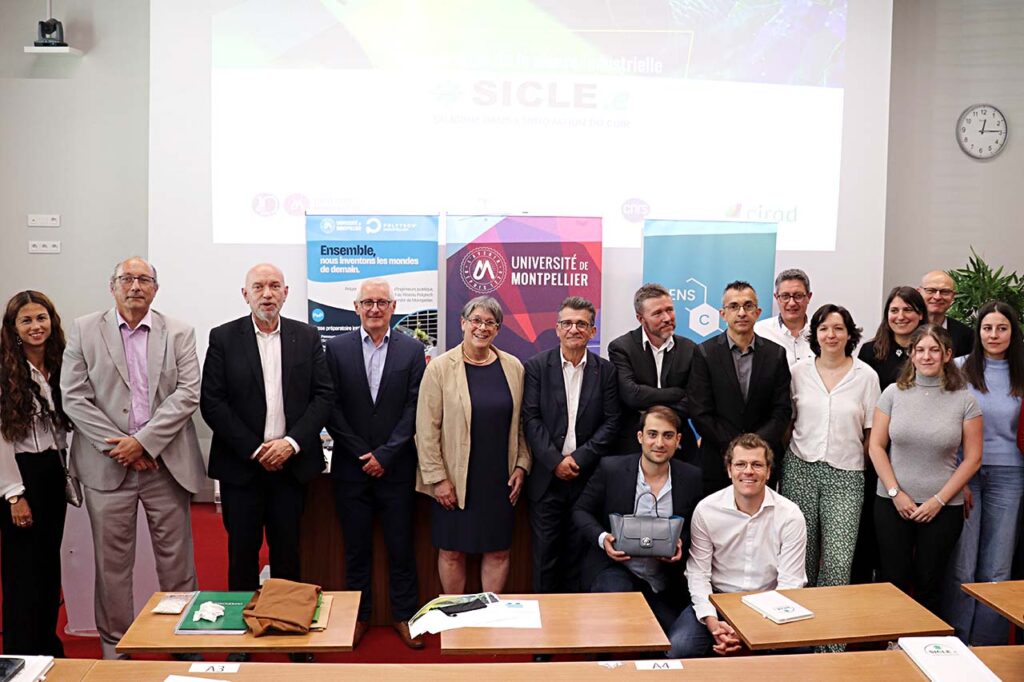
Although he was the one who brought the project to the ANR, Gilles Subra emphasizes that this new chair is the result of a truly “collective” effort. Inaugurated on Tuesday, May 20, at the University of Montpellier in the presence of President Philippe Augé, the SICLE.e Chair brings together multiple partners: the CTC Group,the Max Mousseron Institute of Biomolecules ( IBMM),the Charles Gerhardt Institute of Montpellier (ICGM), and CIRAD’s BioWooEB laboratory. Their goal: to promote a more sustainable leather industry by developing new technologies based on the use of silicon.
The story begins in 2021. At the time, behind closed doors in their laboratories, Ahmad Mehdi’s team at the ICGM and Gilles Subra’s team at the IBMM had already been working for several years on combining silicon and collagen, “in the context of health and regenerative medicine issues, ”says Gilles Subra, a researcher at the IBMM. So when a doctoral student on his team learned that the Leather Technical Center (CTC) was seeking partners to develop innovative tanning solutions, he and his colleagues stepped forward.“Since collagen is the main component of leather, we quickly realized that the techniques we were using for regenerative medicine could be applied to tanning hides,”he explains.
“Game changer”
Following this, the researchers and the CTC group agreed on three research contracts to launch the collaboration, followed by two patents in 2024, before jointly submitting this proposal for an industrial chair to the ANR that same year. “There were so many opportunities for development that it was impossible to continue with ad hoc contracts. We needed to give ourselves more time to explore new technologies and give the projects a chance to succeed; the chair was the perfect solution.” In short, a sustainable partnership and very promising avenues of research. “Among the requirements set by the ANR, there had to be a disruptive innovation—a ‘game changer’—and it had to be of interest to an entire economic sector, not just a single company. A chair implies an impact on an entire value chain,” explains Gilles Subra. After meeting all these criteria, in June 2024, the team became the very first recipient of the ANR’s Industrial Chairs call for proposals in the Occitanie region.
In practical terms, the company is on track to develop a genuine alternative to chrome tanning, which until now has yielded the highest-quality results despite its potential environmental impact. Unlike the metals used in most cases, silicon is an inexhaustible and non-toxic resource. “The core of our innovation is that silicic acid is capable of polymerizing when it enters the skin and creating networks between collagen chains. This is what transforms the skin into leather, giving it rot-resistant properties, ”explains Gilles Subra.
Two patents
Unlike traditional tanning methods, which produce a bluish-colored hide, silicon tanning yields white leather. “This makes it possible to create pastel shades that were previously unattainable.” Another significant advantage is that this process produces no toxic waste. Finally, the silica chains that stabilize the tanning process are capable of forming durable bonds with molecules of various properties, thereby“functionalizing”the leather in a sustainable manner. In short, it is possible to create antifungal leather using a molecule that can spread throughout the silica network, as well as water-repellent, fluorescent, or even “anti-counterfeit” leather by embedding an invisible mark that becomes visible when exposed to certain lights… This revolutionary aspect was the subject of the team’s second patent, following the first patent on the tanning process itself.
Although the team was already using these technologies before the chair was established, the University of Montpellier’s Office of Innovation and Partnerships (DIPA) helped put together the application for the ANR. “The DIPA took the lead in helping us draft the proposal, calculate the budget, and give us tips on how to best present our research…,” adds Gilles Subra.
Winning Over Luxury Industry Professionals
Going forward, the team hopes to move upmarket. “We know our technology can already be implemented in tanneries. Several of them are already using our process to train their employees. But we want to achieve a quality equivalent to that of chrome tanning in terms of suppleness, appearance, and feel, in accordance with the highest standards in the leather goods industry. Luxury industry professionals are the biggest clients; if we can convince them, the entire industry will follow.” The researchers also hope to improve the packaging and shelf life of silicic acid, which currently remains stable for only about fifteen days in a container. Finally, they will continue to make use of leather scraps and explore the myriad possibilities for waste recovery: extracting the silicon to compost the remains, using the hide to produce gelatin for the animal feed industry, developing new composite materials from unused scraps, or even transforming the waste into biochar—a type of charcoal used in agriculture to capture water in arid soils and regulate pH…
In total, the team consists of one full-time researcher, two doctoral students over the course of four years, and 12 master’s students each completing a six-month research internship. Not to mention the staff at the partner laboratories and the eight members of the CTC group dedicated to the project, which has a total budget of 4.5 million euros, including 1.04 million specifically earmarked for the industrial chair as part of the call for proposals.“If we make sufficient progress, we hope to see our first articles aimed at the general public as early as next year.”