Joël Singer: “Competition brings me joy and balance”
Joël Singer, a master’s student in Sports Science, took first place in the low kick event in the under-65-kilogram division at the French University Championships, which were held in Brest from January 31 to February 2, 2025.
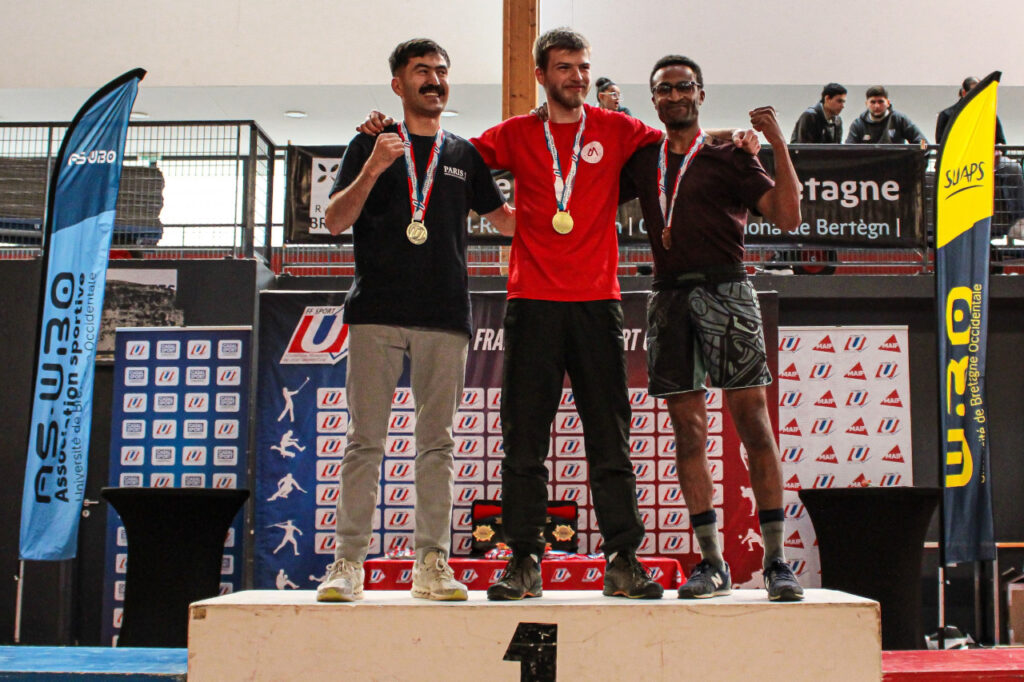
He isn’t very heavy, but he packed a punch, defeating all his opponents to climb to the top of the podium. His discipline? Low kick.“It’s a variation of kickboxing in which you can’t use knee strikes—only kicks and punches,” explains Joël Singer, who competed in the Espoir division. “It’s full-contact, which means the strikes are hard-hitting; knockouts are allowed and even sought after, since they’re a way to win the fight.” The other way? Scoring more points than your opponent by landing strikes powerful enough to be counted by the judges.
A discipline in which Joël Singer now excels, but which wasn’t his first choice in martial arts.“I started with taekwondo, but I wasn’t very good at sparring, and I wasn’t flexible enough: after 10 years, I still couldn’t do the splits! ” So in 2020, the young man took a slight detour that led him to Thai boxing, where“anything goes,” before finding his calling in low kick—a discipline in which he can make the most of both his kicks and a definite penchant for punching, which he fully expresses at the Body-Fighting Club in Montpellier, where he trains.
Fifteen hours of training per week
Joël Singer balances this passion with his academic studies in Sports Science at the University of Montpellier.“As an undergraduate, I had a lot of physical education classes. Between those and my club sessions, I was training fifteen hours a week,” recalls the young champion, who is now pursuing a master’s degree in research.“This year I have a little less time to train; I’m down to about six or seven hours a week.” That’s half as much as the previous year, but still enough to hold his own in the ring.
As for the future, the young athlete already has a very clear idea of his plan: a thesis aimed at quantifying training load in combat sports. This project allows him to combine his athletic practice with his studies, and he hopes to pursue it as part of a career in research. And what about his athletic career?“I’m already committed to my studies, a goal that takes up a lot of my time, which doesn’t seem compatible with a career as a professional athlete, but I’ll continue to compete. Competition is always something that drives me, motivates me, and broadens my skill set; it brings me joy and balance.”