Protecting coral reefs does not offset decades of decline in reef fish populations
An international study conducted by researchers from the University of Montpellier, the CNRS, and the IRD shows that, while marine protected areas improve biodiversity locally, they offset only a small portion of the losses caused by decades of human activity on tropical coral reefs. Published in the journal *Nature Ecology & Evolution*, this research underscores the urgent need to take action that goes far beyond simply creating new protected areas.
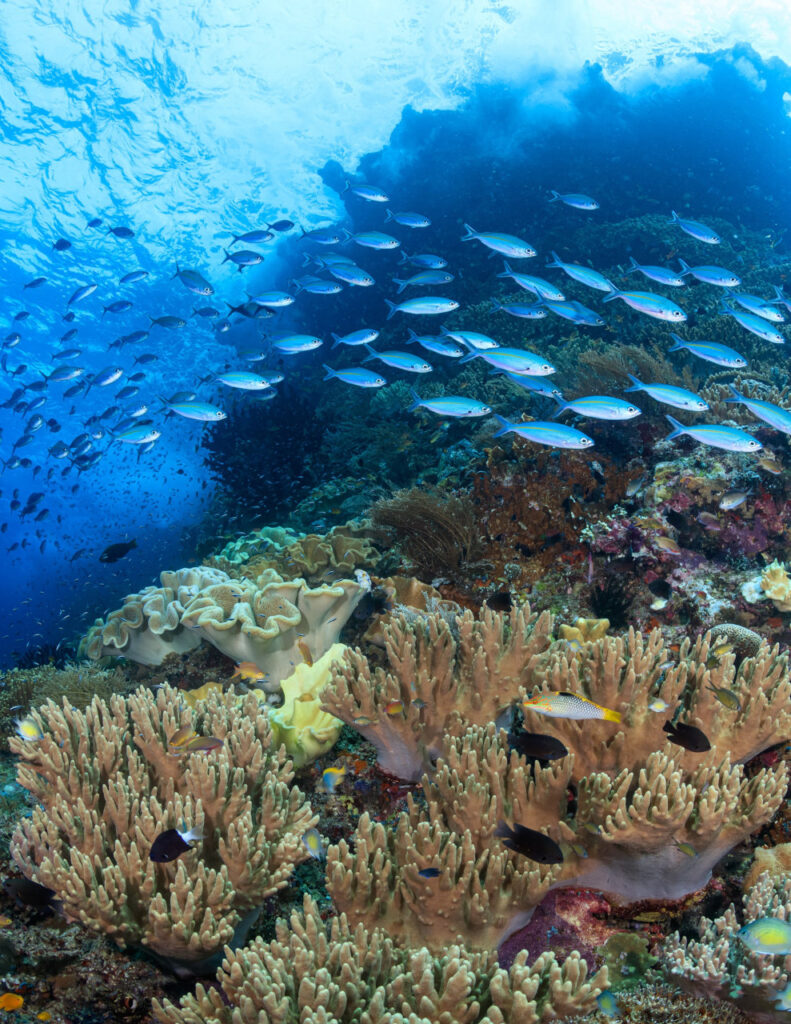
A Global Analysis of Coral Reefs
This study is the result of a broad international collaboration, based on data collected on more than 1,600 fish species in a wide variety of environmental and socioeconomic contexts. Thanks to the Reef Life Survey citizen science program, which has been operating globally for more than 18 years, researchers analyzed fish abundances across more than 2,800 tropical reefs. They assessed 22 major contributions made by reef fish, which are essential both to the proper functioning of reefs and to the well-being of human populations. These contributions relate both to the proper functioning of reef ecosystems—through balanced food webs, the presence of large predators, and high functional diversity—and to direct benefits for human societies, such as food resources, the nutritional quality of fish, and the aesthetic and cultural value of reefs.
Using innovative modeling tools, researchers have reconstructed what the reefs would look like today in the absence of human pressures. Their approach makes it possible, for the first time, to directly compare the extent of the impacts of human activities with the benefits of conservation efforts. The results show that the human footprint has profoundly altered these contributions.
Alarming Results and a Call to Change the Model
The lead author, Ulysse Flandrin, notes that “compared to estimates in the absence of human pressure, the biomass of large predatory fish has declined by more than 120% globally, while the biomass available for human consumption has declined by nearly 40%.” By comparison, the average benefits associated with marine protected areas remain limited: even within these protected areas, current measures would offset only about 29% of the losses in exploitable biomass and barely 5% of the decline in large predators.
Only long-established and strictly protected marine areas—where all forms of extraction have been banned for several decades—show significant benefits for biodiversity and human populations. However, this type of reserve remains rare on a global scale: the majority of marine protected areas still allow extractive activities or suffer from poor enforcement of regulations. Protection, while essential, acts slowly and locally, and cannot on its own reverse the trends of degradation observed on a global scale.
“Marine protected areas are essential, but our findings clearly show that they offset only a small fraction of the losses that have accumulated over decades. Increasing protection without reducing our overall impact on the oceans amounts to slowing down the degradation without actually reversing it,” explains Nicolas Mouquet.
These findings take on particular significance in the context of international goals aimed at protecting 30% of the ocean by 2030. “Even if achieved, this goal will not be enough to restore tropical reefs as long as global pressures continue to intensify,” emphasizes Ulysse Flandrin. The authors therefore call for a paradigm shift: the protection of marine areas must be accompanied by a drastic reduction in the human footprint across all oceans. Beyond coral reefs, this study proposes an innovative methodological framework for assessing the impact of human activities and the effectiveness of conservation policies.
Practical Information:
- Article publication date: March 6, 2026
- The full study: here
Bibliography: Marine Protected Areas Marginally Offset Anthropogenic Declines in Tropical Reef Fish Contributions to Nature and People – Ulysse Flandrin, Nicolas Mouquet, Nicolas Loiseau, Cyril Hautecoeur, Eva Maire, Matthew McLean, Loïc Sanchez, Ella Clausius, Rick Stuart-Smith, Graham Edgar, Camille Albouy, Joshua Cinner, David Mouillot – Nature Ecology & Evolution (2026)