[LUM#15] Water: A Challenge for Cities
Good-quality water in is not a given. It’s actually a crucial issue for African cities, whose populations grow day by day, yet lack the necessary infrastructure for water distribution and sanitation infrastructure to support this .
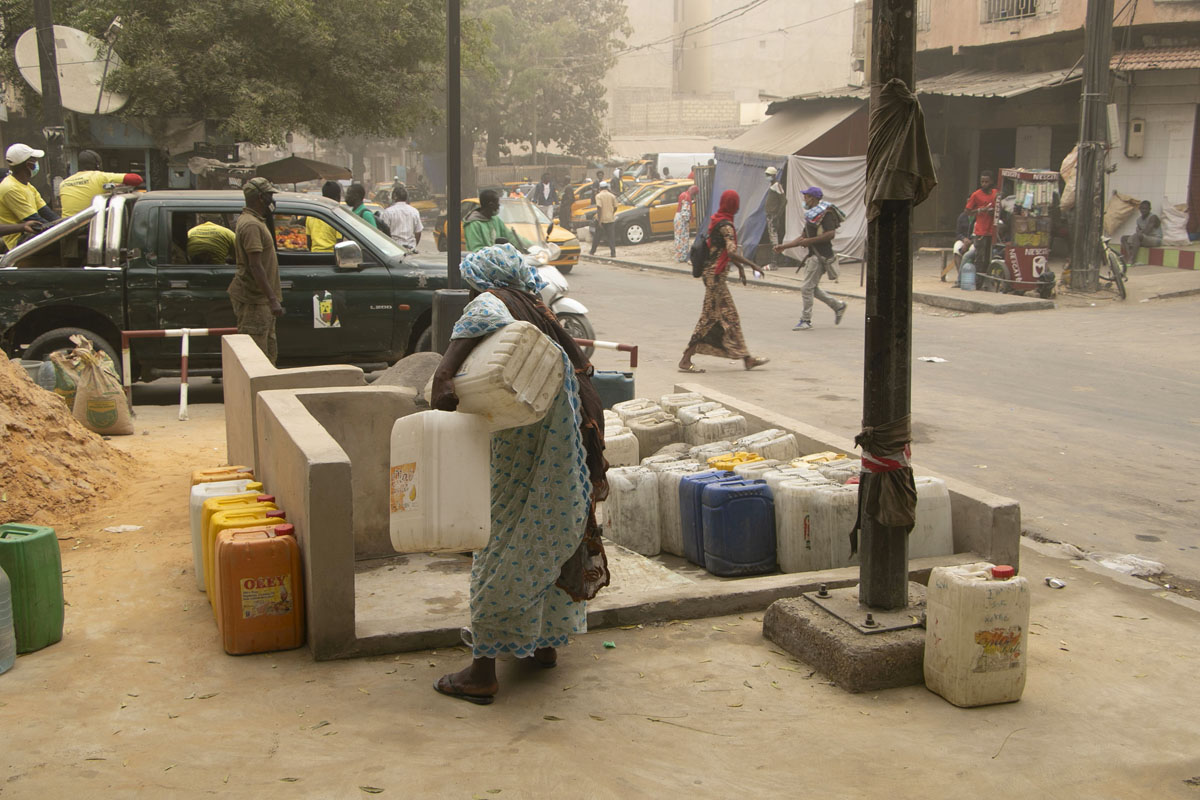
On the Blue Planet, more than 2 billion people lack access to good-quality water. The majority of them live in Africa, a continent of contrasts, where water is abundant in some places and critically scarce in others. “The entire sub-Saharan region is suffering from a worsening water shortage,” warns Eric Servat. “Groundwater levels there are very low, and some rivers have completely dried up, ” explains the director of the UNESCO International Center for Water Research and Education ( ICIREWARD). This critical situation is exacerbated by global warming, which is accompanied by a decline in rainfall.
Climate refugees
While access to water is a global issue, it is a particular challenge in cities, “a challenge we do not yet fully grasp,” notes Eric Servat. “That’s because thousands of people are leaving their lives in rural areas every day—areas that have become uninhabitable, whether due to climate change or other causes, such as terrorism, for example.” All of these climate refugees are settling in cities. As a result, urban populations are exploding, and megacities with more than 10 million inhabitants are multiplying.
While urbanization is a global trend—it is estimated that by 2050, nearly 70% of the world’s population will live in cities—this phenomenon raises issues specific to Africa. New urban dwellers there face a double burden: “They have left everything behind to come to these large cities, where they do not understand the social norms, and where they are crammed into precarious living conditions, often without access to safe drinking water.” The cause? “These cities are sorely lacking in infrastructure, particularly drinking water distribution systems and sewage systems,” explains Eric Servat.
Disease vector
This is a genuine public health problem, because while water is the source of life, it is also a major vector for disease. “In the absence of a sanitation system, polluted water seeps into the ground. It then directly pollutes the groundwater and contaminates a resource that is already scarce in some areas, ” explains Eric Servat. “On average, every day around the world, 1,400 children under the age of 5 die from diarrheal diseases often caused by water unfit for consumption, ” laments the hydrologist.
So how can we provide sufficient quantities of high-quality water? While there are membrane filtration and seawater desalination systems for producing drinking water, they are “far from being able to meet the entire demand.” Making water safe to drink and distributing it in sufficient quantities requires the construction of large-scale infrastructure to pump water from aquifers or draw it from lakes that are sometimes located very far away.”
Investment shortfall
Infrastructure is, in fact, a key component of the strategy for ensuring access to water. “Given limited resources, water is all too often treated as the poor relation in the policies implemented in African countries, ” notes Eric Servat. The result is a significant investment shortfall in this area and a glaring lack of infrastructure, which leaves people in a very precarious situation.
Kōichirō Matsuura had already made this observation years ago: “Despite the importance of water to all aspects of human life, the sector suffers from a chronic lack of political support, inadequate governance, and significant underinvestment, ” the former Director-General of UNESCO noted at the time. “Kōichirō Matsuura also emphasized the urgency of an action plan if we are to avoid a global water crisis,” adds Eric Servat.“ These words were spoken at the beginning of this century but remain highly relevant today!”
"Water-carrying chores" that weigh heavily on girls
Walking for hours to fetch drinking water. Walking farther and farther in search of this increasingly scarce “blue gold.” This is the daily reality for millions of young girls in Africa who are responsible for their households’ water supply. All those hours spent away from school, as Audrey Azoulay, Director-General of UNESCO, emphasized on World Water Day, March 22, 2020: “The time women and girls spend on ‘water chores’ amounts to hundreds of millions of hours during which they are not in school and are denied access to an education that could empower them and help them become responsible citizens free to make their own choices.”
“Women’s role in relation to water has a real impact on society, particularly in terms of democracy,” adds Eric Servat. The director of the UNESCO International Center for Water has therefore decided to get involved in this cause. “We have contacted two UNESCO Chairs working on the issue of water and gender in Togo and Côte d’Ivoire, which have been active in the field for 15 years,” explains the researcher, who hopes to establish partnerships with these Chairs, which will be represented at the New Africa-France Summit in October 2021 in Montpellier. This effort also involves training: “The scientific community in the Global North can, in particular, contribute to the training of female students in the field of water.”
Check out theUM podcasts, now available on your favorite platform (Spotify, Deezer, Apple Podcasts, Amazon Music, etc.).