[LUM#23] Arboviruses: A Reminder
Chikungunya, Zika, West Nile virus… these exotic names are now part of our vocabulary and our health risks. For while these diseases were long confined to distant latitudes, they are now taking hold in our regions as a result of global warming.
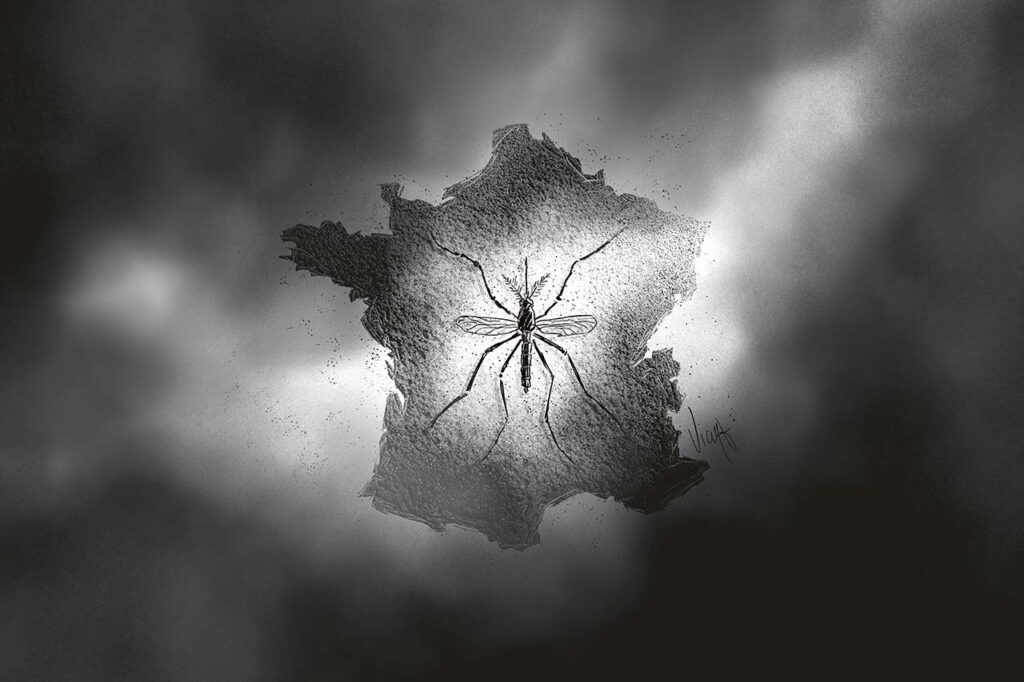
In 2010, France saw its first cases of chikungunya (Le Monde, September 25, 2010). In 2019, unprecedented cases of patients infected with the Zika virus were reported (Institut Pasteur, November 4, 2019). These infections immediately drew the full attention of health authorities, and for good reason: this was the first time that indigenous cases of these diseases had appeared in metropolitan France—meaning that the patients did not bring the virus back from a distant trip, but were infected here, without even crossing the border.
Since then, the number of cases has continued to rise. “More than 700 cases of chikungunya were reported in mainland France in 2025, while the West Nile virus has claimed 40 lives in Europe this year, ” explains Yannick Simonin, a virologist at the Pathogenesis and Control of Chronic and Emerging Infections (PCCEI) laboratory. And these are only the diagnosed cases. Experts estimate that the majority of infected patients go undetected because these viruses mostly cause flu-like symptoms.
Mosquitoes in the crosshairs
But why are these diseases taking hold in countries that were previously free of them? “These outbreaks are caused by a specific group of viruses known as arboviruses, which are transmitted to humans through insect bites, including those from mosquitoes,” the researcher explains. In the researchers’ sights: the tiger mosquito, Aedes albopictus, which transmits Zika, chikungunya, and dengue, among others, but also our “local” species, Culex pipiens, which is a vector for the West Nile virus. “All the conditions are in place for an explosion of arbovirus diseases, driven in particular by global warming, ” warns Yannick Simonin.
First reason: rising temperatures are causing mosquitoes’ range to expand. Aedes albopictus is now present in 80 metropolitan departments, and experts estimate that it will be found throughout France within a few years. “Not only are mosquitoes colonizing more areas, but they’re also present for longer periods throughout the year, which automatically extends the window for disease transmission, ” explains the virologist.
Mosquitoes are also living longer. “When temperatures are high, up to a certain threshold, individual mosquitoes live longer, which also increases the risk of transmission, ” explains Yannick Simonin. To make matters worse, heat increases the mosquito’s metabolism and thus the rate at which viruses multiply. And that’s not all: “The alternating dry and wet periods observed with climate change promote the formation of larval breeding sites and mosquito egg-laying,” adds Yannick Simonin.
Everyone's business
What can be done to protect ourselves from this threat? For Yannick Simonin, the fight against mosquito-borne diseases starts with prevention. “Institutions aren’t ready, but neither are we as citizens. People clearly perceive the nuisance caused by mosquitoes, but not the health risk associated with their bites. A real shift in awareness is necessary because citizen action is likely the most effective.”
The researcher believes it is necessary to better inform the public so that everyone can take steps to protect themselves from bites, “by wearing long, loose-fitting clothing or using mosquito nets.” But also to limit breeding sites, “individually, in our homes and gardens, but also collectively, by better planning urban developments, such as rooftop terraces where water can pool or urban greening that can provide shelter for mosquitoes.”
These measures could well make a difference, especially as the Directorate General for Health works to better inform doctors about the risk of arboviral diseases and ANSES—the French Agency for Food, Environmental and Occupational Health & Safety—has established a working group on the likelihood of mosquito-borne disease outbreaks in mainland France. “Ultimately, preventing arboviral diseases is everyone’s responsibility.”
A blessing in disguise
While Europe is the region most affected by the increased risk of arboviral diseases, other parts of the world may actually see these diseases decline as a result of global warming. “Mosquitoes cannot regulate their body temperature, and while they die when it’s too cold, they also cannot survive when it’s too hot. Certain countries in Africa or southern Spain could therefore see a decline in mosquito-borne diseases in the coming years,” explains Yannick Simonin. A small consolation indeed…
UM podcasts are now available on your favorite platform (Spotify, Deezer, Apple Podcasts, Amazon Music, etc.).