[LUM#23] A Hefty Bill for the Oceans
By the end of the century, marine biomass will decline by 20% if greenhouse gas emissions continue at the current rate. This is the finding of an extensive modeling study conducted by scientists from the Fishmip project, including Yunne Shin, a researcher at the Marbec laboratory. Their results serve as a warning about the scale and speed of the changes underway.
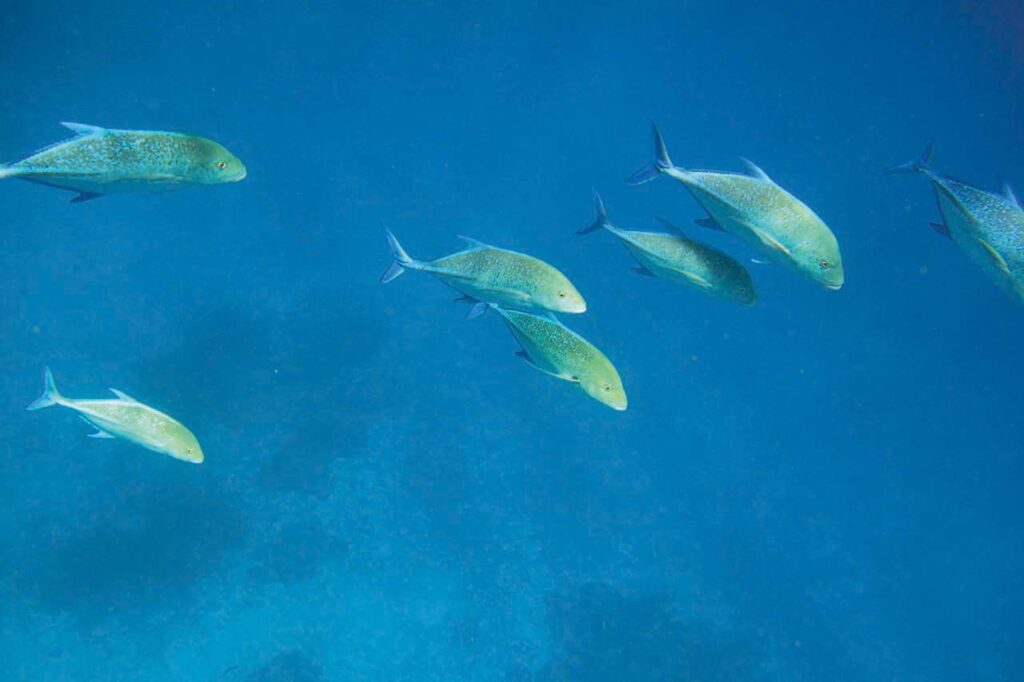
Faced with an ocean that is changing before their very eyes, some 100 researchers involved in the Fishmip project are sounding the alarm (Global and regional marine ecosystem models reveal key uncertainties in climate change projections, Earth’s Future, March 2025). Their models integrate the physical and biogeochemical changes in the ocean with numerous indicators of marine life: fish physiology, migrations, primary production… As a result, the shift of fish species toward the more temperate waters of the poles is expected to continue, gradually depopulating the entire intertropical zone. “Yet it is in these regions that populations depend most on marine resources for their protein intake,” emphasizes Yunne Shin, one of the project’s key contributors. More broadly, fish stocks will be profoundly altered everywhere in the coming years (Detection, Attribution, and Projection of Global Marine Ecosystem and Fisheries Changes: FishMIP 2.0, Earth’s Future, December 2024).
1,677 endangered marine species
In this context, one of the challenges is to quickly raise public awareness.
This is the purpose of the Starship Barometer, launched in 2025 at the United Nations Ocean Conference (UNOC) in Nice. “Every year, it provides key figures on the state of the oceans, our dependence on this ecosystem, and its management, ” explains Yunne Shin. The key figure to remember is 1,677 marine species threatened with extinction. Among them are large demersal carnivores. “A study shows that creating marine protected areas off-limits to fishing across 10% of the Mediterranean Sea’s surface would help sustain these populations despite climate change, ” explains the researcher.
In this enclosed sea, biodiversity loss is particularly critical due to recurring heat waves and overfishing. And since they cannot migrate northward because of the continental barrier, many species will disappear as the climate warms. According to projections from the Osmose marine model developed by Marbec, the northwestern region will gradually become depopulated. In the east, however,
ecosystems are becoming more tropical: “The water is warmer in the eastern part of the Mediterranean, and many thermophilic and exotic species arriving via the Suez Canal are expected to see their biomass skyrocket, ” explains Yunne Shin, noting that the current model does not yet account for trophic interactions between invasive and endemic species.
Two possible futures
With the aim of further raising public awareness, Marbec has developed an educational board game, *Osmose*, which invites players to take on the role of a fish, a fisherman, or a manager to better understand the dynamics of marine ecosystems. A short science-fiction film was also produced to transport viewers to the end of the century, presenting two possible scenarios. One continues the current situation, while the other envisions a carbon-free society.“All the visual elements were co-created with stakeholders in the fishing and conservation sectors of the Gulf of Lion to bring these two possible futures to life: the boats, the fishing methods, the social organization of work…,” explains Yunne Shin. Light fishing boats for a local market or a giant automated vessel for an elite market—we’ll let you choose!
UM podcasts areUM available on your favorite platform (Spotify, Deezer, Apple Podcasts, Amazon Music, etc.).