[LUM#23] The Underbrush Under Surveillance
Between 2014 and 2024, the temperature in the understory of Guyana’s tropical forests rose by an average of 0.037 degrees. While the protective effect of the canopy persists, it does not offset global warming and is even beginning to wane, as explained by Sylvain Schmitt, a researcher at Forêt et Société, explains.
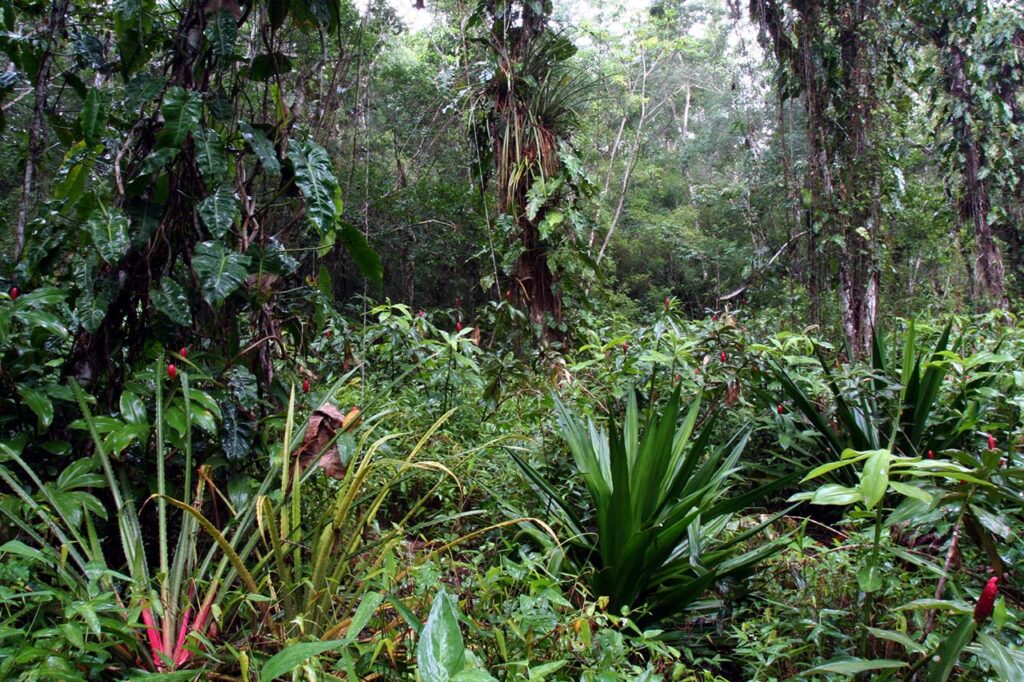
In French Guiana, a multitude of plant and animal species thrive beneath the forest canopy. Among them is *Pristimantis espedeus*, an endemic tree frog that finds in this understory a cool haven without which it could not survive.“The forest is a vertical structure, with a first layer of vegetation that acts as an interface between the atmosphere and the forest, thereby creating a buffering effect. Beneath this canopy, the understory consists of young trees as well as shorter species that require little light and thus benefit from a cooler, more humid microclimate,” explains Sylvain Schmitt, a specialist in forest ecosystems at the Forests and Societies Laboratory.
Buffer effect
But in the era of climate change, does this buffering effect of the canopy still protect the understory? To find out, Gabriel Hes, a doctoral student at the University of Toulouse, compiled data from numerous studies conducted in French Guiana, including one co-authored by Sylvain Schmitt (Temperatures in the understory of eastern Amazonian forests reached a record high in 2023–2024, *Scientific Reports*, 2025), to create a 10-year time series of air temperatures (2014–2024). This marks a first in the study of these ecosystems.“These data come from about 100 sensors installed in various areas of the forest in the eastern Amazon,” explains Sylvain Schmitt. “This is of crucial importance to us because the effect of climate change on the understory is poorly documented in both tropical and temperate zones.”
And the results clearly confirm that the canopy continues to act as a buffer for the understory, with“a smoothing out of both high and low values when comparing the temperatures of these microclimates with those of the macroclimate.”Nevertheless, a significant upward trend is still observed, with an average increase in understory temperature of 0.037 degrees per year, compared to +0.057 degrees outside the understory.“The buffer is definitely there, but it does not offset the overall rise in temperatures, which therefore also affect the understory,” notes the ecologist.
El Niño, La Niña
Most strikingly, the 2023–2024 season stands out as an exceptional one, marked by record-breaking drought and heat ranging from +0.7 to +1.6 degrees. This anomaly can be attributed to the El Niño oceanographic phenomenon, but it remains a cause for concern, as Sylvain Schmitt points out: “This type of phenomenon, which prolongs and intensifies the dry season, is observed repeatedly, but with global warming, there is reason to fear an increase in the frequency and intensity of these episodes.” Thesechanges could cause the metabolic functions of these ecosystems to cross a tipping point.
In contrast to these periods of drought, the La Niña phenomenon—characterized by an anomaly in the surface temperature of the Pacific Ocean—brought heavy rains in 2022.“That year ,we observed significant flooding of the forest, followed in French Guiana by widespread die-off, with trees gradually losing all their leaves,” laments Sylvain Schmitt. These rain events could also increase in frequency and intensity. “It rains, it gets wet,” as the nursery rhyme goes—it remains to be seen whether Pristimantis espedeus will still be part of the party.
Check out theUM podcasts, now available on your favorite platform (Spotify, Deezer, Apple Podcasts, Amazon Music, etc.).