Polytech, an engineering school at the university
Backed by a national network,the engineering school focuses on a selective curriculum that is closely aligned with the business world and technological innovations. The result: record-high employment rates for its students and a well-established reputation.
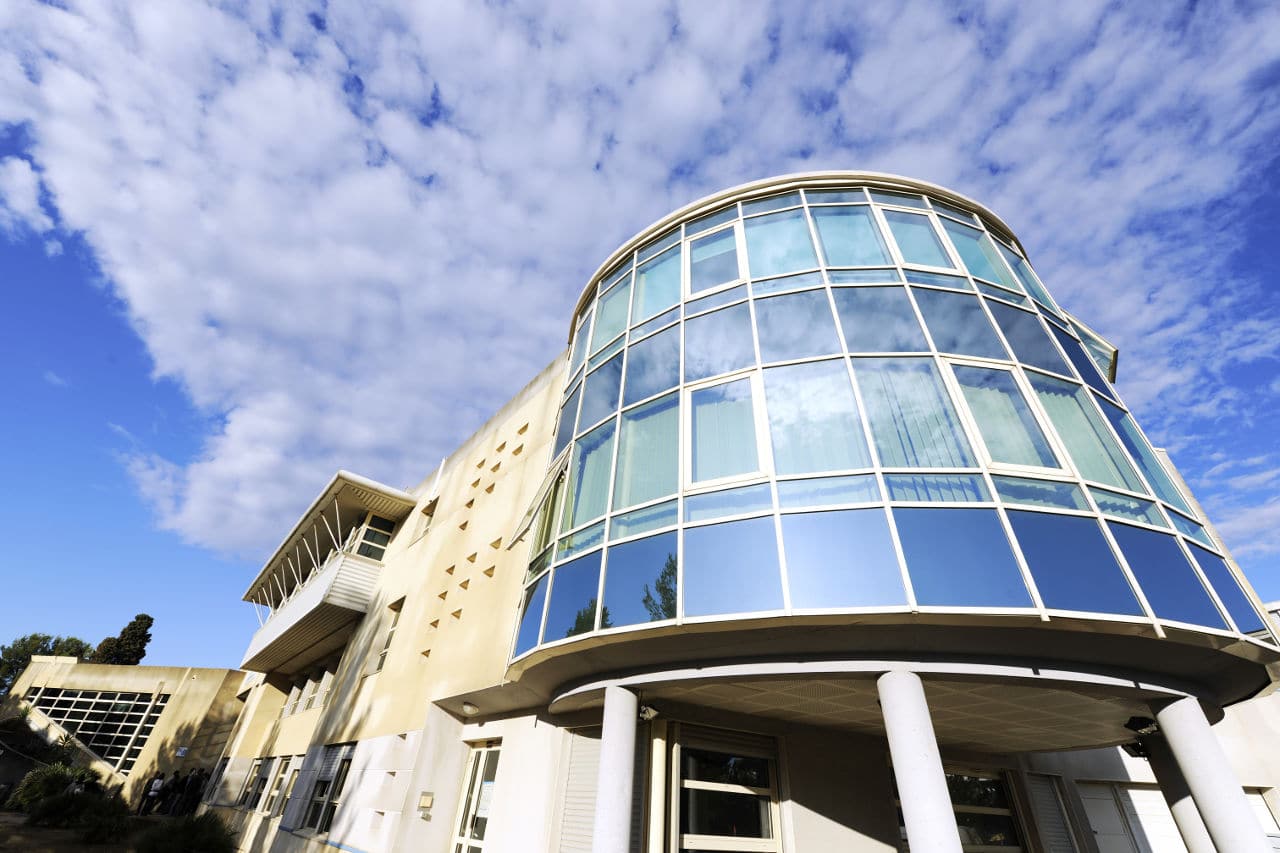
Photo credit: Luc Jennepin
In the lobby ofthe École Polytech Montpellier, a display highlights the professional achievements of alumni who have graduated from the school. It reveals that one alumnus has now made a name for himself at NASA, that another heads Veolia’s operations in Eastern Europe, and that many alumni hold key positions in prestigious industrial groups—when they haven’t successfully launched their own businesses. The school, which specializes in engineering, is quite proud of these achievements—and of its employment rate, which hovers around 90% six months after graduation.
NASA, Airbus, Veolia…
“Beyond the dozen or so schools that everyone knows, such as École Polytechnique and École Centrale, the Polytech network is regarded as a key partner for government ministries and businesses,” says Serge Pravossoudovitch, director of Polytech Montpellier.
More than just a school, Polytech is a network of 15 institutions located in major cities across France. Established in 2003 as an extension of the Eiffel network, the Polytech network holds the distinction of being the “largest network of French engineering schools.” Each year, Polytech Montpellier graduates 300 engineers. These students have had the privilege of benefiting from state-of-the-art facilities throughout their studies. “One of the major advantages of being a university-affiliated school is this close connection with research laboratories ,” explains Serge Pravossoudovitch.
School Spirit
This excellence comes at a price: that of the admissions process. Engineering students are admitted through a competitive entrance exam after completing two years of post-secondary education; they may also apply immediately after high school to a two-year preparatory program. Admission here, too, is contingent upon a highly selective entrance exam. Comprising 10 departments covering an equal number of specializations, the curriculum offered by the university school spans fields such as biological and food engineering, microelectronics and embedded systems, computer science combined with management, mechanical engineering, materials science, and water sciences… The curriculum is taught by 130 faculty members as well as nearly 300 guest lecturers from the business world.
The goal: to adapt the curriculum to the demands of a market that is evolving at the same pace as technological innovations. Here, the “school spirit” is no empty phrase: everyone is on a first-name basis, there’s a close relationship with students, and a family-like atmosphere. This combination makes Polytech one of the most “laid-back” educational institutions in theUM. But this is only on the surface, because a serious approach is essential for students who, upon graduation, will take on leadership roles in sectors as critical as aerospace, automotive, food safety, robotics, and aerospace…
School Through a Student's Eyes
Baptiste Théau, a senior majoring inand automation, President of the Student Life Office (BVE)
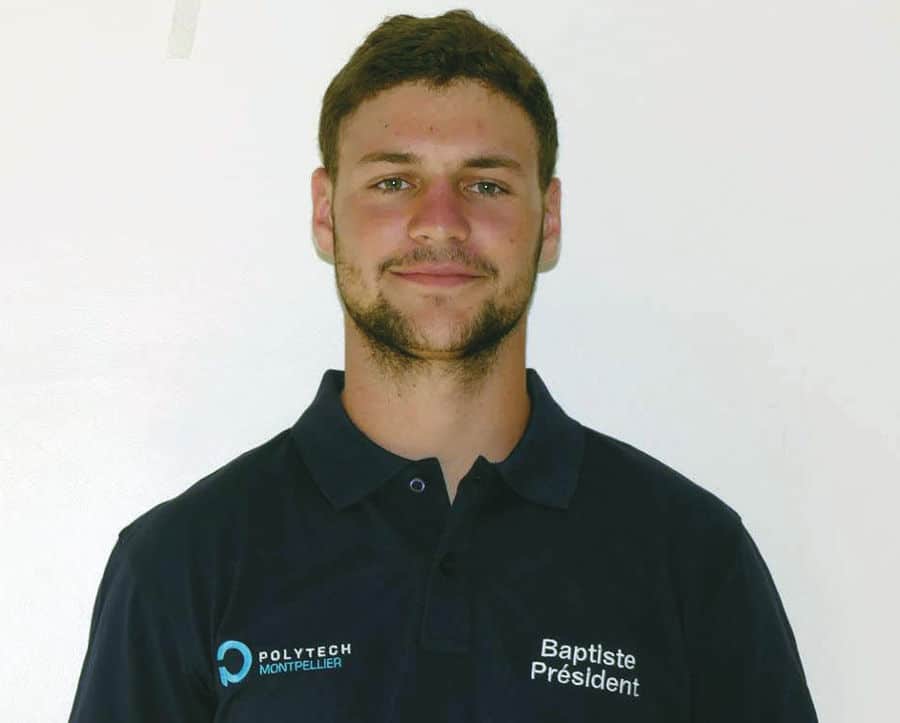 “ Like many others, I didn’t know anyone when I first arrived, since so many students come from other cities. Orientation is therefore a very important time. It revolves around sports activities and social events organized by the school’s various clubs and the BVE. As a result, we discover common interests even before classes begin. This year, the BVE will randomly distribute colored wristbands to form eight teams that will compete in challenges throughout the month… The goal is to bring students together across different academic years, since students from First-year students will be mixed in with third-year students… "
Key Figures
- 1,400 students
- 10 specialties
- 50 administrative and technical staff members
- 130 teachers
- 300 industry professionals
- More than 100 partner universities worldwide
- 600 host companies
- 12 partner research laboratories
Polytech trails Kito de Pavant!
Since 2014, École Polytech and Languedoc-based sailor Kito de Pavant have been partners in “Made in Midi,” the
collaborative program to develop a boat designed for the world’s biggest sailing races.
This is a golden opportunity for engineering students to take on a major technological challenge: helping to develop a boat capable of sailing for several months nonstop during the legendary Vendée Globe. Although luck was not on the sailor’s side in 2017—forcing him to withdraw in the South Seas—the experience allowed Polytech students to apply their knowledge in designing decision-support tools, selecting materials, and even designing components such as the rudder, which was built by a team from theUM , including several Polytech students!
The Polytech team wins the 2018 French Robotics Cup
On May 10, 11, and 12, 2018, in La-Roche-sur-Yon, Robotech Legends—a robotics club made up of alumni from Polytech Montpellier—won the French Robotics Cup and placed third in the Eurobot Open finals.
During this fun, scientific, and technical amateur robotics challenge, participants designed and built an autonomous robot that complied with the rules, embodied the spirit of the event, and was capable of competing in the matches.
The Robotech Legends team consists of five alumni from Polytech Montpellier: Romain Penot, Alexandre Schutz, Denis Jullien, Carole Jacquinot, and Guillaume Patrigeon, who serves as team leader and is a doctoral student at LIRMM in the Microelectronics Department.