[LUM#15] Rethinking Intensification Models in Africa
Producing more to feed a rapidly growing population is the challenge facing African agriculture. Can this necessary intensification be achieved through agroecology? Lum posed this question to agronomists Nadine Andrieu and Eric Scopel*, co-leaders of the “Agroecological Transitions ” at CIRAD.
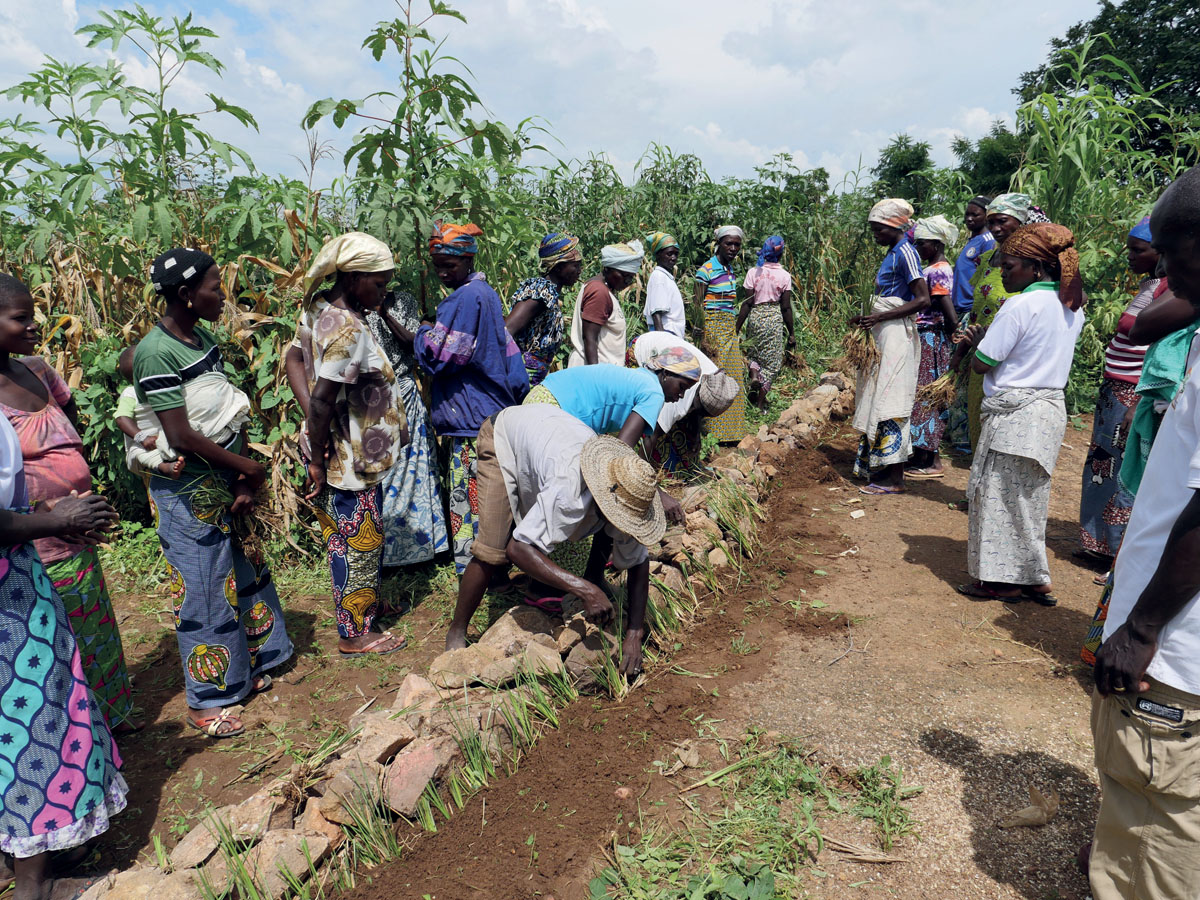
Promoting ecological processes for more sustainable agricultural production is one of the principles of agroecology. “It’s a different way of looking at the production process, one based on the proper use of natural resources such as water, soil, and biodiversity,” emphasizes Eric Scopel. “Implementing it reduces dependence on external inputs , particularly chemicals.” It also reduces dependence on energy sources such as oil, for example.
Agriculture without pesticides and tractors? “Not entirely,” the agronomist clarifies. “The idea isn’t to do away with them altogether, but to try to be as independent of them as possible and to use them in the most appropriate ways. It’s a different vision of agriculture.” A vision with many dimensions: scientific, practical, but also social and philosophical. “Agroecology reexamines the role of agriculture in feeding humanity, with a long-term vision: we can’t jeopardize the agroecosystem we’re working on if, in 10 years, we won’t be able to use it anymore!”
Pesticide mixtures
While agroecological practices date back to ancient times, the scientific approach to agroecology began to take root in the 1980s, first in the Americas, before spreading to the rest of the world. And in Africa? “The concept of agroecology emerged relatively late there, even though some NGOs were already working to reduce pesticide use on the continent, particularly in vegetable farming, which uses a great deal of them, ” says Eric Scopel.
This, in fact, is one of the paradoxes of the African continent, where the Green Revolution is still in its infancy. “Overall, the use of agricultural inputs is significantly lower there; for example, the use of nitrogen fertilizers is 10 times lower than in France. But the crop protection market still exists, and some sectors resort to the unregulated use of these products, without standards or controls.” Due to a lack of information and technical assistance, some farmers sometimes use mixtures of pesticides indiscriminately, with significant consequences for health and the environment. “These practices lead, in particular, to pollution problems, such as the contamination of groundwater.”
The agricultural sector is undergoing major changes and faces a significant challenge: feeding a growing population that is expected to double by 2050. “Average production levels in Africa are one-eighth those in Europe; it is imperative to increase productivity to feed everyone,” explain the experts. “What we need to do now is consider what model of intensification should be developed on the African continent.”
Fragile fertility
Can agroecology and intensification go hand in hand? For the two agronomists, the answer is yes: “It’s conceivable to increase production by 50 percent—from 1 metric ton per hectare to 1.5 metric tons—by adopting sound agronomic practices.” These practices are all the more relevant in tropical regions, where soil fertility is compromised by climatic conditions. “All it takes is a heavy rain to wash away the soil’s humus layer and render it uncultivable. We really need to focus on soil management to slow down the natural processes of degradation.” In practice? “Maintaining cover crops, mulching, and managing field boundaries to better control surface runoff, as well as reducing tillage—these practices help protect soil fertility, which is more fragile in Africa, ” explains Eric Scopel, who describes agroecology as a model that is “low in inputs but high in knowledge.” And labor-intensive, as Nadine Andrieu points out: “This may require an increase in the workload for the farmer and their family, so we must also explore ways to reorganize the work.”
To further increase production, agroecology also proposes leveraging the complementary nature of species, for example by growing legumes and grains together, as their crops are complementary. “Legumes live in symbiosis with a bacterium capable of fixing atmospheric nitrogen and converting it into a mineral form available to plants; they act as a natural fertilizer,” explains the agronomist. “Restoring biodiversity to farms by moving toward mixed cropping is beneficial for food and nutritional security.”
Create the conditions for transformation
But this approach isn’t always easy to implement. “In Europe, policymakers are showing a nascent but firm awareness of the need for the agroecological model; this isn’t always the case in Africa, where a modern vision of agriculture—based on inputs, tractors, and monoculture—is still sometimes championed. This narrative coexists with another that actively promotes agroecology,” explains Nadine Andrieu. It’s a tricky position for researchers, given that Europe itself has prioritized maximizing yields without seeking compromise…
Hence the importance of involving all stakeholders in the sector, at every level: farmers, of course, but also traders, cooperatives, local researchers… Not to mention national and international policymakers: “We must work on all these dimensions simultaneously to create the best conditions for this transformation on the ground. There is a real challenge in rethinking models of intensification in Africa, and if everything falls into place, then we can seriously consider meeting food needs through agroecology.”
Check out theUM podcasts, now available on your favorite platform (Spotify, Deezer, Apple Podcasts, Amazon Music, etc.).
* Eric Scopel: Aïda Research Unit on Agroecology and Sustainable Intensification of Annual Crops – CIRAD
Nadine Andrieu: Joint Research Unit on Innovation and Development in Agriculture and Food (INRAE-CIRAD-Institut Agro)