Live joyfully, live like Rabelais!
On Wednesday, March 8, students, doctors, staff, and friends of the University gathered at the Jardin des Plantes to unveil the restored Rabelais monument. It was an opportunity for the Montpellier Medical Students’ Association to reaffirm its connection to the French writer, a former student at the Montpellier Faculty of Medicine, as well as to his philosophy, summed up in the famous phrase: “Live joyfully!”
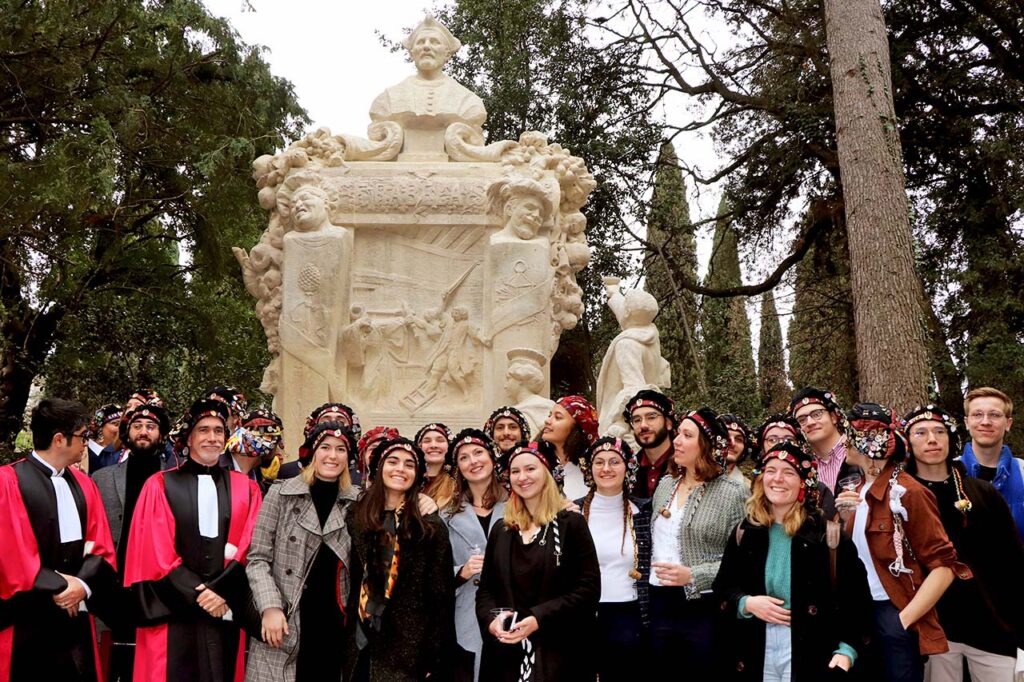
About twenty of them stand out from the small crowd making its way into Montpellier’s Botanical Garden on this misty morning of March 8. Proudly wearing their traditional caps, the medical students of Montpellier have their eyes fixed on the Rabelais monument—their monument—finally restored thanks to the support of the University, the Faculty of Medicine, and the indispensable Jardin des Plantes Corporate Foundation, which kindly joined them in this project of great emotional and symbolic value. “This monument, which was inaugurated 102 years ago, and this quote from Rabelais still say a great deal about the students of Montpellier,” declared Camille Pelissier, president of the Montpellier Medical Students’ Association. “It is the very essence of our folklore and our values, which we pass down from year to year and which are so dear to us.”
The traditions of medical students
And while this tradition remains largely an insider’s affair, the students present that morning were eager to share their memories of“carabinage”—an annual ceremony held at the foot of the monument to induct second-year medical students into the student fraternity. Tradition dictates that after taking the oath, each student takes a photo at the back of the sculpture, where the writer’s famous maxim is engraved in stone:“Live joyfully!”“We’re pursuing a difficult course of study, ” Camille Pelissiercontinues , “so it’s important for us to emphasize this celebration of life’s pleasures.”
It was in 1921, on the occasion of the 700th anniversary of the Montpellier Faculty of Medicine, that the medical students of the time commissioned this work from the sculptor Jacques Villeneuve, who named it “En vin vérité.” Beneath the bust of Rabelais that overlooks the monument, the faces of Pantagruel and Gargantua frame a bas-relief depicting a scene from a farce written and performed at the time by Rabelais on Rue de la Loge. In the foreground, an allegory of the Faculty of Medicine, depicted as a woman in a professor’s robe, leans over Hippocrates’ Aphorisms, translated into Greek by Rabelais. Finally, on the right, a medical student faces Rabelais and holds out a cup of wine in his right hand.
The cup is full again
A cup that had mysteriously vanished into the mists of time and that this restoration brings back from the past.“Missing parts are normally part of a monument’s history; it would never occur to anyone to add the missing parts of the Venus de Milo, but in this case, with this vase, there was a reason to restore it,” explains Pierre-Jean Trabon, a heritage architect who led this restoration with the approval of the DRAC. “We participated in all the site meetings,” continues Camille Pelissier. “The significance of this monument is passed down from generation to generation; we had knowledge of details that were unknown to the architects.” Details that the cleaning of the stone overgrown with vegetation, as well as the repointing of the stones and the redevelopment of the surrounding area, reveal once again in all their beauty.
And it was to celebrate this rediscovered beauty and the certainty that generations of students will continue to celebrate the Rabelaisian art of living that the medical students of Montpellier concluded this ceremony with glasses in hand, echoing the words of their president:
“Fellow medical students, in honor of our shared mentor François Rabelais, let’s raise our glasses with him—and above all, let’s never forget to live joyfully!”
Cheers.