Cécile Echalier: Focus on Biomaterials
Cécile Echalier’s research goal is to develop new biomaterials that will have highly anticipated applications in healthcare and regenerative medicine. The chemist at the Max Mousseron Institute of Biomolecules has just been appointed associate professor at the University of Montpellier—the very same place where she once sat in the lecture halls as a student.
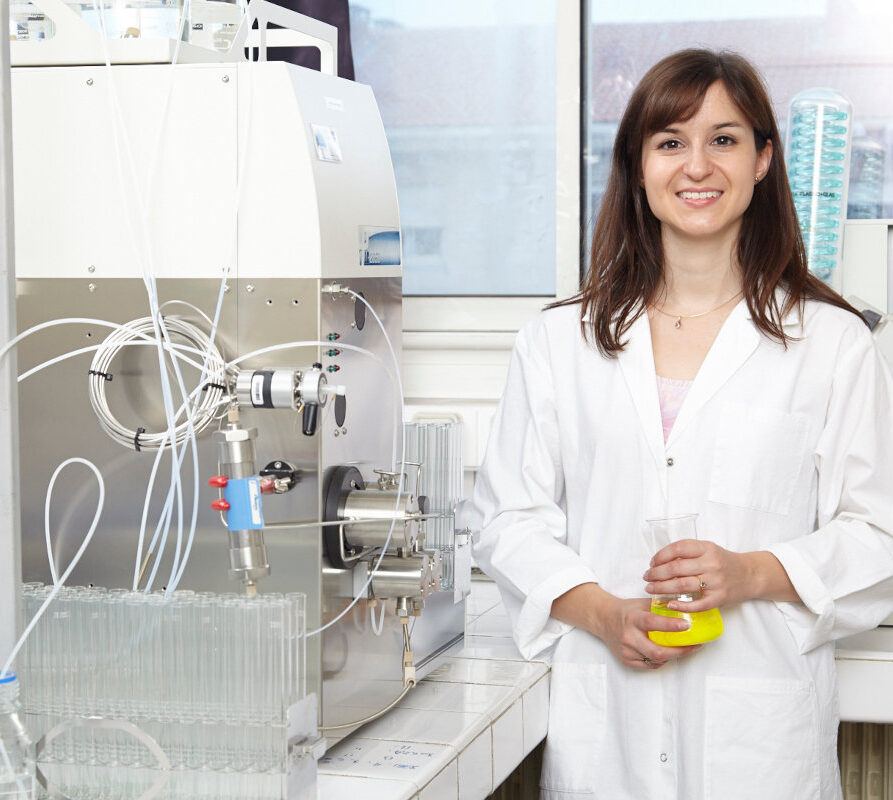
At first, Cécile Echalier didn’t enroll in the chemistry bachelor’s program at the University of Montpellier with the intention of doing research.“I was passionate about teaching; I wanted to enter the IUFM after my bachelor’s to become an elementary school teacher,” recalls the young researcher. It was a well-trodden path that chance would eventually upend. Upon entering their first year of master’s studies, chemistry students are required to complete an internship that is assigned to them… by lottery. For Cécile Echalier, this meant working on peptide chemistry with Gilles Subra, a professor at the University of Montpellier and a researcher at the Max Mousseron Institute of Biomolecules. This encounter would divert her from a career as an elementary school teacher: “This experience gave me the opportunity to discover what research was all about, but I was still drawn to teaching, so I wanted to do both.”
Gilles Subra listened attentively to this new direction, offering the young student a spot on his team if she decided to write a thesis. The idea took shape in the student’s mind during her second year of her master’s program, which she spent partly at the University of Glasgow, where she completed a six-month internship in the field of chemobiology.
New Hybrid Materials
Upon her return in 2013, she joined the Amino Acids, Heterocycles, Peptides, and Proteins team atthe Max Mousseron Institute of Biomolecules to workon her dissertation. “I chose a project that was starting from scratch; I wanted to prove the concept.”This project was based on a topic that was fairly new at the time: hybrid biomaterials. In collaboration with Ahmad Mehdi ofthe Charles Gerhardt Institute in Montpellier, the young researcher combined the expertise in peptide chemistry and inorganic chemistry from these two laboratories to create new hybrid hydrogels.
“The idea was to apply sol-gel chemistry to the synthesis of materials used in the healthcare field; it was quite groundbreaking at the time,” the chemist recalls. This is because the development of these biomaterials requires the use of green chemistry:“The processes involved must be compatible with living cells; for example, we cannot use toxic solvents.”
This is a challenge that Cécile Echalier tackled head-on during her three years of doctoral research, during which she authored five articles as first author, and a field that is gaining momentum. “At the end of my doctoral research, I trained three doctoral students in the chemistry of these hybrid materials, and they continued the research I had begun, ”she explains. In 2016, she was awarded a L’Oréal-UNESCO fellowship, a grant that the chemist used to purchase a 3D printer and thus take her work in materials development to the next level.
Useful Purpose
After completing this remarkable dissertation, Cécile Echalier went on to do postdoctoral research in Heidelberg, Germany, where she temporarily set aside the field of biomaterials to work in chemobiology. Although her subject matter changed, there was one guiding principle she never let go of: “I need to know that my research will serve a useful purpose; it’s not just me having fun in my lab—it has to serve some purpose.”In this European molecular biology laboratory, the researcher went on to develop probes to study the activation mechanism of drug candidates.
A “useful” postdoc that was followed by a second one, this time at Imperial College London, where Cécile Echalier returned to her beloved biomaterials for two and a half years—and never looked back. Upon her return to France in 2021, she took up a position as a temporary teaching and research assistant (ATER) at the University of Montpellier. As part of her teaching responsibilities, the new ATER teaches courses at the School of Pharmacy, as well as at the Sète University Institute of Technology (IUT) and the School of Sciences. The instructor enjoys addressing“a very diverse audience, whose future paths range from research to careers as engineers or technicians.”
As for her research career, the young woman has once again made the IBMM her home. There, she reunited with Gilles Subra and the field of biomaterials, which gained new momentum in 2022 with the launch of Nanoremedi—a research and training program jointly led by six European universities aimed at training doctoral students in the field of peptides and nanomaterials, and which received funding from the Marie Skłodowska-Curie Actions Doctoral Network.
Medical Applications
In collaboration with Danièle Noël’s team atthe IRMB and other partners in the European consortium, the chemists aim, through Nanoremedi, to develop new materials for regenerative medicine. The research team is focusing specifically on three medical applications:“the engineering of vascular grafts to replace damaged arteries, the development of stem cell-based biotherapies for bone and cartilage repair, and the development of strategies to promote implant integration and prevent bacterial contamination,” explains Cécile Echalier.
A little over a year after the project was launched, 13 doctoral students were recruited to carry out these ambitious goals. And Cécile Echalier has just taken another step forward in her career:“On November1, I was appointed assistant professor at the University of Montpellier. This is a significant milestone because it now allows me to apply for funding as a principal investigator.” The chemist has already submitted an ANR Young Researcher grant proposal aimed at further developing new, gentler chemical processes—this time compatible with 3D printing techniques. A response is eagerly awaited by the end of 2024.
News
When Generative AI Can Predict Fish Communities
Published on: October 23 , 2026
A new study published on October 22 in *Current Biology* and led by Noémie Coulon,…