Montpellier Environmental Research Observatory (OREME)
Overview
The Montpellier Environmental Research Observatory (OREME) is an internal research unit of the University of Montpellier and an Observatory of the Sciences of the Universe (OSU). It brings together more than 1,200 scientists from the CNRS, theUM, the IRD, and the INRAE, spread across eight laboratories.
OREME monitors changes in the Earth, water, biodiversity, and the universe. It collects, certifies, and makes available reliable long-term environmental data. It supports scientists and decision-makers in analyzing this data, promotes its reuse, and disseminates it widely through science outreach and public awareness initiatives.
Understanding the changes taking place in the world around us helps us adapt to them more effectively.
Director: Agnès Lèbre (astronomer)
Some figures
- 8 affiliated research units
Geosciences Montpellier (GM), Hydrosciences Montpellier (HSM), Center for Functional and Evolutionary Ecology (CEFE), Montpellier Universe and Particles Laboratory (LUPM), Montpellier Institute of Evolutionary Sciences (ISEM), Marine Biodiversity, Exploitation, and Conservation (MARBEC), G-EAU (Water Management, Stakeholders, Users), TETIS (Territory, Environment, Remote Sensing, Spatial Information) - 3 observation platforms
AETE-ISO – Support for Field Experiments and Instrumentation
MEDIMEER – Marine and Coastal Environments
Data Platform – Access, processing, dissemination, and utilization of data - 1 marine research station in Sète
, Mediterranean Station for Coastal Environment (SMEL)
Training Courses
Dedicated to research and observation, the Observatory does not host students on its premises but participates in the Environmental Sciences program at the University of Montpellier. As such, OREME contributes to the Master’s in Environmental Sciences, which offers five-year post-secondary programs that combine excellence in research with the transfer of knowledge to the professional world.
News
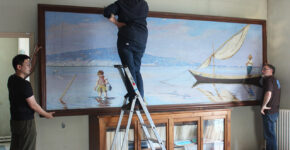
A New Lease on Life for “The Thau Lagoon and Mount Saint-Clair”
Published on: July 24 , 2025
The painting “The Thau Lagoon and Mount Saint-Clair,” on display at the marine station in…