Biology and Health Division
Five research clusters (Agriculture, Environment, Biodiversity; Biology and Health; Chemistry; Mathematics, Computer Science, Physics, Systems; Social Sciences) were established in September 2019 within the MUSE Foundation and subsequently designated as intermediate structures of the University of Montpellier when it was established as an experimental public institution in 2022.
The Biology and Health Research Cluster serves as a hub for scientific activity, fostering synergy among research institutions and stakeholders, and providing a forum for scientific collaboration aimed at developing joint initiatives among the partners represented on the Committee for Strategic and Structural Investments (COMIS).
Governance of the Division
Director of the Biology and Health Division: Pierre-Emmanuel Milhiet
Administrative and Management Support Officer: Laure Bourbon
Head of the Human Resources Committee (CRH) and Deputy Director: Jean-Yves Le Guennec
Human Resources Committee (CRH) Administrator: Magali Fayol-Chastaing
Strategic Steering Committee (COS)
The Strategic Steering Committee serves as a link between the Research Cluster Research its institutional partners. It helps define the Research Cluster’s broad strategic scientific directions Research provides input on the action plan proposed by the Director of the Research Cluster.
Division Council
The Cluster Council issues advisory opinions on the direction and implementation of the Cluster’s initiatives and strategy.
Executive Board
It includes the division's senior management, one representative from BIATS, one representative of the doctoral students, representatives of the research areas, and representatives of the working groups.
Human Resources Committee (HRC)
The “Human Resources” Committee addresses issues specific to the staff of the University of Montpellier. Each “Human Resources” Committee issues an advisory opinion in accordance with the statutory provisions specific to the Professors researchers.
Key Figures
24 Biology and Health Laboratories
8 Partner Institutions
4 Research SupportUnit
3 Technology Platforms
7 Thematic ResearchAreas
2 DoctoralSchools (CBS2: Chemical and Biological Sciences for Health, SMH: Human Movement Sciences)
1 LabUM EpiGenMed
106 other PIA projects (Equipex, etc.)
2 Centers of Excellence: CoEN & CeAND
1 SIRIC ( Research Cancer Research Site)
5 FHUs (University Hospital Federations)
6 Nationalinfrastructures
44 Start-ups
8 ERC (European Research Council)
1 IUF (Institut Universitaire de France)
975 faculty members and researchers
1,581 doctoral students / 7,088 doctoral students atUM
5,062publications
413 theses defended
233 industrial and R&Dcontracts
111 patents
41 CIFREfellowships
for the 2020–2025 period:
3 ATIP/AVENIR teams
Partner Institutions
- CIRAD – Center for International Cooperation in Research for Development
- Montpellier University Hospital – Montpellier University Hospital Center
- Nîmes University Hospital – Nîmes University Hospital
- CNRS – National Center for Research
- ICM – Montpellier Cancer Institute
- INRAE – National Institute for Research Agriculture, Food, and the Environment
- INSERM – National Institute of Health and Research
- IRD – Research Institute Research Development
The Division's Missions
The Biology and Health Research Cluster is responsible for:
- organize scientific outreach activities within the community focused on specific themes or fields and develop a scientific outlook;
- initiate and coordinate responses to calls for proposals for cross-sectoral regional, national, or international projects;
- help implement the University of Montpellier’s international strategy and raise its global profile;
- propose coordinated initiatives to foster the link between education and Research
- participate in forward-looking analysis of employment and skills;
- Establish a “Human Resources” committee and ensure its operation so that it can issue opinions on issues specific to human resources in research at the University of Montpellier.
Scientific Scope
- The University of Montpellier’s partner institutions involved in the Research Cluster.
- Research units affiliated with the Research Cluster.
- Support and Research Units Research UAR).
- Technology platforms.
- Doctoral schools: CBS2 (Chemical and Biological Sciences for Health) & SMH (Human Movement Sciences).
- The Teaching and Research Units Research UFR), schools, and institutes of the University of Montpellier affiliated with the Research Cluster
Research Areas
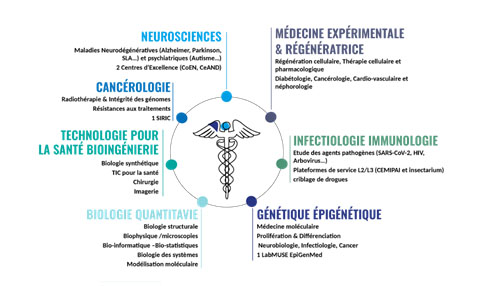
The Biology-Health Research Cluster is organized into seven thematic areas of research, teaching, and outreach.
Each area is represented by an Professor researcher or Professor (plus an alternate), an appointed unit director (DU), and an appointed university hospital representative (HU).
Quantitative Biology
Researcher Representative /Professor: Chérine Béchara (IGF)
+ Alternate: Antoine Le Gall (CBS)
DU Representative: Pierre-Emmanuel Milhiet (CBS)
HU Representative: Nicolas Molinari (IDESP)
Quantitative Biology aims to understand the underlying principles of complex biological behaviors in terms of physical and mathematical parameters. It is therefore an approach that applies to all fields of biology and draws on technological expertise such as:
- Structural Biology
- Biophysics and Microscopy: From the Single Molecule to Tissue
- Bioinformatics (structural, genomic, etc.) and biostatistics
- Systems Biology
- Multiscale molecular modeling
This community comprises 40 research teams spread across 9 research units (CBS, CRBM, IGF, IGH, IGMM, IRIM, IRCM, LBN, LPHI).
The Quantitative Biology community, whose teams are supported by prestigious grants (ERC, ATIP-Avenir, Bettencourt-Schueller, etc.), coordinates and/or participates in several projects designated as part of the “Programme d’Investissements d’avenir”: the Integrative Structural Bioinformatics project (Bip-Bip) and three national infrastructures in the fields of optical imaging (France Bio-Imaging—FBI), structural biology (French Integrated Structural Biology Infrastructure—FRISBI), and chemoinformatics (ChemBioFrance). In addition, several teams working in this field are key players in prestigious international networks (Physics of Living Systems, LifeTime).
Oncology
Researcher Representative /Professor: Jacques Colinge (IRCM)
+ Alternate: Céline Gongora (IRCM)
University Representative: Nathalie Bonnefoy (IRCM)
University Hospital Representative: Guillaume Cartron (IGMM)
Montpellier’s large cancer research community is involved in everything from understanding the fundamental mechanisms of cancer to improving its treatment.
It comprises some 50 teams spread across 10 joint research units under the supervision of the University of Montpellier and either the CNRS or Inserm (CBS, CRBM, IGF, IGH, IGMM, IRCM, IRIM, IRMB, LPHI, PhyMedExp), as well as three healthcare centers (Montpellier University Hospital, Nîmes University Hospital, and ICM).
This community’s excellence in research is internationally recognized. This is reflected in national accreditations:
- The “SIRIC Montpellier Cancer” project was accredited in 2013, 2018, and 2023 by INCa, DGOS, and AVIESAN.
SIRIC Montpellier Cancer is one of eight Research Cancer Research Sites in France. Modeled after the American “Comprehensive Cancer Centers,” it brings together on a single site a group of clinicians and researchers from the Montpellier Cancer Institute, the Montpellier University Hospital, and eight research institutes affiliated with Inserm, the CNRS, and the two universities in Montpellier. Drawing on multidisciplinary research teams (clinical, biological, physical, mathematical, and humanities and social sciences) and state-of-the-art technological platforms, SIRIC Montpellier Cancer is currently conducting integrated and innovative research focused on three central themes—radiotherapy, prevention and supportive care, and onco-metabolism—with the ultimate goal of transforming clinical practices in oncology. - The “EvoCan” University Hospital Federation (FHU) project, accredited by AVIESAN in 2017 and 2023
Working in a complementary and coordinated manner with SIRIC, EvoCan has been dedicated since 2023 to the development and clinical deployment of immunotherapies, which represent a major approach to fighting tumors. This includes both antibodies targeting molecules that modulate the immune system and immunocellular approaches using genetically modified T cells (CAR-T cells). - Several cancer research teams in Montpellier have been accredited by the National League Against Cancer and the Foundation for Research (FRM), or are part of the “MabImprove” LabEx or the “EpiGenMed” LabMUSE at the Montpellier MUSE I-Site.
Genetics-Epigenetics
Researcher Representative /Professor: Robert Feil (IGMM)
+ Alternate: Rosemary Kiernan (IGH)
University Representative: Philippe Pasero (IGH)
University Hospital Representative: David Genevieve (IRMB)
The Montpellier Genetics and Epigenetics Community comprises 22 teams spread across 14 research units (CBS, CRBM, DEFE, DMEM, IGF, IGH, IGMM, INM, Intertryp, IRCM, IRIM, IRMB, LPHI, PhyMedExp).
In 2010, as part of the “Investissement d’Avenir” program, the excellence of research in this field was recognized with the creation of the “EpiGenMed” Laboratory of Excellence (LabEx). The EpiGenMed LabEx has enjoyed remarkable success, with major discoveries made by its teams that have been recognized with national and international awards and honors. EpiGenMed has been designated a Montpellier University Laboratory of Excellence (LabMUSE) as part of the I-SITE project. Its goal is to promote basic and clinical research by establishing interdisciplinary projects “to move from the genome and epigenome toward the molecular medicine of tomorrow.” These outstanding research teams study the implications of genetics and epigenetics in cell proliferation and differentiation, normal development, neurobiology, infectious diseases, and cancer, in close collaboration with the Montpellier research community.
This area of research also aims to develop clinical applications in several fields. To this end, in 2018, the Montpellier University Hospital entered into a partnership to facilitate the translation of discoveries from basic scientific research into medical research applications. As part of this initiative, the clinical teams from the Montpellier-Nîmes Interhospital Federation of Medical Genetics and Molecular Medicine (3 clinical units, 15 hospital laboratories) have joined the existing teams in the Genetics-Epigenetics research area. This scientific integration aims to develop partnerships that will combine scientific discoveries in genetics and epigenetics with future medical applications.
Infectious Diseases and Immunology
Researcher Representative /Professor: Nathalie Chazal (IRIM)
+ Alternate: Jean-Philippe Lavigne (VBIC)
DU Representative: Matteo Bonazzi (IRIM)
HU Representative: Edouard Tuaillon (PCCEI)
The Infectious Diseases and Immunology community is organized as a continuum of Research – Research – population Research . It includes a University Hospital Federation (FHU) called “Infection and Chronicity” (InCh) and brings together 7 hospital departments from the Montpellier and Nîmes University Hospitals, as well as 17 research units (ASTRE, CBS, CRBM, IGF, IGH, IGMM, IMAGINE, Intertryp, IRCM, IRIM, IRMB, LPHI, MIVEGEC, PCCEI, TransVIHMI, VBIC), and one hospital platform (LECRII).
This community, which has a major international presence thanks to the establishment of several laboratories abroad (in Africa, Asia, and South America, in cooperation with organizations such as IRD and CIRAD), is heavily involved in numerous international projects focusing on viral infections (HIV, Ebola, SARS-CoV-2, arboviruses, HTLV-1, influenza), parasitic infections (Plasmodium, Toxoplasma), bacterial infections (Mycobacterium, Coxella, Brucella, Pseudomonas, Staphylococcus, antibiotic resistance and multidrug resistance), and neglected tropical diseases (trypanosomiasis, leishmaniasis).
In addition to these projects, the exceptional technical facilities at UAR BioCampus Montpellier—which are available to all researchers in the Biology and Health department— this community also has access to other, more specialized technical facilities, such as those at the UAR CEMIPAI (Center for the Study of Infectious Diseases and Anti-Infective Pharmacology) and the housing, breeding, experimental conditioning, and experimentation facilities at the A2/A3 animal facilities and the I2/I3 Insectariums.
Finally, a major partnership has been established with large industrial groups and well-established SMEs and micro-enterprises, including: Horiba, SANOFI-Aventis, Biorad, Abivax, Metafora, Deinove, Nosopharm, and Azilead.
Experimental and Regenerative Medicine
Researcher Representative /Professor: Jean-Marc Brondello (IRMB)
+ Alternate: Delphine Gitenay (IRMB)
University Representative: Alain Lacampagne (PhyMedExp)
Hospital Representative: Christian Jorgensen (IRMB)
Experimental and Regenerative Medicine is the study of the mechanistic basis of diseases and the development of new therapies based on tissue regeneration, cell therapy, and pharmacology. To this end, the research teams working in this area have developed unique models of target human diseases, as well as patient cohorts, to test innovative therapies.
This community comprises 27 teams spread across 9 research units (BC2M, DMEM, EuromovDMH, IGF, IGH, INM, IRMB, MMDN, PhyMedExp).
The excellence of this community is recognized by the designation of a National Infrastructure for Health Biology—E-Cell France, which offers services covering all phases of a cell therapy project—and by AVIESAN’s accreditation of the RegenHab University Hospital Federation (FHU).
FHU RegenHab is a clinical, biological, and technological consortium that brings together stem cell biologists, physiologists, robotics engineers, specialists in complex motion imaging, and clinicians in rheumatology, muscle diseases, anesthesiology and critical care, and rehabilitation. It develops new therapeutic approaches to restore movement in patients with diseases that impair musculoskeletal function.
Neuroscience
Researcher Representative /Professor: Sylvie Claeysen (IGF)
+ Alternate: Fabrice Ango (INM)
DU Representative: Sylvain Lehmann (INM)
HU Representative: Philippe Marin (IGF)
The Montpellier Neuroscience Community brings together researchers, faculty members, and clinicians working at the university hospitals in Nîmes and Montpellier, as well as 30 teams spread across six research units (CRBM, IGF, IGH, IGMM, INM, MMDN)
It has two Centers of Excellence. The first, the Montpellier Center of Excellence for Neurodegenerative Diseases (CoEN), which holds AVIESAN accreditation, focuses specifically on biomarkers and personalized medicine. The center’s goal is to foster the development of multidisciplinary projects that bring together basic, preclinical, clinical, epidemiological, and social science research on diseases that pose major public health challenges, such as Alzheimer’s disease, Parkinson’s disease, multiple sclerosis, and ALS.
The second is the Center of Excellence on Autism and Neurodevelopmental Disorders “CeAND,” an interdisciplinary research and education network aimed at fostering interactions between researchers, practitioners, and individuals affected by these conditions, with the goals of identifying the determinants of autism spectrum disorder and neurodevelopmental disorders, developing biomarkers for diagnosis and prognosis, and enabling personalized medicine. In addition, CeAND has been accredited by the Interministerial Delegation for the National Strategy on Autism within the field of neurodevelopmental disorders.
The Neurosciences Community also includes the FHU NEUROCLIN University-Hospital Federation, whose goal is to organize neuroscience research in areas where the region has strong expertise (sensory-motor disorders, neurodegenerative diseases, cognition, psychiatry) through to clinical trials, and to establish companies to develop new drugs or technological devices.
These centers of excellence work in close synergy, particularly in the field of biomarkers, through the sharing of multicenter cohorts, certified biobanks, and state-of-the-art technological approaches (NGS, quantitative mass spectrometry, multiplex and ultrasensitive immunoassays, etc.).
Healthcare Technology – Bioengineering
Researcher Representative /Professor: Denis Mottet (EuroMov)
+ Alternate: Prisca Boisguérin (PhyMedExp)
University Department (DU) Representative: Stéphane Perrey (EuroMov)
University Hospital (HU) Representative: Maurice Hayot (PhyMedExp)
This research area encompasses four main themes, ranging from synthetic biology to information and communication technologies (ICT) for healthcare, surgery, and imaging.
Bioengineering encompasses all in vitro diagnostic and/or analytical technologies, their application in living organisms, and biomaterials.
Synthetic biology is a relatively new field that combines biology and engineering to design new living biological systems for diagnostic and therapeutic applications. The teams involved in this field include clinical teams at Montpellier University Hospital (endocrinology and diabetes, psychiatric emergency and post-emergency care, wounds and wound healing) and 31 basic research teams spread across 16 research units (BC2M, CBS, EuromovDMH, IGF, IGH, IGMM, INM, IRCM, IRIM, IRMB, LBN, Li2D, MMDN, PhyMedExp, Sys2Diag, TransVIHMI)
ICT is increasingly being used for patients with chronic diseases and older adults. It enables the collection and monitoring of biomarkers necessary for patient care, treatment adjustments, and rehabilitation. The main teams involved in this field are departments at the Montpellier University Hospital (Nutrition Department, Department of Clinical Physiology) and
research teams such as: PhyMedExp, LBN, Epsylon, EA MRM, and the Institut des Mines d’Alès. In addition to clinical departments and research laboratories, these activities are also carried out within two FHUs (ICT4CARE and REGENHAB).
An e-Health chair has been established in this field within the Entreprendre Foundation at the University of Montpellier.
The “Surgery” category encompasses not only surgical technologies—including tele-surgery—and related materials and equipment, but also implantable devices, functional replacement devices, and prostheses.
The Imaging category encompasses all anatomical and functional imaging technologies, both in vitro and in vivo.
Research Organizations
- BioCampus Montpellier (BCM)
- Biocommunication in Cardiometabolic Medicine (BC2M)
- Lunaret Montpellier BioCenter (BIOLuM)
- Stem Cells, Cellular Plasticity, Tissue Regeneration, and Immunotherapy for Inflammatory Diseases (IRMB)
- Center for the Study of Infectious Diseases and Anti-Infective Pharmacology (CEMIPAI)
- Center for Structural Biology (CBS)
- Montpellier Center for Cell Biology Research (CRBM)
- Embryonic Development, Fertility, and the Environment (DEFE)
- Muscle Dynamics and Metabolism (DMEM)
- EuroMov Digital Health in Motion (EuroMov DHM)
- Génopolys
- Initial Management and Prevention of Acute Organ Failure in Critically Ill Patients (IMAGINE)
- Institute of Human Genetics (IGH)
- Montpellier Institute of Molecular Genetics (IGMM)
- Institute of Functional Genomics (IGF)
- Montpellier Institute of Neuroscience (INM)
- Montpellier Cancer Research Institute (IRCM)
- Montpellier Institute for Infectious Research (IRIM)
- Desbrest Institute of Epidemiology and Public Health (IDESP)
- Host-Vector-Parasite-Environment Interactions in Neglected Tropical Diseases Caused by Trypanosomatids (INTERTRYP)
- Bioengineering and Nanosciences Laboratory (LBN)
- Laboratory of Pathogens and Host Immunity (LPHI)
- Molecular Mechanisms in Neurodegenerative Dementias (MMDN)
- Pathogenesis and Control of Chronic and Emerging Infections (PCCEI)
- Physiology and Experimental Medicine of the Heart and Muscles (PhyMedExp)
- Translational Research on HIV and Endemic and Emerging Infectious Diseases (TransVIHMI)
- Bacterial Virulence and Chronic Infections (VBIC)
Partnership-based research organizations:
Technological Resources
UAR BIOCAMPUS
BioCampus Montpellier is a Research Support Unit Research UAR 3426 CNRS – US 09 INSERM – UM) within the Biology-Health and Agronomy/Environment/Biodiversity Clusters. It comprises 12 high-level technology platforms. The UAR offers its services to research units as well as to industry partners.
- Pharmacology and Interactome Screening (Arpege)
- Baculovirus & Therapy (BACFLY)
- Drosophila (DROSO)
- International ImmunoGenetics Information System (IMGT)
- Montpellier Small Animal Imaging Center (IPAM)
- Montpellier Alliance for Metabolomics & Metabolism Analysis (MAMMA)
- Montpellier DNA Combing (MDC)
- Montpellier Genomic Collections (MGC)
- Montpellier Genomix (MGX)
- Montpellier Imaging Resources (MRI)
- Integrated Platform for Biophysics and Structural Biology (PIBBS)
- Montpellier Organoid Platform (POM)
- Montpellier Proteome Center (PPM)
- Montpellier Vectorology Platform (PVM)
- Montpellier Pet Store Network (RAM)
- Montpellier Experimental Histology Network (RHEM)
- Applied Statistics in Biology (StatABio)
- Zebrafish and Xenopus Platform (ZEFIX)
UAR CEMIPAI – Center for the Study of Infectious Diseases and Anti-Infective Pharmacology
UAR 3725 CEMIPAI is a service platform under the supervision of the CNRS and the University of Montpellier. It offers in vitro research services on Class 3 highly pathogenic viruses, bacteria, prions, microorganisms, and toxins.
Platform: CECEMA – Center for Experimental Breeding and Housing of Animal Models
The CECEMA technical platform is a shared service of the University of Montpellier; it is part of the RAM (Montpellier Animal Facility Network) and is designed to house animals needed for scientific research and teaching.
A platform affiliated with the Biology-Health Cluster: BNIF – BioNanoImaging Foundry
The BNIF technology platform at the University of Montpellier is equipped with state-of-the-art equipment that research teams in instrumentation, methodology, image processing, biology and health, and plant physiology utilize and continue to develop. The platform is formally affiliated with the MIPS department, but by its very nature, it interacts extensively with the other clusters—Biology-Health, Agronomy, and Chemistry—which are the primary users of the tools.
Pricing
Long-Term Thematic Projects
PTL COSMIC – Complex Organoid Systems with Multifaceted Interactions
- Project Leader: Nathalie Chazal, IRIM
- Website
PTL HiLight – An Intimate Exploration of Life: Analysis with High Spatial and Temporal Resolution
- Contact: Julie Perroy, IGF
- Website
The I-SITE program of excellence, led by the University of Montpellier, has decided to provide strong support for research through the creation of Long-Term Thematic Projects (PTLs). The overall goal of these programs is to support research in Montpellier, foster the emergence of new frontiers in science, and promote training through research. Following consultation with our community and discussions organized by the Biology-Health Cluster, two PTLs in Biology-Health have been identified. The first focuses on the development of new experimental models for the translational research of the future (called COSMIC), while the second focuses on the high-spatial- and temporal-resolution analysis of living systems (called HiLight).
More Info
Contacts
; Division Director: Pierre-Emmanuel Milhiet;
; Administrative and Management Support Officer: Laure Bourbon
University of Montpellier
Building 24 – 4th floor
Place Eugène Bataillon
34095 Montpellier Cedex 5
By tram: Line 1 – Université des sciences et des lettres stop
News
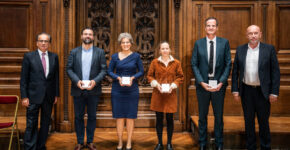
Six New Award Recipients from the University of Montpellier at the IUF in 2024
Published on: October 22 , 2024
Six female faculty members and Professors the University of Montpellier are…