[LUM#23] The Fire Ecologist
More frequent and more intense wildfires in some areas are one of the most pressing effects of global warming. To better study these phenomena and their impact on ecosystems, ecologist Tristan Charles-Dominique is pulling out all the stops.
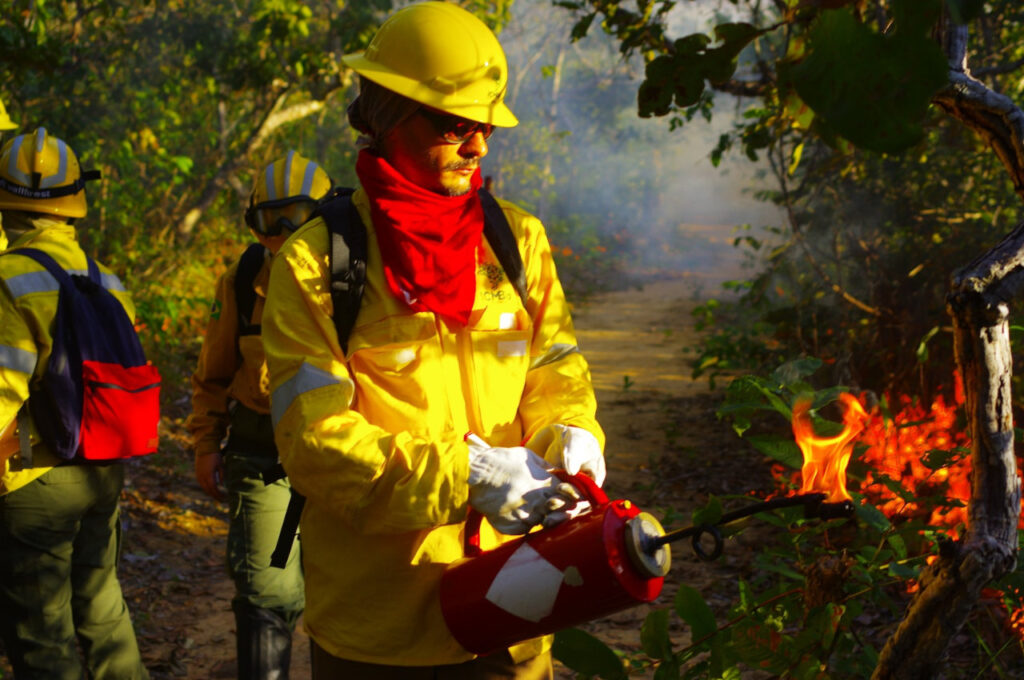
17,000 hectares. That is the area that burned in the Corbières Mountains in August 2025 (France Info, August 7, 2025). A forest fire of exceptional magnitude in France, but a mere drop in the bucket compared to the megafires that ravaged more than 8 million hectares in Canada in 2025 (France Info, 6/7/2025) or the fires that burned 18 million hectares in Australia in 2020 (France Info, January 21, 2020). And to better anticipate the consequences of these fires, it is sometimes necessary to set them deliberately, as Tristan Charles-Dominique, a “fire ecologist” at the Amap laboratory, does.
A field that emerged in the 1980s and shows no signs of slowing down, as the frequency of these extreme events has skyrocketed in recent years due to global warming.“For a megafire to break out, all the right conditions—wind, humidity, and temperature—must align, which is happening more and more often. In South Africa, for example, a mega-fire used to occur on average once every 40 years, but now it happens every 5 to 10 years,” explains Tristan Charles-Dominique, who notes that South Africa and Australia are particularly at the forefront of fire ecology.
Alarming Situation
While France is less at risk, it is not immune to seeing its forests go up in smoke . “Global warming promotes the growth of scrub, which acts as a veritable fuel; it’s a powder keg that’s getting worse year by year, and the situation here, too, is becoming alarming,” the expert emphasizes.
And when it comes to fire, not all plants are created equal: while some burn like kindling, others have surprising strategies for avoiding the flames, allowing them to survive the inferno or rise from their ashes.“Some plants develop their durable parts sheltered underground, while others have thick bark that resists flames, at least to a certain extent,” explains Tristan Charles-Dominique. Still others focus on the aftermath, such as the Aleppo pine (France Bleu, September 6, 2024), whose cones open when exposed to heat, releasing seeds that will be the first to germinate after the fire has passed.
Redesigned Landscapes
“Conversely, other plants have no resistance to fire, such as forest trees, for example—those that retain their leaves or dead branches, or those that produce flammable resins.” As a result of these disparities, landscapes can be completely transformed after a fire, benefiting resilient species and harming the most vulnerable ones.
To better study how flames will reshape forests in their wake, researchers are sometimes the ones who light the fuse.“We conduct controlled burns—always with firefighters present—on experimental plots spanning several hectares, which allows us to study the vegetation’s ability to conduct fire and provides the information needed to improve fire risk management. ” These experiments also enable fire ecologists to better predict the consequences of fires on the mosaic of flammable and non-flammable vegetation. It’s a discipline that isn’t about to go out.
See also:
Check out theUM podcasts, now available on your favorite platform (Spotify, Deezer, Apple Podcasts, Amazon Music, etc.).